

Phase 1: The Invisible War Behind the Spotlight
Hello! It’s your Daily Hangul editor.
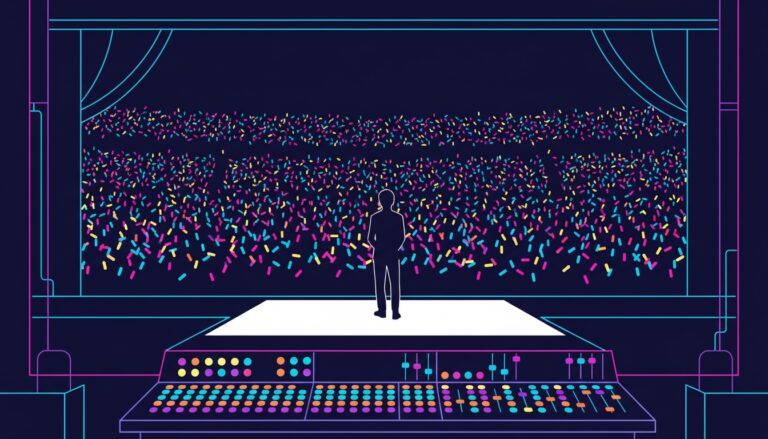
Imagine this: The Gocheok Sky Dome is shaking. Twenty thousand fans are screaming, waving their light sticks in a synchronized ocean of color. On stage, the idols are smiling, breathless, looking perfect. But if you could tap into the in-ear monitors or the staff headsets right now, you’d hear a completely different reality. It’s a war zone.
“The vocal mic is cutting out!” “Cue the pyros!” “Why isn’t the lift moving?!”
If you watch K-Pop “Behind the Scenes” content, you’ve seen the tension. The director’s sharp tone, the staff running bent at the waist to stay out of sight, the endless sound checks. In the world of Korean performance planning (공연 예술 기획), language isn’t just for communication—it’s for survival. A misunderstood instruction can ruin a performance or, worse, get someone hurt.
Today, we are stepping behind the velvet rope. We’re going to look at the sharp, efficient, and sometimes intense Korean used by the people who make the magic happen.
Phase 2: Deep Dive into Backstage Lingo
1. 소리가 먹먹해요 (Sori-ga meongmeok-haeyo)
- Pronunciation: [Sori-ga meong-meok-hae-yo] (Sounds like ‘mung-muck’, similar to the sound of chewing with your mouth full)
- Meaning: “The sound is muffled.”
- K-Culture Moment: You’ll hear this during rehearsal. An artist taps their mic, frowns, and looks at the sound engineer. The sound isn’t crisp; it feels like hearing music underwater.
- Editor’s Insight: This is a crucial adjective in acoustics. Meongmeok-hada (먹먹하다) describes a blocked sensation, like your ears popping on an airplane. If an artist says this, they are panicking because they can’t hear the detail in their voice.
- Situation Spectrum:
[🚫 Boss to CEO] ———— [⚠️ Colleague] ———— [✅ Tech Crew] - 🤔 Think About It: In English, we might say “it’s muddy” or “it’s not clear.” Korean uses a word that describes a physical sensation in the ear. Why do you think Korean often uses physical feeling words to describe sound?
2. 하울링 떠요 (Howling tteoyo)
- Pronunciation: [Ha-ul-ling tteo-yo]
- Meaning: “There is feedback.”
- K-Culture Moment: A piercing screech comes from the speakers. The audio director yells, “하울링 잡아!” (Catch the howling!).
- Editor’s Insight: Koreans use the English word “Howling” for audio feedback. The verb tteuda (뜨다) usually means to float or rise (like the sun). Here, it implies the technical glitch is “surfacing” or “popping up.” It’s distinct from passive verbs; the problem is actively rising.
- Situation Spectrum:
[🚫 Formal Speech] ———— [⚠️ Professional Context] ———— [✅ Industry Standard]
3. 큐 들어갈게요 (Cue deureogal-geyo)
- Pronunciation: [Kyu deu-reo-gal-ge-yo]
- Meaning: “Cueing now” / “Starting the sequence.”
- K-Culture Moment: The stage manager (SM) is on the headset. The lights dim. The tension peaks. “Standby… Cue deureogal-geyo.”
- Editor’s Insight: Literally, “The cue will enter.” In Korean stage production, cues aren’t just given; they “enter” the space. It signifies an intrusion into the stillness. This is the trigger phrase that starts everything.
Phase 3: Textbook vs. Real Life (The Battle of Efficiency)
In a high-pressure environment, polite grammar often gets stripped away for speed.
| Situation | 📖 Textbook Korean | 🗣️ Real Backstage Korean | 💡 The Vibe Shift |
|---|---|---|---|
| Checking the mic | 마이크 소리 좀 확인해 주세요. (Please check the mic sound.) | 마이크 체크 원투! (Mic check one-two!) | Universal loanwords are preferred for instant clarity. |
| Asking for more volume | 소리를 조금만 더 크게 해 주시겠어요? | 볼륨 업! 더, 더! (Volume up! More, more!) | No time for “please.” Imperatives rule the booth. |
| Ending the rehearsal | 모두 수고하셨습니다. 연습을 마칩니다. | 수고하셨습니다! 밥 먹고 갑시다! (Good job! Let’s eat and go!) | Food is the ultimate signal that work is officially over. |
Note: Even though sentences become short, the honorific ending
~yoor~sum-nidausually remains when addressing superiors, even in chaos. That’s the Korean hierarchy holding strong.
Phase 4: Cultural Context — The “Nunchi” of the Hierarchy
1. The “Maknae” (Youngest) Hustle
In a production team, if you are the youngest (maknae), you are not just a planner; you are the designated runner. You might hear, “Isul-a, coffee!” heavily implies “Go get coffee for everyone now.” In K-Dramas like Producers, you see the newbie carrying 10 cups of iced Americano. That’s real. The speed at which you bring that coffee is a test of your competence.
2. The Invisible Staff
Have you noticed stagehands in Korea often wear black masks and black clothes from head to toe? It’s called “Ninja Mode.” The cultural rule is: If the audience sees you, you have failed. When handing a mic to an idol mid-concert, staff will crouch-run (duck walk) to remain invisible. It’s an extreme form of humility and professionalism.
Phase 5: Roleplay — The Sound Check Crisis
Setting: Gocheok Sky Dome, 2:00 PM. Rehearsal. You are the Main Sound Director. A famous solo singer (NPC) is on stage, looking frustrated.
Singer (Minji): (Tapping in-ear monitor) 아, 감독님! 인이어 소리가 너무 작아서 반주가 하나도 안 들려요!
(Ah, gamdong-nim! In-eo sori-ga neomu jagaseo banju-ga hanado an deullyeoyo!)
(Ah, Director! The in-ear sound is too low, I can’t hear the backing track at all!)
YOU (Select your response):
🔀 Decision Point
– A) “네, 알겠습니다. 잠시만요.” (Polite, standard, safe)
– B) “반주 올려드릴까요, 아니면 목소리를 올려드릴까요?” (Technical, specific, problem-solving)
– C) “아, 진짜요? 이상하네. 아까는 괜찮았는데.” (Defensive, casual — Risk!)
✅ Best Choice: B
Reasoning: In professional settings, especially with artists under stress, immediate technical specificity is better than vague politeness. You need to narrow down the problem instantly.
Dialogue Continues (Scenario B):
YOU: 반주 올려드릴까요, 아니면 목소리를 올려드릴까요?
(Should I raise the backing track or your vocals?)
Singer (Minji): 반주요! 그리고 리버브(reverb) 좀 빼주세요. 너무 울려요.
(The backing track! And please take out some reverb. It’s ringing too much.)
YOU: (Turning knobs) 네, 반주 올리고 리버브 드라이하게 갑니다. 지금은 어떠세요?
(Okay, raising track and going dry on reverb. How is it now?)
Singer (Minji): (Singing a bar) 음… 네, 훨씬 나아요. 감사합니다! 수고하셨습니다!
(Hmm… Yes, much better. Thank you! Good work!)
Phase 6: 10-Second Shadowing Drill
Let’s practice the most urgent phrase you’ll use when the tech fails. Say this with urgency but clarity.
😤 Urgent / Professional:
모니터 / 스피커 / 하울링이 / 너무 심해요!
(Moniteo / seupikeo / haulling-i / neomu simhaeyo!)
“The monitor speaker feedback is too severe!”
Phase 7: K-Culture Mini Glossary (Concert Edition)
| Korean | Romanization | English | Context |
|---|---|---|---|
| 떼창 | Tte-chang | Group Sing-along | When the crowd sings along loudly. Korean crowds are famous for this (e.g., Bohemian Rhapsody in Seoul). |
| 막공 | Mak-gong | Last Concert | The final show of a tour. Usually has the most emotional speeches. |
| 첫콘 | Cheot-kon | First Concert | The opening night. Often has technical jitters but high excitement. |
| 피켓팅 | Pi-ket-ting | Blood Ticketing | “Blood” + “Ticketing.” Refers to the war-like difficulty of buying tickets for top idols. |
| 멘트 | Men-teu | Ment/Comment | The talking segments between songs. “멘트가 너무 길어요” (The talking part is too long). |
Phase 8: Traveler’s Survival Kit — Going to a Concert
Even if you aren’t producing the show, you might be attending one. Here is how to survive the venue.
🆘 Survival Expression
– 🇰🇷 “티켓 교환처가 어디예요?” (Tiket gyohwan-cheo-ga eodiyeyo?)
– 🗣️ Meaning: “Where is the ticket exchange booth?”
– 📍 Use here: Outside the stadium, looking lost.
– 💡 Pro Tip: In Korea, you often need a physical ID (Passport/ARC) that matches the name on the ticket exactly to pick it up. No exceptions.
📌 Editor’s Travel Note: The “Mul-bum” (Water Storage)
At Korean concerts (standing sections), staff often hand out water bottles if people look faint. Don’t be shy to raise your hand and shout “Mool jom juseyo!” (Water please!). Dehydration is the enemy of the fan.
Phase 9: Think Deeper — Perfection vs. Vibe
Topic: The Obsession with “Kalgunmu” (Razor-Sharp Dance) and Stage Production
Have you noticed how Korean concerts are obsessed with synchronization? It’s not just the dancers; the lights, the pyrotechnics, and the screen graphics are timed to the millisecond. This reflects the concept of “Kalgunmu” (Group dancing as sharp as a knife).
In Western concerts, there is often room for improvisation or “riding the vibe.” In Korea, the stage is a canvas of absolute precision. This is why the language used backstage is so clipped and military-like. The goal isn’t just to entertain; it’s to execute a perfect plan without a single error. Does this drive for perfection stifle spontaneity, or does it create a higher form of art?
Phase 10: FAQ & Troubleshooting
Q: Can I use these technical terms (Cue, Standby) in daily life?
A: Mostly no. If you tell a taxi driver “Cue deureogal-geyo” when the light turns green, he will think you are crazy. Keep these for the stage or broadcasting contexts.
Q: How do I address the staff?
A: Use “Gamdong-nim” (Director) for almost anyone in charge (camera, sound, lighting). It’s a respectful catch-all title that strokes their ego and shows respect.
❌ Common Mistake: Calling staff “Ahjussi” or “Unnie.”
✅ Correct: Even if they look young, use “Staff-bun” (Staff member) or their title. It’s a workplace, not a family gathering.
Phase 11: Wrap-up & Mission
One-Liner: Backstage Korean is about speed, precision, and minimizing misunderstandings using physical adjectives like “meongmeok-hada.”
Action Missions:
– 🥉 Bronze: Watch a K-Pop “Recording Behind” video on YouTube and listen for the word “In-ear” or “Monitor.”
– 🥈 Silver: In a quiet room, practice the “Mic check one-two” in a Korean accent (Ma-i-keu che-keu won-tu!).
– 🥇 Gold: If you go to a karaoke (Noraebang), adjust the echo and tell your friend: “에코가 너무 심해요!” (The echo is too severe!).
💬 Your Turn: Have you ever noticed a technical mistake in a concert? How did the artist react? Tell me in the comments!
Phase 12: Quiz — The Sound Check
Situation: The feedback noise is hurting everyone’s ears. What do you yell?
- 소리가 맛있어요! (The sound is delicious!)
- 하울링 떠요! (Feedback is rising!)
- 조명 큐! (Lighting Cue!)
Answer: 2. 하울링 떠요!
Why #1 is wrong: Unless you are eating the microphone, the sound is not delicious.
Why #3 is wrong: Lighting won’t fix the audio screech.
Frequently Asked Questions (FAQ)
Q: What does "소리가 먹먹해요 (Sori-ga meongmeok-haeyo)" mean in Korean and how do you pronounce it?
A: In Korean, "소리가 먹먹해요 (Sori-ga meongmeok-haeyo)" is pronounced [Sori-ga meong-meok-hae-yo] and means: "The sound is muffled."
Q: What does "하울링 떠요 (Howling tteoyo)" mean in Korean and how do you pronounce it?
A: In Korean, "하울링 떠요 (Howling tteoyo)" is pronounced [Ha-ul-ling tteo-yo] and means: "There is feedback."
Q: What does "큐 들어갈게요 (Cue deureogal-geyo)" mean in Korean and how do you pronounce it?
A: In Korean, "큐 들어갈게요 (Cue deureogal-geyo)" is pronounced [Kyu deu-reo-gal-ge-yo] and means: "Cueing now" / "Starting the sequence."







