

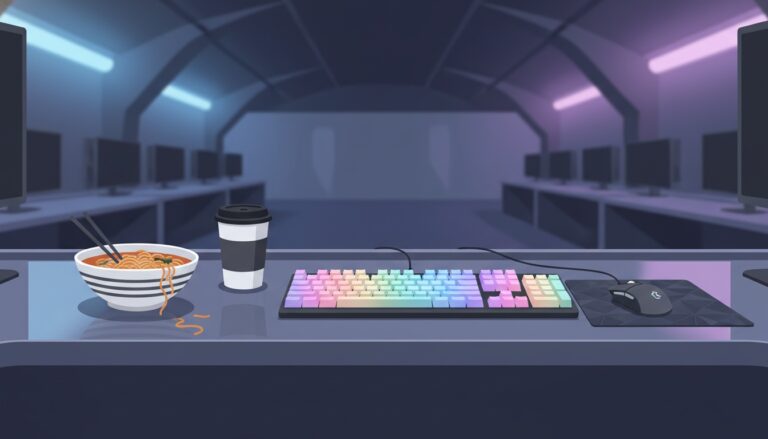
Phase 1: The Smell of Ramyun and Mechanical Keyboards
Hello! It’s your editor from Daily Hangul. 👋
Imagine this: You’ve just walked into a PC Bang (PC Café) in Hongdae. The air smells like spicy Ramyun and triumph. You hear the deafening click-clack of mechanical keyboards and someone shouting instructions in League of Legends. You find the perfect spot—high-spec monitor, comfy chair—but there’s a problem.
The previous user left a battlefield behind: an empty iced coffee cup and a greasy Ramyun bowl. 😱
If you stand there waiting for telepathy to work on the part-time staff (Albasaeng), you’ll be waiting all night. You need to speak up. But simply saying “Clean!” is rude, and “I am sorry but…” takes too long.
Today, I’ll give you the one magic sentence that gets your seat sparkling clean in 10 seconds. Let’s get you seated and gaming.
Phase 2: The Magic Sentence (Deep Dive)
Here is the only phrase you need to know for this situation.
1. 여기 자리 좀 치워주세요
- Pronunciation: [Yeogi jari jom chiwo-juseyo]
- Sound-alike: Yuh-gee jah-ree JOM chee-wo-ju-se-yo
- Meaning:
- Literal: Here / seat / a little / clear / please give.
- Real Nuance: “Could you please clear off this seat for me?”
Editor’s Insight:
The most important word here isn’t “clean” (chiwo). It’s 좀 (Jom). Literally, it means “a little,” but in Korean culture, it acts like a softener. Without “Jom,” you sound like a boss giving orders. With “Jom,” you sound like a polite customer asking for a favor. It’s the WD-40 of Korean conversation.Situation Spectrum:
[🚫 Formal Boss] ———— [✅ PC Bang Staff] ———— [✅ Restaurant Server]
* This phrase is perfect for service workers when you need a table cleared.🤔 Think About It:
Why do Koreans say “give me cleaning” (juseyo) instead of just “clean”? It reflects the “benefactive” nature of the language—you are acknowledging that their action is a favor for you.
Phase 3: Textbook vs. Real Life
Koreans distinguish between “cleaning a room” and “clearing a table.” Don’t mix them up!
| Situation | 📖 Textbook Korean | 🗣️ Real Korean | 💡 Why is it different? |
|---|---|---|---|
| Dirty Table | 청소해 주세요 (Cheongso-hae juseyo) | 치워 주세요 (Chiwo juseyo) | Cheongso sounds like you want them to bring a vacuum cleaner and mop. Chiwo means “remove the mess.” |
| Calling Staff | 저기요 (Jeogiyo) | 사장님 / 여기요 (Sajangnim / Yeogiyo) | Calling a young part-timer “Boss” (Sajangnim) is a common way to show respect in service jobs. |
Phase 4: Cultural Context — The “Mukbang” Station
4-1. Non-verbal: The “Hurry” Glance
In a PC Bang, speed is everything. When you ask the staff to clean, you don’t need deep eye contact or a bow. Just point at the mess with an open hand, say the phrase, and give a quick nod. They are busy; they appreciate brevity.
4-2. K-Culture Connection: K-Food
Have you seen those K-Drama scenes (like in Weightlifting Fairy Kim Bok-joo) where characters order a feast at a computer desk?
Korean PC Bangs are basically restaurants with high-end computers. Because people eat everything from Hotdogs to Kimchi Fried Rice at their seats, asking to “clear the seat” is a routine interaction, occurring hundreds of times a day. You aren’t being annoying; you’re just part of the ecosystem.
Phase 5: Roleplay — Claiming Your Throne 👑
Setting: Friday night, 10 PM. A busy PC Bang in Gangnam. You found the last empty seat, but it’s covered in trash.
Characters:
– YOU: Just want to play Overwatch.
– Staff: A busy university student carrying a tray of sodas.
Staff: (Passing by quickly) …
YOU: (You catch their attention)
저기요! 여기 자리 좀 치워주세요.
(Jeogiyo! Yeogi jari jom chiwo-juseyo.)
(English) “Excuse me! Could you please clear this seat?”
Staff: 아, 네! 금방 해드릴게요.
(Ah, ne! Geumbang hae-deuril-geyo.)
(English) “Ah, yes! I’ll do it right away.”
🔀 Decision Point: The staff is taking a long time. What do you do?
- A) Stand silently behind the chair and stare at them.
- B) Find a wet wipe and do it yourself.
- C) Say “Ppal-li” (Hurry up) loudly.
✅ Best Choice: B — If it’s just a small stain, grabbing a wet wipe (Mul-tisu) is faster and makes you look like a cool, low-maintenance regular.
⚠️ Choice A Analysis: Staring can be seen as aggressive pressure (Koreans call this “laser eyes”).
Phase 6: 10-Second Shadowing Drill
Let’s practice. Don’t be shy—say it loud!
😤 Polite but Urgent:
Yeogi / jari jom / chiwo-juseyo!
(Here / seat please / clear-give-me!)
Phase 7: K-Culture Mini Glossary
| Korean | Romanization | English | Context |
|---|---|---|---|
| 알바 | Alba | Part-timer | Short for “Arbeit” (German). The staff at PC bangs. |
| 선불 | Seonbul | Prepaid | You usually pay at a machine (kiosk) before using the PC. |
| 물티슈 | Mul-tisu | Wet Wipe | The holy grail of hygiene in Korea. Found everywhere. |
Phase 8: Traveler’s Survival Kit (PC Bang Edition)
Going to a PC Bang is a must-do experience in Korea, even if you don’t game. It’s cheap, cool, and the food is amazing.
🆘 Survival Expression #1
– 🇰🇷 “물티슈 있어요?” (Mul-tisu isseoyo?)
– 🗣️ Meaning: “Do you have wet wipes?”
– 📍 Where to use: When the keyboard feels sticky.
– 💡 Pro Tip: Most PC Bangs have a self-service bar with water and wet wipes.📌 Editor’s Travel Note
Almost all PC Bangs now use Kiosks for payment. They usually have an “English” button. You pay for time (e.g., 2 hours), get a code/receipt, sit down, and log in with that number.
Phase 9: Think Deeper — Service & Hierarchy
Language & Power:
Notice how we use honorifics (-yeyo, -juseyo) even to a part-time student who might be younger than you. In Korea, the customer-staff relationship dictates the language more than age does initially. However, you might hear older Korean men (
Frequently Asked Questions (FAQ)
Q: What does "여기 자리 좀 치워주세요" mean in Korean and how do you pronounce it?
A: In Korean, "여기 자리 좀 치워주세요" is pronounced [Yeogi jari jom chiwo-juseyo] and means: Literal: Here / seat / a little / clear / please give.







