

Phase 1: Introduction
Greeting: 안녕하세요! This is your Senior Editor at Daily Hangul.
So, you’ve reached an advanced level of Korean. You can debate social issues, watch K-dramas without subtitles, and maybe even write a decent email to your boss. But let me ask you this: Are you confident enough to throw away a chicken bone in front of your Korean neighbors?
I’ve seen C1-level speakers freeze in front of the 음식물 쓰레기통 (Food Waste Bin). Why? because Korea’s waste disposal system is notoriously strict, and the logic behind “what is food” and “what is trash” can be baffling.
If you get this wrong, it’s not just embarrassing; you could face fines (과태료) or, worse, the silent judgement of the apartment security guard (경비 아저씨). Today, we move beyond simple vocabulary. We are going to master the logic and nuance of Korean food waste disposal.
Phase 2: Deep Dive into Key Expressions
Here are the C1-level terms you need to navigate the waste disposal area like a local.
1. 배출 기준 (Discharge Standards)
- Pronunciation: Bae-chul Gi-jun [Sounds like: ‘Bae’ as in bae-gel + ‘chul’ as in chewing gum + ‘Gi’ as in Guitar + ‘jun’ as in June]
- Meaning:
- Literal: Discharge Criteria
- Real Nuance: The strict set of rules defining how, when, and where to throw things away. It implies a regulation you must follow, not just a suggestion.
- Editor’s Insight: You will see this written on notices in your building’s elevator. It’s a formal term. Use this when asking for clarification to show you respect the rules.
- Situation Check: Formal (O) / Casual (∆ – acceptable if discussing rules seriously)
2. 이물질 (Foreign Substance / Contaminant)
- Pronunciation: I-mul-jil [Sounds like: ‘E’ as in Email + ‘mul’ as in mulberry + ‘jil’ as in Jill]
- Meaning:
- Literal: Alien substance
- Real Nuance: Anything mixed into the food waste that shouldn’t be there (plastic, vinyl, toothpicks, bottle caps).
- Editor’s Insight: This is the #1 reason waste gets rejected. In a recycling context, it carries a negative nuance of “contamination.”
- Situation Check: Formal (O) / Casual (O)
3. 수거 거부 (Refusal of Collection)
- Pronunciation: Su-geo Geo-bu [Sounds like: ‘Su’ as in Sue + ‘geo’ as in Go (but softer) + ‘Geo-bu’]
- Meaning:
- Literal: Collection Refusal
- Real Nuance: When the sanitation workers leave your trash behind with a warning sticker because you messed up. It is the ultimate walk of shame.
- Editor’s Insight: If you see a sticker saying “수거 거부,” it means you need to re-sort your trash immediately.
- Situation Check: Formal (O) / Written Notices (O)
Phase 3: Textbook vs. Real Life
How do Koreans actually talk about trash nuances?
| Textbook Korean (Standard) | Real Life Korean (Natural/Nuanced) |
|---|---|
| 음식물 쓰레기를 분리해 주세요. (Please separate the food waste.) | 이거 음식물에 버리면 안 돼요. (You shouldn’t throw this in ‘food’ [waste].) |
| 이것은 일반 쓰레기입니다. (This is general waste.) | 이건 그냥 종량제에 넣어야 해요. (You just have to put this in the standard bag.) |
| 딱딱한 껍질은 버리면 안 됩니다. (You must not throw away hard shells.) | 딱딱한 건 동물이 못 먹어서 안 돼요. (Hard things are a no-go because animals can’t eat them.) |
Editor’s Note: In daily speech, Koreans often shorten 음식물 쓰레기 to just 음식물 (food matter) when standing in front of the bins. “이거 음식물이야?” (Is this food waste?)
Phase 4: Cultural Context & Manners
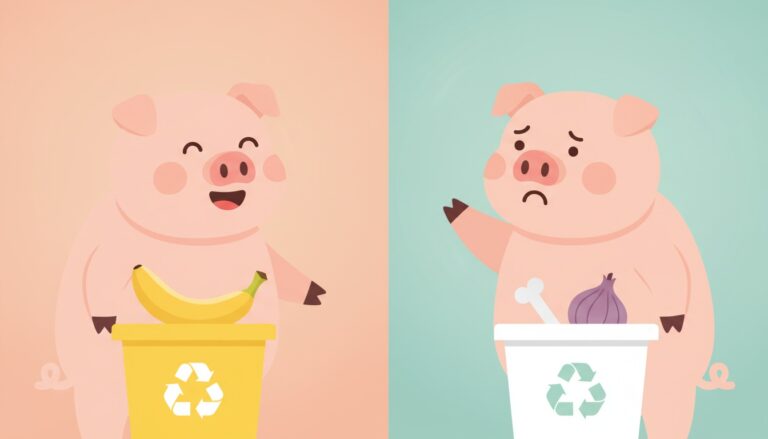
The Golden Rule: “Can a Pig Eat This?”
Unlike many Western countries where food waste goes to landfills or compost, a significant portion of Korea’s food waste is processed into animal feed (saru).
Therefore, the ultimate litmus test for separation is:
“동물이 먹을 수 있나요?” (Can an animal eat this?)
- Chicken Bones: Too sharp. Animals can choke. -> General Waste (일반 쓰레기)
- Onion/Garlic Skins: No nutritional value and too fibrous. -> General Waste
- Eggshells: Too hard/chalky. -> General Waste
- Fruit Pits (Peach/Apricot): Too hard. -> General Waste
The RFID Weighing Machine
In modern apartments, you don’t just dump food. You use an RFID card. The machine speaks to you, weighs your waste, and charges you by the gram.
* Nunchi Tip: Don’t stand there shaking the bag to get every last drop out if there is a line behind you. Just dump it quickly and move. Also, never leave the plastic bag inside the machine unless it’s a designated biodegradable bag (which is rare).
Phase 5: Real-Life Scenario (Roleplay)
Setting: Two friends cleaning up after a housewarming party (Chib-deul-i).
Characters:
* Mark (Learner): Trying to be helpful.
* Ji-eun (Korean Friend): Strict about recycling.
Mark: (Holding a bag of chicken bones and leftover radish)
치킨 뼈랑 무 남은 거 전부 음식물 봉투에 담았어. 나 잘했지?
(I put all the chicken bones and leftover radish in the food waste bag. I did good, right?)
Ji-eun: (Eyes widening in horror, rushing over)
잠깐만! 그대로 버리면 과태료 낼 수도 있어.
(Wait! If you throw it away like that, you might have to pay a fine.)
Mark:
정말? 이것도 다 먹다 남은 음식이잖아.
(Really? But this is all leftover food.)
Ji-eun: (Taking the bag and separating the bones)
한국에서는 동물이 먹을 수 있는지가 기준이야. 뼈는 일반 쓰레기로 분리 배출해야 해.
(In Korea, the standard is whether animals can eat it. Bones must be separated and discharged as general waste.)
Mark:
아, 헷갈리네. 그럼 양파 껍질은?
(Ah, it’s confusing. Then what about onion skins?)
Ji-eun:
그것도 영양분이 없어서 일반 쓰레기야. 모르면 그냥 나한테 물어봐!
(That also has no nutrients, so it’s general waste. If you don’t know, just ask me!)
Phase 6: 10-Second Shadowing Drill
Practice this sentence to explain the logic to others (or remind yourself).
“It is a principle to exclude items that animals cannot eat, such as bones or shells.”
뼈나 껍데기처럼 / 동물이 먹을 수 없는 건 / 제외하는 게 원칙이에요.
[Ppyeo-na kkeop-de-gi-cheo-reom / dong-mu-ri meo-geul su eom-neun geon / je-oe-ha-neun ge won-chi-gi-e-yo.]
Key Points:
* Pause at the / marks.
* 원칙이에요 (won-chi-gi-e-yo): Pronounce smoothly, linking the final consonant to the vowel.
Phase 7: FAQ & Troubleshooting
Q: Can I put gochujang (red pepper paste) or doenjang (soybean paste) in food waste?
A: NO! (Surprisingly)
Pastes are too salty (high salinity) and can harm animals if used as feed. Large amounts of sauce or paste should actually be thrown away as General Waste, or rinsed thoroughly before disposal.
Q: What if I have a whole watermelon rind?
A: Because it is soft and has moisture, it is Food Waste. However, you must chop it into small pieces so the machine can process it.
Q: Can I use a regular plastic bag to carry the food waste to the bin?
A: Yes, but you must empty the contents into the bin and throw the dirty plastic bag into a separate Vinyl/Plastic recycling bin (or General Waste, depending on how dirty it is). Never throw the plastic bag into the food waste bin.
Phase 8: Wrap-up
One-Liner Summary:
If an animal can’t chew it or digest it (bones, pits, hard shells, onion skins), it belongs in the Standard Garbage Bag (General Waste), not the Food Waste Bin.
Action Mission:
Next time you peel an onion or eat a hard-boiled egg, consciously say out loud: “이건 동물이 못 먹어!” (Animals can’t eat this!) and throw it in the general trash.
Tell me in the comments:
What was the most surprising item you found out was NOT considered “food waste” in Korea? I was shocked about the onion skins!
Phase 9: Pop Quiz
Which of the following items should be thrown into the Food Waste (음식물 쓰레기) bin?
- Chicken Bones (치킨 뼈)
- Eggshells (달걀 껍데기)
- Banana Peels (바나나 껍질)
- Onion Skins (양파 껍질)
Click to see the answer
Answer: 3. Banana Peels
Explanation: Banana peels are soft, moist, and nutritious for animals. All the others are hard, fibrous, or dangerous for animals and must go into General Waste (일반 쓰레기).
Frequently Asked Questions (FAQ)
Q: What does "배출 기준 (Discharge Standards)" mean in Korean and how do you pronounce it?
A: In Korean, "배출 기준 (Discharge Standards)" is pronounced [Bae-chul Gi-jun [Sounds like: 'Bae' as in bae-gel + 'chul' as in chewing gum + 'Gi' as in Guitar + 'jun' as in June] and means: Literal: Discharge Criteria
Q: What does "이물질 (Foreign Substance / Contaminant)" mean in Korean and how do you pronounce it?
A: In Korean, "이물질 (Foreign Substance / Contaminant)" is pronounced [I-mul-jil [Sounds like: 'E' as in Email + 'mul' as in mulberry + 'jil' as in Jill] and means: Literal: Alien substance
Q: What does "수거 거부 (Refusal of Collection)" mean in Korean and how do you pronounce it?
A: In Korean, "수거 거부 (Refusal of Collection)" is pronounced [Su-geo Geo-bu [Sounds like: 'Su' as in Sue + 'geo' as in Go (but softer] and means: Literal: Collection Refusal







