

Confused by ‘Saheul’? The K-Drama Date Counting Guide
Phase 1: Immersive Hook
Greeting: Hello! I’m your Daily Hangul editor.
Picture this: You are watching a K-Drama. The main couple just broke up (again). The background music swells, and Big Bang’s legendary song starts playing: “Haru haru…” 🎶
You look at the subtitles. It says “Day by day.”
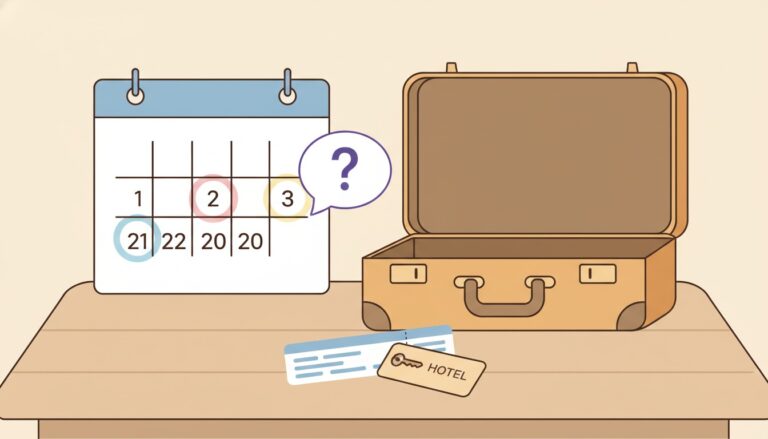
But later, you’re at a hotel in Seoul trying to extend your stay. You want to stay for four days. You vaguely remember the number four is “Sa” in Korean. So you say, “Saheul (사흘).” The receptionist smiles and books you for three days.
Wait, what happened? Why did “Sa” turn into three? 😱
Don’t panic. Even young Koreans get confused by this. In fact, a few years ago, the word Saheul caused a massive controversy on the Korean internet because many people thought it meant four days!
Today, we are going to fix this so you never book the wrong hotel dates.
Phase 2: Deep Dive (The Big Three)
In Korean, when we count the duration of days (how long), we often use special native words instead of just numbers. Here are the only three you absolutely must know as a beginner.
1. 하루 (Haru)
- Pronunciation: [Ha-ru] (Sounds like “Ha!” + “Roo” as in Kangaroo)
- Meaning: One day
- K-Pop Moment: Big Bang’s “Haru Haru” (Day by Day). It captures the feeling of days dragging on when you are sad.
- Editor’s Insight: Haru is beautiful. It feels softer than saying “1-il” (which sounds mathematical). You use this for feelings. “It was a long day” is “Gin haru-yeosseo.”
- Situation Spectrum:
[🚫 Formal Report] ———— [✅ Friendly/Casual/Daily Life]- 🤔 Think About It: Why do songs use Haru instead of Il-il? Does Haru sound more emotional to your ears?
2. 이틀 (Iteul)
- Pronunciation: [I-teul] (Sounds like “E” + “Tool”)
- Meaning: Two days
- Context: Very common for weekend trips. “I stayed there for iteul.”
- Editor’s Insight: It comes from the old Korean word for “two.” It’s extremely common in spoken conversation. If you say “2-il” (I-il), people understand, but Iteul sounds much more natural.
- Situation Spectrum:
[🚫 Military Orders] ———— [✅ Everyday Speech]3. 사흘 (Saheul)
- Pronunciation: [Sa-heul] (Sa + Hull of a ship)
- Meaning: Three days (WARNING: NOT FOUR!)
- The Trap: In Sino-Korean numbers, 4 is Sa. But here, Saheul comes from the native number 3 (Set). This is the biggest trap in the Korean language.
- Editor’s Insight: If you are scared to use this, just say “Sam-il” (3 days). It’s safer. But if you hear it in a drama, know that it means 3.
- Situation Spectrum:
[✅ News/Literature] ———— [✅ Older Generation] ———— [⚠️ Gen Z (Might be confused)]- 🤔 Think About It: Even native speakers fight about this word. If a language causes confusion among natives, is it ‘evolving’ or ‘decaying’?
Phase 3: Textbook vs. Real Life
| Situation | 📖 Textbook Korean | 🗣️ Real Korean (Street) | 💡 Why? |
|---|---|---|---|
| How long? | 며칠 동안? (Myeochil dongan?) | 몇 박? (Myeot bak?) | Myeot bak refers to “nights” (like hotel stays). It’s shorter/faster. |
| 1 Day | 일일 (Il-il) | 하루 (Haru) | Il-il sounds like a robot or a document. Haru is life. |
| 2 Days | 이일 (I-il) | 이틀 (Iteul) | I-il is hard to pronounce (two vowels). Iteul flows better. |
| 3 Days | 삼일 (Sam-il) | 삼일 or 사흘 | Younger people prefer Sam-il to avoid the “Saheul=4?” confusion. |
Bottom Note: For 4 days, the word is Naheul. But honestly? Just use Sa-il (4-il). Don’t torture yourself yet!
Phase 4: Cultural Deep Dive — The ‘Nunchi’ of Dates
The “Saheul” Controversy
When the Korean government announced a holiday period as Saheul (3 days), “Saheul 4 days” became a top search trend. Many people complained, “Why use difficult words? Just say 3 days!”
Editor’s Travel Tip:
If you book an Airbnb or discuss a schedule with a Korean friend, clarity is key.
– Don’t just say: “Saheul stay.”
– Do say: “Saheul, aka 3 nights, right?”
Koreans will appreciate this double-check because they might be confused too!
Phase 5: Immersive Roleplay
Scenario: You are at a Guesthouse in Jeju Island. You love it so much you want to extend your trip. It is Tuesday morning.
Characters:
– YOU: Tourist falling in love with Jeju.
– Owner: Friendly ‘Ajumma’ (Auntie) owner.
Dialogue:
Owner: 내일 체크아웃이죠? (Naeil chekeu-aut ijo?)
(Tomorrow is checkout, right?)
YOU: 저… 여기 너무 좋아요. (Jeo… yeogi neomu joayo.)
(I… love it here so much.)
YOU: [Your Choice]
🔀 Your Turn! How do you extend for 2 days?
– A) “I-il deo isseulgeyo.” (Literally: 2 days more I will stay)
– B) “Iteul deo itgo sipeoyo.” (I want to stay for Iteul more)
– C) “Two days more, please.”✅ Best Choice: B — “Iteul” sounds natural and soft. “Itgo sipeoyo” (want to stay) is polite.
⚠️ Choice A: Grammatically fine, but “I-il” sounds a bit stiff in conversation.
Owner: 아이고, 정말요? 그럼 하루치 깎아줄게요! (Aigo, really? Then I’ll discount Haru‘s worth!)
(Did you catch that? She gave you 1 day free/discount!)
Phase 6: 10-Second Shadowing Drill
Let’s practice the flow. Focus on the “L” sound in Iteul.
- Sentimental (Looking at a sunset):
😢 하루가 / 너무 / 빨라요.
(Ha-ru-ga / neomu / ppallayo.)
The day is too fast. -
Casual (Planning a trip):
😊 이틀만 / 쉴게.
(I-teul-man / swil-ge.)
I’ll rest for just two days.
Phase 7: K-Culture Mini Glossary
| Korean | Romanization | English | Context |
|---|---|---|---|
| 1박 2일 | Il-bak I-il | 1 Night 2 Days | Famous Korean variety show name. Also the standard way to say “overnight trip.” |
| 당일치기 | Dang-il chigi | Day Trip | A trip without staying overnight. Literally “Hitting it on the day.” |
| 호캉스 | Hokangseu | Hotel Vacance | A staycation in a hotel (very popular in Korea). You often go for Haru or Iteul. |
Phase 8: Traveler’s Survival Kit
Topic: Hotel Check-in/out
🆘 Survival Phrases
1. “Haru deo mukgo sipeoyo.” (I want to stay one more day.)
– Use this at the front desk.
2. “Myeot bak i-yeyo?” (How many nights is it?)
– Myeot = How many, Bak = Nights.
3. “Check-out eonje yeyo?” (When is check-out?)📌 Editor’s Travel Note
In Korea, many hotels have a strict “Check-in at 3 PM, Check-out at 11 AM” rule. If you just want to use a room for Haru (a few hours during the day), look for “Daesil” (대실 – Renting a room for 3-4 hours). This is common in Motels, but not luxury hotels.
Phase 9: Think Deeper — Why Two Systems?
Topic: Language & Complexity
Why does Korea have Native numbers (Hana, Dul, Set) and Sino-Korean numbers (Il, I, Sam)?
It’s like how English has “Freedom” (Germanic roots – feels emotional, raw) and “Liberty” (Latin roots – feels legal, precise).
Haru, Iteul, Saheul are native words. They feel closer to home, tied to the rhythm of life and nature. 1-il, 2-il, 3-il are Sino-Korean. They are for calculation, money, and dates on a calendar. When you use Haru, you aren’t just counting time; you are experiencing it.
💬 Your Turn: Does your language have two words for the same thing? Which one do you use more? Tell me in the comments!
Phase 10: Troubleshooting & FAQ
Q: Can I use Haru to mean “The 1st day of the month”?
A: NO! 🚫
– Duration (1 day long) = Haru
– Date (May 1st) = 1-il (Il-il)
Don’t mix these up, or you will miss your flight!
Q: Is Saheul rude?
A: No, it’s elegant. But it’s confusing. Use it with older people to sound smart. Use 3-il with friends to be clear.
Phase 11: Wrap-up & Mission
Summary:
– 1 Day duration = Haru (Emotional, common)
– 2 Days duration = Iteul (Standard spoken)
– 3 Days duration = Saheul (Tricky! Means 3, not 4)
Action Mission:
– 🥉 Bronze: Say “Haru, Iteul, Saheul” aloud 3 times while holding up 1, 2, and 3 fingers.
– 🥈 Silver: Listen to Big Bang’s “Haru Haru” and try to catch the word in the chorus.
– 🥇 Gold: Go to a Korean booking site (like Naver Maps) and look for “1박 2일” (1 night 2 days) on a pension listing.
See you next time! 안녕! 👋
Frequently Asked Questions (FAQ)
Q: What does "하루 (Haru)" mean in Korean and how do you pronounce it?
A: In Korean, "하루 (Haru)" is pronounced [Ha-ru] and means: One day
Q: What does "이틀 (Iteul)" mean in Korean and how do you pronounce it?
A: In Korean, "이틀 (Iteul)" is pronounced [I-teul] and means: Two days
Q: What does "사흘 (Saheul)" mean in Korean and how do you pronounce it?
A: In Korean, "사흘 (Saheul)" is pronounced [Sa-heul] and means: Three days (WARNING: NOT FOUR!)






