

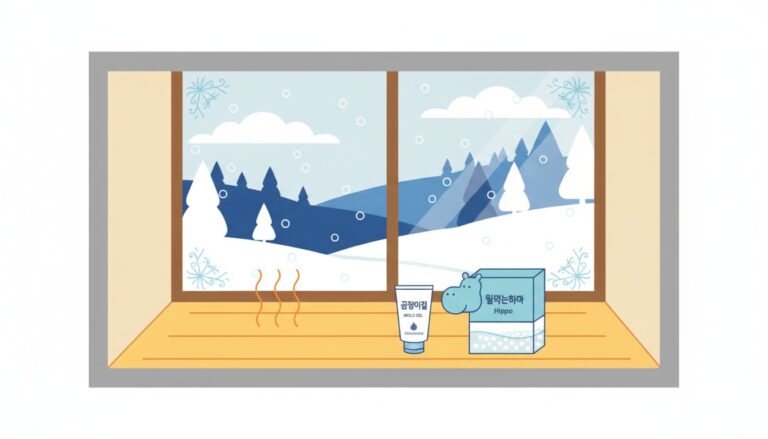
Phase 1: The Immersive Hook
Hello there! This is your Daily Hangul Editor.
If you’ve watched the masterpiece film Parasite, you likely remember the visceral reaction the wealthy characters had to the distinct “smell” of the protagonist family. That wasn’t just the smell of poverty; specifically, it was the scent of a semi-basement (banjiha) struggling with humidity and mold.
But here is the plot twist: you don’t need to live in a semi-basement to encounter this enemy. You could be in a sleek, high-rise officetel in Gangnam or a cozy one-room in Hongdae. Winter comes, you crank up the floor heating (Ondol), and suddenly, you see them—tiny black dots creeping up your wallpaper like an unwanted horror movie subplot.
Welcome to the great Korean battle against Gyeollo (Condensation).
Today, we aren’t just learning words; we are learning survival skills for your Korean home life. I’m going to teach you how to handle this situation with the precision of a chemical expert and the diplomatic grace required to talk to a Korean landlord.
Phase 2: Deep Dive into Key Expressions
1. 결로 (Gyeollo)
- Pronunciation: [Gyeol-lo] + Think of the ‘lo’ sound in ‘low’, but tighter.
- Meaning: Condensation (Literal: Dew formation)
- Nuance: In Western architecture, condensation might just be foggy windows. In Korea, due to the extreme temperature difference between the Siberian-cold outside and the boiling-hot Ondol floor inside, Gyeollo is the arch-nemesis of wallpapers. It is the precursor to mold.
- K-Culture Moment: In reality TV shows like I Live Alone, you often see celebrities setting up dehumidifiers. They aren’t just for comfort; they are fighting Gyeollo.
- Situation Spectrum:
[🚫 Formal] ———— [✅ Essential Housing Term] - 🤔 Think About It: Why does Korean have a specific, scientific-sounding term like Gyeollo commonly used in everyday household conversation? It suggests that managing indoor climate is a collective, structural struggle in Korean housing architecture.
2. 곰팡이가 피다 (Gompang-i-ga pida)
- Pronunciation: [Gom-pang-i-ga pi-da]
- Meaning: Mold blooms (Literal)
- Editor’s Insight: This is arguably one of the most ironically poetic phrases in Korean. The verb 피다 (pida) is typically reserved for beautiful things like flowers (kkot). Yet, we use it for mold. It implies an organic, spreading growth that feels almost alive. When you call your landlord, you don’t say “There is mold.” You say, “The mold has bloomed.”
- Situation Spectrum:
[🚫 Casual] ———— [⚠️ Serious] ———— [✅ Standard]- Use this when reporting the issue. It sounds objective yet urgent.
3. 환기 좀 시키세요 (Hwangi jom sikiseyo)
- Pronunciation: [Hwan-gi jom si-ki-se-yo]
- Meaning: Please ventilate a bit.
- Real Nuance: This is the sentence every foreigner dreads hearing from a landlord. It is often used as a defensive shield. If you complain about mold, 90% of Korean landlords will counter with this phrase, implying the fault lies in your lifestyle, not the building’s insulation.
- K-Culture Moment: Imagine a Korean mother scolding her child. “Open the window! Air it out!” even if it is -10°C outside.
Phase 3: Textbook vs. Real Life
| Situation | 📖 Textbook Korean | 🗣️ Real Korean (Survival) | 💡 Why the difference? |
|---|---|---|---|
| Buying remover | 곰팡이 제거제 있어요? (Do you have mold remover?) | 이거 곰팡이에 직빵이에요? (Is this a direct hit/instant fix for mold?) | “직빵 (Jikbbang)” is slang for immediate effect. You want results, not just a product. |
| Complaining to landlord | 방에 곰팡이가 있어요. (There is mold in the room.) | 벽지가 다 젖어서 곰팡이가 올라왔어요. (The wallpaper is soaked and mold has come up.) | Passive description vs. Active damage report. You must emphasize the process of damage. |
| Preventing condensation | 환기를 자주 합니다. (I ventilate often.) | 아침저녁으로 문 열어두는데도 이래요. (Even though I keep doors open morning and evening, it’s like this.) | You need to prove you already did your part (ventilation) to shift responsibility to the building. |
Phase 4: Cultural Deep Dive — The “Ondol” Paradox
Let’s talk about the Non-verbal Communication of heating.
Korea’s Ondol (floor heating) system is world-class. It heats the floor, which heats the air. However, this creates a specific cultural friction point.
When you see mold, your instinct might be to complain about a leak. But in Korea, the cultural logic dictates that “The occupant controls the humidity.”
If you report mold to a landlord, they will immediately look for:
1. Drying laundry indoors (A huge No-No without ventilation).
2. Windows shut tight for days.
Pro Tip: Before the landlord visits to inspect the mold, open the windows for 30 minutes and hide your drying rack. You are engaging in a silent battle of “I did my best to manage the house.”
Phase 5: Immersive Roleplay
Setting: It is mid-January in Seoul. -15°C outside. You live in a “Villa” (low-rise multi-unit house). You found black mold in the corner of your bedroom. You called the landlord.
Characters:
– YOU: A foreign resident who knows their rights but wants to be polite.
– Landlord (Ajumma): A tough but sensible lady in her 60s. She hates spending money on repairs.
Dialogue:
Landlord: (Sighs, looking at the wall) 아이고… 학생, 이거 환기 안 시켜서 그래. 겨울에 문을 꽁꽁 닫고 사니까 그렇지.
(Aigo… student, this is because you didn’t ventilate. It’s because you live with the doors shut tight in winter.)
🔀 Decision Point: How do you respond?
A) “Sorry, I will open the windows.”
(Too submissive. You will pay for the wallpaper replacement.)B) “No! I opened them! Fix it!”
(Too aggressive. She will shut down and do nothing.)C) “No, I actually ventilate twice a day. Even bought a dehumidifier. I think it’s an insulation issue.”
(The C2 Pro Gamer Move.)
YOU (Choice C): 어머니, 저 아침마다 환기 꼬박꼬박 하고, 제습기도 틀어놔요. 이건 단열 문제 같은데요?
(Eomeoni, I ventilate religiously every morning and run a dehumidifier too. This looks like an insulation issue?)
Landlord: (Hesitates, realizing you aren’t a pushover) 그래? 흠… 그럼 곰팡이 젤 한번 발라보고, 정 안되면 업자 불러볼게.
(Really? Hmm… then try applying the mold gel first, and if that really doesn’t work, I’ll call a contractor.)
🎭 Stage Direction: You have successfully defended your security deposit.
Phase 6: 10-Second Shadowing Drill
Let’s practice the sentence that defends your innocence regarding mold.
- Emotion: 😤 Firm but polite (Unfairly accused)
- Sentence: 아침저녁으로 / 환기하는데도 / 물이 계속 맺혀요!
- Romanization: Achim-jeonyeok-euro / hwan-gi-ha-neun-de-do / mul-i gye-sok maet-hyeo-yo!
- Meaning: Even though I ventilate morning and evening, water keeps forming (condensing)!
Phase 7: K-Culture Mini Glossary
| Korean | Romanization | Meaning in Context |
|---|---|---|
| 다이소 | Daiso | The holy land for Korean living. Where you buy the “Mold Remover Gel” (look for 곰팡이 제거 젤). |
| 뽁뽁이 | Bbok-bbok-i | Bubble wrap. Koreans stick this on windows in winter for insulation. It’s a quintessential winter visual. |
| 물먹는 하마 | Mul-meok-neun Hama | Lit: “Water-eating Hippo.” A famous brand of dehumidifier box you put in closets. |
| 탄성코트 | Tanseong-coat | A type of rubbery paint used on balconies to prevent condensation. High-end villas brag about having this. |
Phase 8: Traveler’s & Expat’s Survival Kit
If you are staying in an Airbnb or semi-long-term rental:
🆘 Survival Shopping List (Daiso Edition)
1. 곰팡이 제거 젤 (Mold Remover Gel): Apply it on the silicone of the window frame. Wait 2 hours. Rinse. It is magic.
2. 문풍지 (Mun-pung-ji): Foam strips to block drafts from windows.
3. 제습제 (Dehumidifier Agent): Buy the “Hippo” tubs for your closet.
📌 Editor’s Note: If you are just traveling for a week in a hotel, you won’t need this. But if you see condensation on your hotel window, don’t let your suitcase touch that wall. The moisture can transfer and ruin your bag leather overnight.
Phase 9: Think Deeper — Language & Housing Class
The vocabulary of mold and cleaning reveals the hierarchy of housing in Korea.
In luxury apartments (Apart), systems are automated. You rarely hear the word Gyeollo because the construction standards are incredibly high. However, in Villas (low-rise) or Banjiha (semi-basement), these words are part of daily survival.
The phrase “반지하 냄새” (Banjiha smell) from Parasite is not just about hygiene; it is a sensory marker of class that cannot be washed away. When we learn words like Hwangi (ventilation) and Gyeollo (condensation), we are actually learning the language of the working class managing their environment against the harsh Korean seasons.
💬 Your Turn: Does your country have specific words for housing problems that imply a certain social status?
Phase 10: FAQ & Troubleshooting
Q: Can I just paint over the mold?
A: ❌ Absolutely NOT. In Korea, if you paint over wallpaper without treating the mold, the landlord can sue you for damages later because the mold will rot the drywall underneath. You must kill the mold (clean it) or replace the wallpaper.
Q: My landlord is refusing to fix the moldy wallpaper. What do I do?
A: If the mold is caused by structural defects (cracks, leaks), it is the landlord’s duty (Civil Act Article 623). Send a text message (for evidence) with photos stating: “Here is proof of my daily ventilation, but mold persists due to external wall condensation.”
Phase 11: Wrap-up & Action Mission
Summary: Managing Gyeollo is not just cleaning; it’s a strategic negotiation between you, the harsh Korean winter, and your landlord.
🚀 Action Missions:
– 🥉 Bronze: Go to a convenience store or Daiso and locate the “곰팡이 (Mold)” section. Just spotting the word is a win.
– 🥈 Silver: Check your own windows tomorrow morning. Is there dew? Wipe it off and say, “Gyeollo-ga saeng-gyeot-ne” (Condensation has formed).
– 🥇 Gold: If you live in Korea, buy a “Mul-meok-neun Hama” (Moisture Hippo) and place it in your closet. You are now truly living like a local.
See you in the next lesson, and stay dry!
Frequently Asked Questions (FAQ)
Q: What does "결로 (Gyeollo)" mean in Korean and how do you pronounce it?
A: In Korean, "결로 (Gyeollo)" is pronounced [Gyeol-lo] and means: Condensation (Literal: Dew formation)
Q: What does "곰팡이가 피다 (Gompang-i-ga pida)" mean in Korean and how do you pronounce it?
A: In Korean, "곰팡이가 피다 (Gompang-i-ga pida)" is pronounced [Gom-pang-i-ga pi-da] and means: Mold blooms (Literal)
Q: What does "환기 좀 시키세요 (Hwangi jom sikiseyo)" mean in Korean and how do you pronounce it?
A: In Korean, "환기 좀 시키세요 (Hwangi jom sikiseyo)" is pronounced [Hwan-gi jom si-ki-se-yo] and means: Please ventilate a bit.







