

Phase 1: Introduction
Hello! This is your Senior Editor at Daily Hangul. 👋
Congratulations on finding your new place in Korea! You’ve signed the contract, moved your boxes, and are finally standing in front of your new door. But wait… the landlord gave you a generic passcode like 0000 or 1234, right? 😅
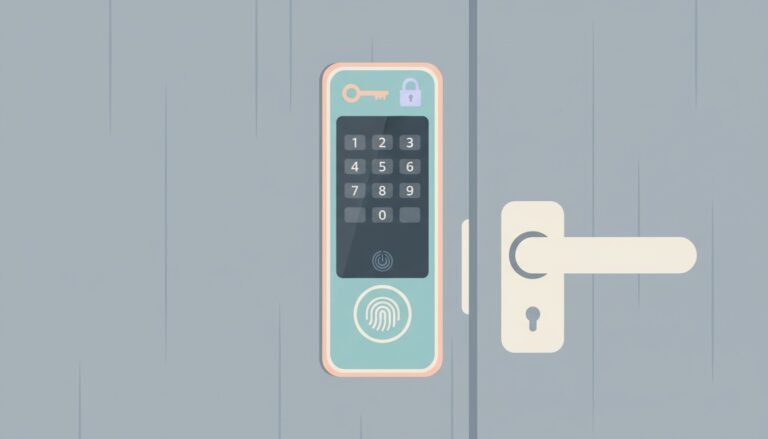
In Korea, almost every home uses a Digital Door Lock. Physical keys are becoming ancient history. While convenient, it can be terrifying if you don’t know how to change the password (or if you accidentally lock yourself out while trying).
Today, we are going to learn how to ask for help changing your passcode. Knowing these phrases won’t just keep your home safe; it will save you from frantically calling a locksmith at 11 PM. Let’s make you feel secure in your new Korean home!
(Note: This guide is based on real questions from our students who just moved to Seoul!)
Phase 2: Deep Dive into Key Expressions
Here are the top 3 expressions you need to survive this situation. We are keeping it at an A2 (Beginner) level—polite enough for a landlord, but simple enough to remember.
1. 비밀번호 바꾸고 싶어요 (I want to change the password)
- Pronunciation: Bi-mil-beon-ho ba-kku-go si-peo-yo
- Bi-mil sounds like “Bee-meal”
- beon-ho sounds like “Bun-ho”
- Meaning: “I want to change the password.”
- Editor’s Insight: This is your clear statement of intent. The grammar pattern -고 싶어요 (-go si-peo-yo) means “I want to…” It is the golden key to expressing your desires in Korean.
- Situation Check: Perfect for speaking to your landlord, building manager, or real estate agent.
2. 어떻게 해요? (How do I do it?)
- Pronunciation: Eo-tteo-ke hae-yo?
- Eo-tteo-ke sounds like “Otter-kay”
- Meaning: “How do I do it?” / “How does it work?”
- Editor’s Insight: If you just stare at the door lock and say this, Koreans will immediately understand you need a tutorial. It’s a universal phrase for when you are stuck.
- Situation Check: Use this anytime, anywhere. From bank ATMs to washing machines.
3. 알려주세요 (Please let me know / Please teach me)
- Pronunciation: Al-lyeo-ju-se-yo
- ju-se-yo sounds like “Jew-say-yo”
- Meaning: “Please let me know” or “Please inform me.”
- Editor’s Insight: This is softer and more polite than just asking “How?”. It implies you are asking for a favor. It makes the listener feel helpful.
- Situation Check: Very polite. Use this when you want to leave a good impression on your new landlord.
Phase 3: Textbook vs. Real Life
Textbooks are safe, but sometimes they sound like a robot. Here is how people actually talk.
| Textbook Korean (Standard) | Real Life Korean (Natural/Casual) |
|---|---|
| 비밀번호를 변경하고 싶습니다. (I would like to modify the password.) |
비번 어떻게 바꿔요? (How do I change the ‘PW’?) |
| 방법을 가르쳐 주세요. (Please teach me the method.) |
이거 설정 어떻게 해요? (How do I ‘set’ this up?) |
💡 Bottom Note: In daily conversation, Koreans often shorten 비밀번호 (Password) to 비번 (Bi-beon). Using Bi-beon instantly makes you sound like a local insider!
Phase 4: Cultural Context & Manners 🇰🇷
The “Smart” Culture
In Korea, the digital door lock is standard. Even cheap studio apartments have them. Usually, the instructions are written on the battery cover on the inside of the door. Before you call the landlord, try taking off the plastic cover on the back of the lock!
The Privacy Manner
When you invite a Korean friend over and input your password, you might notice they suddenly look away, turn around, or stare at the ceiling. They aren’t being rude; they are protecting your privacy!
Tip: If you are changing the password while the landlord is watching (to help you), they will likely turn away. You should do the same if you see someone entering their code.
Phase 5: Roleplay Script 🎬
Situation: You just moved in. You are texting or calling your Landlord (집주인 – Jip-ju-in) because you don’t know how to reset the lock.
Characters:
* 👤 You (New Tenant)
* 🏠 Landlord (Korean local)
(Phone Call)
👤 You: 안녕하세요! 저 201호 세입자예요.
(An-nyeong-ha-se-yo! Jeo 201-ho se-ip-ja-ye-yo.)
Hello! I am the tenant of unit 201.
🏠 Landlord: 아, 네! 이사는 잘 했어요?
(Ah, ne! I-sa-neun jal hae-sseo-yo?)
Ah, yes! Did the move go well?
👤 You: 네. 그런데 비밀번호 바꾸고 싶어요. 어떻게 해요?
(Ne. Geu-reon-de bi-mil-beon-ho ba-kku-go si-peo-yo. Eo-tteo-ke hae-yo?)
Yes. But I want to change the password. How do I do it?
🏠 Landlord: 문 안쪽에 버튼이 있어요. 그거 누르면 돼요.
(Mun an-jjo-ge beo-teu-ni i-sseo-yo. Geu-geo nu-reu-myeon dwae-yo.)
There is a button inside the door. Just press that.
👤 You: 아! 찾았어요. 감사합니다!
(Ah! Cha-ja-sseo-yo. Gam-sa-ham-ni-da!)
Ah! I found it. Thank you!
Phase 6: 10-Second Shadowing 🗣️
Read this sentence aloud 3 times. Pay attention to the pauses (/).
“비밀번호 / 바꾸고 싶은데 / 알려주세요.”
- Romanization: Bi-mil-beon-ho / ba-kku-go si-peun-de / al-lyeo-ju-se-yo.
- Focus: Put a little stress on “Ba-kku-go” (Change). Keep the end of the sentence soft.
Phase 7: FAQ & Troubleshooting
- Q: Do I have to tell the landlord my new password?
- A: generally, No. It is your private space. However, if there is a fire or emergency, they might need access. Usually, the master key handles that. You do not need to share your code unless it is a shared boarding house (Hasuk-jip).
- Q: Can I say “Change” as “Change-hae-yo”?
- A: Good try! But usually, we use the verb 바꾸다 (Ba-kku-da) for exchanging or changing settings. So “Ba-kku-go si-peo-yo” is much more natural than using the Konglish word “Change.”
Phase 8: Wrap-up & Action Item
📝 One-Liner Summary:
To change your door lock code, remember the combo: “Bi-mil-beon-ho” (Password) + “Ba-kku-go si-peo-yo” (Want to change).
🚀 Today’s Mission:
Go check your own door lock right now! Find the battery cover on the inside. Is there an instruction sticker? Try to find the word “등록” (Register) or “비밀번호” (Password) written there.
💬 Let’s Chat:
Does your country use keys or digital locks? Tell me in the comments below! 👇
Phase 9: Quick Quiz 🧠
1. What is the short slang word for ‘Password’ (Bi-mil-beon-ho)?
A) Mil-beon
B) Bi-beon
C) Pa-seu
2. How do you say “I want to change…”?
A) Ba-kku-go si-peo-yo
B) Ba-kku-ju-se-yo
C) Ba-kku-sseo-yo
3. True or False: You should stare closely at a Korean person when they are typing their password to show you are paying attention.
A) True
B) False
Click to see answers
1. B (Bi-beon)
2. A (Ba-kku-go si-peo-yo)
3. B (False! Give them privacy!)
Frequently Asked Questions (FAQ)
Q: What does "비밀번호 바꾸고 싶어요 (I want to change the password)" mean in Korean and how do you pronounce it?
A: In Korean, "비밀번호 바꾸고 싶어요 (I want to change the password)" is pronounced [Bi-mil-beon-ho ba-kku-go si-peo-yo] and means: a key conversational Korean expression covered in this lesson.
Q: What does "어떻게 해요? (How do I do it?)" mean in Korean and how do you pronounce it?
A: In Korean, "어떻게 해요? (How do I do it?)" is pronounced [Eo-tteo-ke hae-yo?] and means: a key conversational Korean expression covered in this lesson.
Q: What does "알려주세요 (Please let me know / Please teach me)" mean in Korean and how do you pronounce it?
A: In Korean, "알려주세요 (Please let me know / Please teach me)" is pronounced [Al-lyeo-ju-se-yo] and means: a key conversational Korean expression covered in this lesson.







