

Phase 1: Introduction
Hello! This is your Daily Hangul Editor.
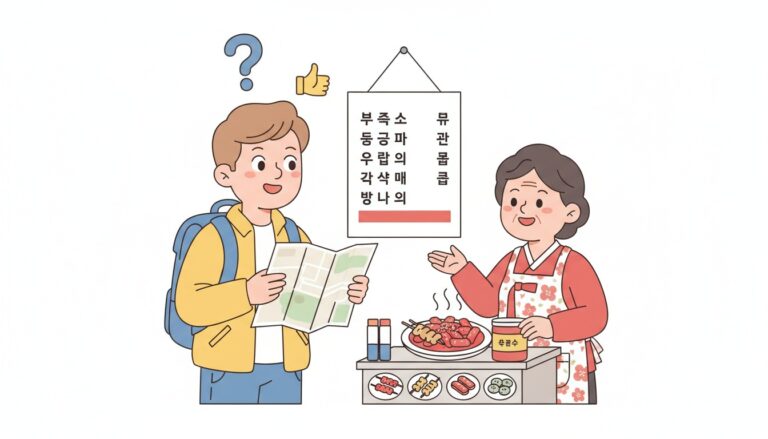
Imagine this: You’ve finally arrived at Gwangjang Market in Seoul. The air is filled with the smell of sesame oil and sizzling pancakes. You see a stall with a long line, and the food looks amazing, but the menu is entirely in Korean. You don’t want to just point at a random red bowl and hope for the best (it might be super spicy fire chicken!).
In this situation, you need the “Magic Key” phrase. This isn’t just about ordering food; it’s about asking for the best experience.
Today, we are going to learn how to ask, “What is famous here?” knowing this phrase instantly upgrades you from a confused tourist to a savvy traveler who knows how to enjoy the local vibes.
Note: This guide is based on real questions from students who visited Korea and realized that guidebooks don’t always help in the heat of the moment!
Phase 2: Deep Dive into Core Phrases
Here are the top 3 expressions you need to survive and thrive in Korean shops and restaurants.
1. 여기서 유명한 게 뭐예요? (What is famous here?)
- Pronunciation (RR): [Yeogiseo yumyeonghan ge mwoyeyo?]
- Sound Analogy:
- Yeo-gi (Sounds like Yogi Bear)
- seo (Sounds like Saw)
- yu-myeong (Sounds like You + Myung)
- han (Sounds like Han Solo)
- ge (Sounds like Get)
- mwo-ye-yo (Sounds like Mwo + Yeah + Yo)
- Meaning:
- Literal: What is the famous thing at this place?
- Real Nuance: “What is your signature dish?” or “What does everyone else buy here?”
- Editor’s Insight: This is your #1 survival weapon. Koreans follow trends closely. If you ask what is “famous” (yumyeonghan), the owner will give you their proudest, safest, and most delicious option. They won’t give you the weird leftovers.
- Situation Check: ✅ Casual (Shops/Street Food) | ✅ Polite (Restaurants)
2. 추천해 주세요. (Please recommend something.)
- Pronunciation (RR): [Chucheonhae juseyo]
- Sound Analogy:
- Chu (Like a Choo-choo train)
- cheon (Sounds like Chun-li)
- hae (Like Hay)
- ju-se-yo (Like Juice + Say + Yo)
- Meaning: Please give me a recommendation.
- Editor’s Insight: If “famous” feels too hard to say, use this. It puts the decision in the owner’s hands. It implies, “I trust your taste, give me the good stuff.”
- Situation Check: ✅ Everywhere
3. 이거 인기 많아요? (Is this popular?)
- Pronunciation (RR): [Igeo inki manayo?]
- Sound Analogy:
- I-geo (Like Ea-gle)
- in-ki (Like In-key)
- ma-na-yo (Like Mana + Yo)
- Meaning: Does this have a lot of popularity?
- Editor’s Insight: Use this when you are holding an item (or pointing at a menu picture) but you are unsure. You are basically asking for social proof before you buy.
- Situation Check: ✅ Shopping | ✅ Ordering
Phase 3: Textbook vs. Real Life
Textbooks teach you to be correct. We teach you to be natural. Since you are Level A1, we will keep it simple but authentic.
| Textbook Korean 📚 | Real Life Korean (Insa Style) 😎 | Why? |
|---|---|---|
| 이 식당의 대표 메뉴는 무엇입니까? (What is the representative menu of this restaurant?) |
여기서 제일 잘 나가는 게 뭐예요? (What goes out/sells the best here?) |
The textbook version sounds like an interview. The real version asks what is a “Best Seller.” |
| 추천해 주시겠습니까? (Would you please recommend?) |
사장님 추천 하나요! (Boss, one recommendation please!) |
Koreans often shorten sentences to be quicker. |
| 이것은 맛이 좋습니까? (Does this taste good?) |
이거 맛있어요? (Is this tasty?) |
Nobody asks if the “taste is good” formally. Just ask “Is it tasty?” |
Editor’s Note: Since you are a beginner, stick to “이거 맛있어요?” (Is this tasty?). It’s cute, simple, and makes the owner smile.
Phase 4: Cultural Context & Manners
1. The Power of “Sajangnim” (Boss)
When you call a staff member or owner, don’t say “Excuse me” or “Hey.” Call them 사장님 (Sajangnim), which means “President” or “Boss.” Even if they are just a part-time worker, calling them “Boss” makes them feel respected and happy. A happy Sajangnim gives more side dishes (Service)!
2. Pointing with an Open Hand
When you ask “Is this popular?” avoid pointing with a single index finger, which can seem aggressive or rude to older people. Instead, gesture towards the menu or item with your entire hand open, palm facing up.
3. The “Herd Mentality” is Good
In Western travel, you might look for “hidden gems” nobody knows about. In Korea, a long line or a “TV Famous” sticker usually means the food is verified. Asking “What is famous?” is a compliment to the shop because it acknowledges their reputation.
Phase 5: Roleplay Scenario
Setting: A busy street food stall in Myeongdong.
Characters:
* Alex: A hungry tourist (Level A1)
* Sajangnim: A friendly stall owner
(Alex looks at the menu, looking a bit confused but hungry.)
Alex: (Smiling) 안녕하세요! 사장님!
(An-nyeong-ha-se-yo! Sa-jang-nim!)
Eng: Hello! Boss!
Sajangnim: 어서 오세요! 뭐 드릴까요?
(Eoseo oseyo! Mwo deurilkkayo?)
Eng: Welcome! What can I give you?
Alex: (Gesturing to the whole stall with an open hand) 음… 여기서 유명한 게 뭐예요?
(Eum… Yeogiseo yumyeonghan ge mwoyeyo?)
Eng: Umm… What is famous here?
Sajangnim: (Pointing to the Spicy Rice Cakes) 떡볶이가 제일 인기 많아요.
(Tteokbokkiga jeil inki manayo.)
Eng: The Tteokbokki is the most popular.
Alex: 아, 그래요? 그럼 이거 주세요!
(Ah, geuraeyo? Geureom igeo juseyo!)
Eng: Ah, really? Then please give me this!
Phase 6: 10-Second Shadowing Drill
Read this out loud. Focus on the pauses (/) to sound natural. Don’t rush!
Sa-jang-nim, / yeo-gi-seo / yu-myeong-han ge / mwo-ye-yo?
- Intonation Tip: Raise your pitch slightly at “mwo-ye-yo?” to show curiosity, not interrogation.
Phase 7: FAQ & Troubleshooting
- Q: Can I use this phrase at a cosmetic store too?
- A: YES! If you go to Olive Young (Korean drugstore) and ask “Yeogiseo yumyeonghan ge mwoyeyo?”, the staff will immediately show you the #1 Best Seller item. It works for food, clothes, and makeup.
- Q: What if they answer too fast and I don’t understand?
- A: Just look at where they point! Usually, the answer to “What is famous?” is accompanied by a finger pointing to the item. If you still don’t know, just smile and say “I-geo ju-se-yo” (Please give me this). Trust the “Famous” pick!
Phase 8: Wrap-up & Mission
Today’s Summary: Don’t stress over the menu. Just ask the expert (the owner) what everyone else loves by asking, “Yeogiseo yumyeonghan ge mwoyeyo?”
Your Mission: Next time you walk into a cafe or shop (even in your own country if it’s a Korean place!), try asking the staff for their “Signature Menu” or what is “Famous.” See if you can spot the “Best Seller” items!
Have you ever ordered something “Famous” that turned out to be totally surprising? Tell me in the comments! 👇
Phase 9: Quick Quiz
1. Which word means “Boss” or “Owner” (the magic word to be polite)?
a) Oppa
b) Sajangnim
c) Ajussi
2. What is the best gesture when asking about a menu item?
a) Pointing with one finger
b) Nodding your head
c) Using an open hand palm up
3. If you want to ask “Is this popular?”, what do you say?
a) Igeo inki manayo?
b) Igeo mwoyeyo?
c) Annyeonghaseyo?
(Answers: 1-b, 2-c, 3-a)
Frequently Asked Questions (FAQ)
Q: What does "여기서 유명한 게 뭐예요? (What is famous here?)" mean in Korean and how do you pronounce it?
A: In Korean, "여기서 유명한 게 뭐예요? (What is famous here?)" is pronounced [RR] and means: a key conversational Korean expression covered in this lesson.
Q: What does "추천해 주세요. (Please recommend something.)" mean in Korean and how do you pronounce it?
A: In Korean, "추천해 주세요. (Please recommend something.)" is pronounced [RR] and means: a key conversational Korean expression covered in this lesson.
Q: What does "이거 인기 많아요? (Is this popular?)" mean in Korean and how do you pronounce it?
A: In Korean, "이거 인기 많아요? (Is this popular?)" is pronounced [RR] and means: a key conversational Korean expression covered in this lesson.







