

Phase 1: Introduction
Hello! This is your editor from Daily Hangul.
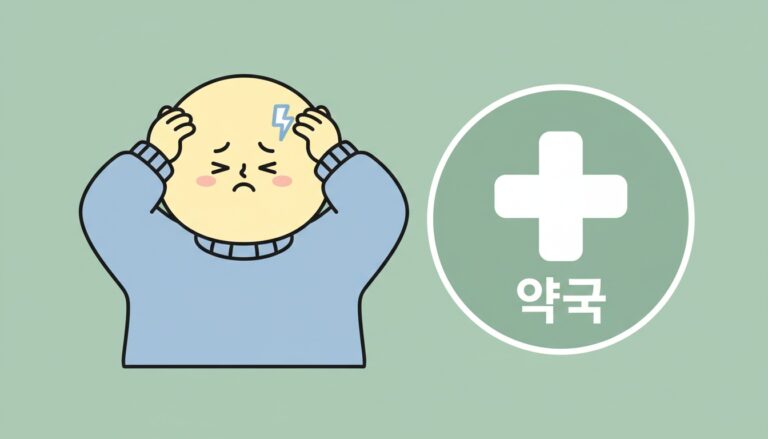
Imagine this: You wake up in your Airbnb in Seoul. Maybe the air conditioner was too strong, or perhaps that spicy tteokbokki last night was a bit too adventurous. Your head is pounding, or your stomach feels like a washing machine. You walk into a pharmacy (called 약국 or Yakguk), and the pharmacist looks at you and asks something in Korean. Panic sets in.
Today, we are going to stop that panic. We are covering the Health & Hospital module, specifically focusing on the Unit: “어디가 아파요?” (Where does it hurt?).
Knowing how to say “It hurts” isn’t just about language; it’s about getting the help you need when you feel vulnerable. As a tutor, I’ve seen students try to mime their symptoms like a game of charades. While cute, it’s not efficient! Let’s learn to say it with confidence.
(Note: This guide is based on real questions from our A1 beginner students who survived the Korean flu season!)
Phase 2: Deep Dive (Core Expressions)
Here are the top 3 expressions you absolutely need. We are keeping it simple (A1 level).
1. 아파요 (It hurts / I’m sick)
- Pronunciation: [apayo] -> “Ah-pah-yo”
- Tip: The ‘Ah’ sounds like when you open your mouth for the dentist.
- Meaning: It hurts / I am in pain.
- Editor’s Insight: This is the magic word. If you forget everything else, just point to your body part and say “Ah-pah-yo.” It works 100% of the time.
- Situation Check: Safe to use with strangers, doctors, and pharmacists (Polite style).
2. [Body Part] + 이/가 아파요 ([Body Part] hurts)
To be specific, you put the body part before “apayo.”
- 머리가 아파요 (Meori-ga apayo) = My head hurts (Headache).
- Pronunciation: “Muh-ree-gah Ah-pah-yo”
- 배가 아파요 (Bae-ga apayo) = My stomach hurts (Stomachache).
- Pronunciation: “Bae-gah Ah-pah-yo” (Bae like ‘Bear’ without the ‘r’)
- 목이 아파요 (Mogi apayo) = My throat/neck hurts.
- Pronunciation: “Moh-gee Ah-pah-yo”
- Editor’s Insight: Don’t stress too much about the particles ‘가 (ga)’ or ‘이 (i)’. If you just say “Meori Apayo,” everyone will understand perfectly.
3. 감기에 걸렸어요 (I caught a cold)
- Pronunciation: [gamgie geollyeosseoyo] -> “Gam-gee-eh Gull-yuh-ssuh-yo”
- Meaning: I caught a cold.
- Editor’s Insight: Koreans take colds seriously. If you sniffle, someone might ask, “Gamgi?” (Cold?). This is your answer.
Phase 3: Textbook vs. Real Life
Textbooks often teach very formal medical terms. Here is how people actually talk at the local clinic.
| Textbook (Robot Style) 🤖 | Real Life (Natural Style) ✨ |
|---|---|
| 복통이 있습니다. (I have abdominal pain.) | 배가 너무 아파요. (My stomach hurts so much.) |
| 두통약을 주세요. (Please give me headache medicine.) | 머리 아픈데 약 주세요. (My head hurts, please give me medicine.) |
| 병원에 가십시오. (Please go to the hospital.) | 병원 가보세요. (You should check out a hospital.) |
Editor’s Note: For A1 beginners, using “너무 (Neomu – very/too)” adds great emphasis. “Neomu apayo!” (It hurts SO much!) gets you sympathy instantly.
Phase 4: Cultural Context & Manners
🚑 The “Hospital” vs. “Pharmacy” Culture
In many Western countries, you go to a GP (General Practitioner) or stick it out at home. In Korea, going to the hospital (병원 – Byeong-won) is very common, even for a light cold. It is affordable and fast.
👀 The “Gesture” Rule
When telling a doctor where it hurts, use your hands.
It sounds obvious, but culturally, Koreans are very visual. Don’t just say “stomach”; rub your stomach. It helps confirm the meaning, especially if your pronunciation isn’t perfect yet.
Phase 5: Roleplay Script
Setting: You walk into a local Pharmacy (약국 – Yakguk). You have a sore throat.
Characters: Jason (You), Pharmacist (Yaksa).
Jason: (Walking in, holding throat) 안녕하세요.
* (An-nyeong-ha-se-yo / Hello.)
Pharmacist: 안녕하세요. 어디가 아파요?
* (Eodi-ga a-pa-yo? / Where does it hurt?)
Jason: 목이 아파요. 너무 아파요.
* (Mogi a-pa-yo. Neomu a-pa-yo. / My throat hurts. It hurts a lot.)
Pharmacist: 아, 알겠습니다. 여기 약 있어요.
* (Ah, al-get-seum-ni-da. Yeogi yak is-seo-yo. / Ah, I see. Here is medicine.)
Jason: (Receiving with two hands) 감사합니다.
* (Gam-sa-ham-ni-da. / Thank you.)
Phase 6: 10-Second Shadowing
Let’s practice the most useful sentence. Read this aloud, pausing at the slashes /.
“선생님, / 저는 / 배가 / 너무 / 아파요.”
(Seon-saeng-nim, / jeo-neun / bae-ga / neomu / apayo.)
Meaning: Doctor, / I / stomach / really / hurt.
Focus: Stress the word “Neomu” (Too/Really) to show urgency!
Phase 7: FAQ & Troubleshooting
Q: Can I say “Appa” instead of “Apayo”?
A: No! “Appa” (아빠) means Dad! “Apayo” (아파요) means It hurts. Be careful, or you might call the doctor “Dad.”
Q: Should I bow when I say I’m sick?
A: A slight nod is always polite in Korea, even when you are sick. But if you are in severe pain, nobody expects you to be perfectly polite!
Phase 8: Wrap-up
One-Liner Summary: When in doubt, point to the body part and say “Apayo” (Ah-pah-yo).
Action Mission: Touch your head, stomach, and knee right now. Say the Korean word for it + “Apayo.” (e.g., “Meori Apayo”). Get your mouth used to the rhythm!
Tell me in the comments: Have you ever gotten sick while traveling? How did you handle it?
Phase 9: Quiz
1. How do you say “Headache” (My head hurts)?
a) Bae-ga apayo
b) Meori-ga apayo
c) Mogi apayo
2. What does “Yakguk” (약국) mean?
a) Hospital
b) School
c) Pharmacy
3. True or False: You should never go to a hospital in Korea for a simple cold.
a) True
b) False (It’s very common and okay!)
(Scroll down for answers)
Answers: 1. (b), 2. (c), 3. (b)
Frequently Asked Questions (FAQ)
Q: What does "아파요 (It hurts / I’m sick)" mean in Korean and how do you pronounce it?
A: In Korean, "아파요 (It hurts / I’m sick)" is pronounced [apayo] and means: a key conversational Korean expression covered in this lesson.







