

Introduction: Joining the “Real” Korean Conversation
Hello, Daily Hangul family! It’s your Senior Editor here.
Today, we are stepping away from K-Drama romances and diving into the real heat of Korean society. If you are aiming for C2 (Advanced) fluency, you can’t just talk about what you ate for lunch. You need to be able to discuss social issues that actually keep Koreans up at night.
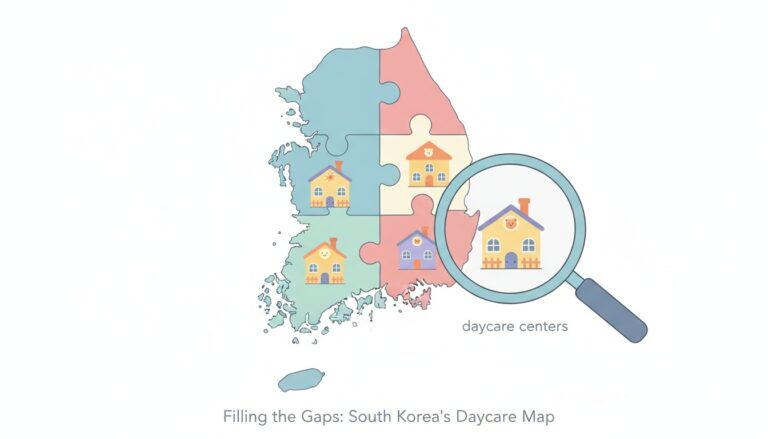
One of the hottest topics? The Childcare Crisis (보육 대란).
Imagine you are watching the 9 PM news with your Korean friends, or discussing why your colleague looks so tired. The topic of “waiting lists for daycare centers” comes up. If you just smile and nod, you remain a foreigner. But if you can sigh and say, “Honestly, getting into a public daycare is harder than plucking a star from the sky,” you instantly become an insider.
This lesson isn’t just about vocabulary; it’s about understanding the deep anxiety and policy debates surrounding Korean families today. These are the words that show you truly understand Korea.
Phase 2: Deep Dive into Key Expressions
Here are the three heavy-hitters you need to discuss welfare policies like a pro.
1. 보육 대란 [Boyuk Daeran]
- Pronunciation: Bo-yuk Dae-ran [Think of ‘Bo’ as in ‘Boat’ without the t, and ‘Ran’ like the first part of ‘Run’ but with an ‘Ah’ sound]
- Meaning: Childcare Crisis / Childcare Chaos
- Editor’s Insight: The word ‘대란’ (Big Chaos/Crisis) is used when a system collapses or faces extreme shortage (e.g., Traffic chaos = 교통 대란). It implies panic. Using this instead of just “problem” (문제) shows you grasp the severity of the situation.
- Situation Check: Formal & Casual. Used in news headlines and angry parent group chats.
2. 국공립 어린이집 확충 [Gukgongnip Eorinijip Hwachung]
- Pronunciation: Guk-gong-nip (The ‘p’ at the end is barely released) Hwa-chung [Hwa like ‘Flower’, Chung like ‘Chewing’ gum]
- Meaning: Expansion of National/Public Daycare Centers
- Editor’s Insight: This is a policy keyword. ‘확충’ (Expansion) is a formal Hanja word used for infrastructure or budget, not for stretching your pants. Koreans prefer ‘National/Public’ (국공립) centers because they are cheaper and perceived as more trustworthy than private ones.
- Situation Check: Formal / Debate / Serious conversation.
3. 하늘의 별 따기 [Haneurui Byeol Ttagi]
- Pronunciation: Ha-neul-ui Byeol Tta-gi [Sounds like: Han-eu-ree Byul Tta-gi]
- Meaning: Plucking a star from the sky (Idiom: Extremely difficult/Impossible)
- Editor’s Insight: This is the perfect idiom for this situation. When something is technically possible but statistically nearly impossible (like winning a lottery or getting a spot in a famous daycare), use this. It adds emotional weight to the statistic.
- Situation Check: All situations (Idiomatic).
Phase 3: Textbook vs. Real Life
At the C2 level, you need to sound like a native speaker discussing politics, not a textbook reading a manifesto.
| Textbook Korean (Correct but stiff) | Real Korean (Natural & Nuanced) |
|---|---|
| 국공립 어린이집에 들어가는 것은 매우 어렵습니다. (It is very difficult to enter a public daycare.) |
국공립 대기 번호 줄어드는 게 아주 함흥차사예요. (The waiting list number moving is practically ‘Hamheungchasa’ [taking forever/no news].) |
| 정부는 보육 시설을 늘려야 합니다. (The government must increase childcare facilities.) |
믿고 맡길 데가 없으니, 확충이 시급하죠. (There’s nowhere to trust, so expansion is urgent.) |
| 경쟁률이 높습니다. (The competition rate is high.) |
경쟁률이 진짜 로또 당첨 수준이라니까요. (I’m telling you, the competition is basically lottery level.) |
Note: ‘함흥차사’ (Hamheungchasa) is a historical idiom referring to a messenger who never returned. Use this when waiting for something that never happens!
Phase 4: Cultural Context & Manners
The “Nunchi” of Parenting Struggles
In Korea, the Low Birth Rate (저출산) is a sensitive national emergency. When discussing this:
- Don’t offer simple solutions. Saying “Just build more schools” sounds naive. Acknowledge the complexity (budget, teachers, real estate).
- Validate the anxiety. If a Korean says they can’t find a daycare, the correct reaction isn’t logic; it’s empathy using the “chaos” terminology. “Wow, is it really that bad? It sounds like a total war (전쟁).”
- Public vs. Private: Understanding the desperation for Gukgongnip (Public) centers is key. It’s not just about money; it’s about the government’s quality control. Showing you know this distinction earns you massive respect.
Phase 5: Roleplay Script
Setting: Two colleagues, Min-ji (Korean) and Alex (Advanced Learner), drinking coffee during a break. Min-ji is worried about her nephew.
(Min-ji looks at her phone and sighs deeply)
Min-ji: 휴, 언니가 조카 어린이집 대기 걸어놨는데, 순번이 100번대래. 말이 돼?
(Sigh, my sister put my nephew on the daycare waiting list, but he’s number 100-something. Does that make sense?)
Alex: 100번대요? 와, 뉴스에서 보육 대란이라고 하더니 진짜네요.
(100-something? Wow, the news called it a childcare crisis, and it’s real.)
Min-ji: 그러니까. 사립은 불안하고, 국공립은 자리가 없고. 진짜 답답하다.
(Exactly. Private ones make us anxious, and public ones have no spots. It’s so frustrating.)
Alex: 맞아요. 정부에서 국공립 어린이집 확충을 계속 한다고는 하는데, 체감하기엔 아직 부족한가 봐요.
(Right. The government keeps saying they are working on the expansion of public daycares, but I guess it doesn’t feel like enough yet.)
Min-ji: 내 말이 그 말이야. 진짜 국공립 들어가는 게 하늘의 별 따기라니까.
(That’s what I’m saying. Getting into a public one is literally plucking a star from the sky.)
Phase 6: 10-Second Shadowing Drill
Read this sentence aloud to practice your C2 flow. Focus on the pause after the particle 는 and 이 to emphasize the subject.
“단순한 지원금보다는 / 부모들이 안심할 수 있는 / 국공립 시설 확충이 / 근본적인 해결책입니다.”
Pronunciation Guide:
* Dan-sun-han ji-won-geum bo-da-neun / (Rather than simple cash handouts)
* Bu-mo-deul-i an-sim-hal su it-neun / (that parents can feel at ease with)
* Guk-gong-nip si-seol hwa-chung-i / (the expansion of public facilities)
* Geun-bon-jeok-in hae-gyeol-chaek im-ni-da. (is the fundamental solution.)
Phase 7: FAQ & Troubleshooting
Q: Can I use the word “확충” (Expansion) for my vocabulary skills?
A: No! That sounds very unnatural. 확충 is used for resources, budget, facilities, or infrastructure. For vocabulary, use 늘리다 (increase) or 확장하다 (expand range).
Q: Is it rude to discuss politics/welfare with a superior?
A: Generally, yes, if you start it. However, if your boss complains about childcare first, using terms like 보육 대란 shows you are well-read and empathetic. It elevates your intellectual image.
Phase 8: Summary & Mission
One-Liner Summary: To sound like a local intellectual, stop saying “hard” and start saying “Childcare Crisis” (보육 대란) and “Expansion” (확충).
Action Mission: Search for “저출산 대책” (Low birth rate measures) on YouTube today. Listen for the word 확충. If you hear it, nod knowingly. You are now part of the conversation.
Have you ever seen a “No Kids Zone” in Korea? Let me know your thoughts on Korean child-rearing culture in the comments!
Phase 9: Pop Quiz
- Which word best fills the blank? “Trying to get a taxi in Gangnam on Friday night is _______.”
A) 국공립 (National/Public)
B) 확충 (Expansion)
C) 하늘의 별 따기 (Plucking a star) -
What does ‘보육 대란’ mean?
A) Childcare Center
B) Childcare Crisis/Chaos
C) Childcare Teacher -
True or False: The word ‘확충’ is commonly used when you want to expand your group of friends.
A) True
B) False
Click to see answers
1. C, 2. B, 3. B (False – use it for facilities/infrastructure!)
Frequently Asked Questions (FAQ)
Q: What does "보육 대란 [Boyuk Daeran]" mean in Korean and how do you pronounce it?
A: In Korean, "보육 대란 [Boyuk Daeran]" is pronounced [Bo-yuk Dae-ran [Think of 'Bo' as in 'Boat' without the t, and 'Ran' like the first part of 'Run' but with an 'Ah' sound] and means: Childcare Crisis / Childcare Chaos
Q: What does "국공립 어린이집 확충 [Gukgongnip Eorinijip Hwachung]" mean in Korean and how do you pronounce it?
A: In Korean, "국공립 어린이집 확충 [Gukgongnip Eorinijip Hwachung]" is pronounced [Guk-gong-nip (The 'p' at the end is barely released] and means: Expansion of National/Public Daycare Centers
Q: What does "하늘의 별 따기 [Haneurui Byeol Ttagi]" mean in Korean and how do you pronounce it?
A: In Korean, "하늘의 별 따기 [Haneurui Byeol Ttagi]" is pronounced [Ha-neul-ui Byeol Tta-gi [Sounds like: Han-eu-ree Byul Tta-gi] and means: Plucking a star from the sky (Idiom: Extremely difficult/Impossible)







