

Phase 1: Introduction (Introduction)
Hello! This is your Daily Hangul Editor.
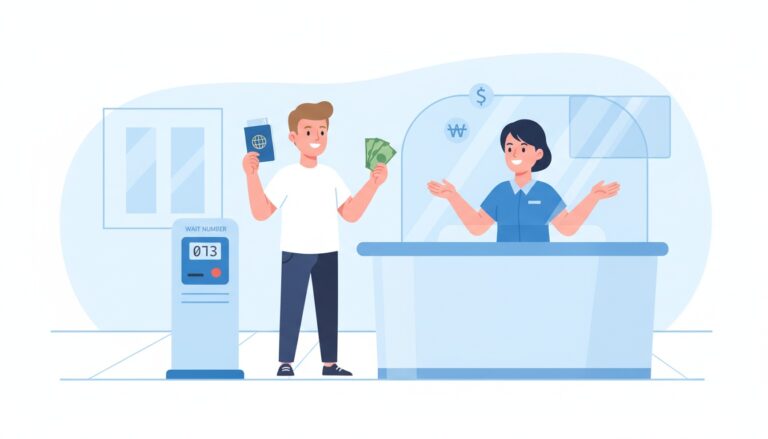
Walking into a bank is stressful enough in your home country, right? Now imagine walking into a Korean bank where dozens of screens are blinking, numbers are dinging, and everyone is moving fast. You are clutching your Dollars or Euros, desperately needing Korean Won (KRW) to buy that delicious street food (Tteokbokki) you saw outside.
Don’t panic! Many beginners freeze up here, simply handing over money silently. But today, I will teach you the “magic words” that will make the bank teller smile and treat you like a pro. This isn’t just about changing money; it’s about confidence.
Note: This guide is based on real questions from our students who got stuck at the bank entrance!
Phase 2: Deep Dive (Core Expressions)
Here are the absolute essentials. If you remember nothing else, remember these three.
1. 환전하러 왔어요 (I came to exchange money)
- Pronunciation: [Hwan-jeon-ha-reo wa-sseo-yo]
- Sound Analogy: Hwan (sounds like ‘Juan’) + Jeon (sounds like ‘John’) + Ha-reo (ha-ruh) + Wa-sseo-yo (wah-sso-yo).
- Meaning: “I came for currency exchange.”
- Editor’s Insight: This is the most standard, polite way to explain your purpose. The word 환전 (Hwan-jeon) means “Exchange money.”
- Situation Check: Formal & Polite. Perfect for the security guard or the teller.
2. 여권 (Passport)
- Pronunciation: [Yeo-gwon]
- Sound Analogy: Yeo (sounds like ‘Yuh’, a slangy ‘yes’) + Gwon (sounds like Tae-kwon-do).
- Meaning: Passport.
- Editor’s Insight: You cannot exchange currency in Korea without an ID. The teller will 100% ask for this. If you hear “Yeo-gwon,” hand it over immediately!
- Situation Check: Essential noun.
3. 번호표 (Number Ticket)
- Pronunciation: [Beon-ho-pyo]
- Sound Analogy: Beon (like ‘Bun’ in hamburger) + Ho (like Santa’s ‘Ho’) + Pyo (like ‘Pyo’ in Pyongyang).
- Meaning: Number ticket / Queue ticket.
- Editor’s Insight: In Korean banks, you don’t just line up. You must pull a ticket from a machine near the door. The security guard might point and say this word.
- Situation Check: Noun.
Phase 3: Textbook vs. Real Life
Textbooks are safe, but sometimes they sound like a robot. Here is how actual Koreans speak at the bank.
| Textbook (Formal) | Real Life (Natural) | Note |
|---|---|---|
| 돈을 바꾸고 싶습니다. (I want to change money.) |
환전 좀 하려고요. (I’m here to do a little exchange.) |
The textbook version is grammatically correct but feels stiff. |
| 미국 달러를 한국 원으로 바꿔주세요. (Please change USD to KRW.) |
이거 원화로 바꿔주세요. (Please change this to Won.) |
Just showing the money (“this”) is much faster! |
Editor’s Note: As an A1 beginner, saying just “환전 (Hwan-jeon)” while smiling is perfectly acceptable too!
Phase 4: Cultural Context (Manners & Nunchi)
1. The Gatekeeper (The Security Guard)
In Korean banks (은행 – Eun-haeng), there is usually a security guard (Cheongwon-gyeongchal) standing right at the entrance. They are not there to arrest you! They are there to help.
* Tip: Don’t walk past them. Look at them. They will likely ask what you need. Just say “Hwan-jeon” (Exchange). They will press the button on the machine and hand you the 번호표 (Number ticket).
2. The “Ding-Dong” Sound
Sit and wait. Do not approach the counter until your number appears on the screen with a loud “Ding-Dong” sound. Korean banking culture values efficiency and order.
Phase 5: Real Roleplay (Scenario)
Setting: A bank branch in Myeongdong.
Characters: Jason (Tourist) and Teller (Bank Staff).
Jason: (Approaching the counter after his number is called)
안녕하세요. 환전하러 왔어요.
[An-nyeong-ha-se-yo. Hwan-jeon-ha-reo wa-sseo-yo.]
(Hello. I came to exchange money.)
Teller: 네, 달러세요?
[Ne, Dal-leo-se-yo?]
(Yes, is it Dollars?)
Jason: 네. (Handing over money)
Teller: 여권 주시겠어요?
[Yeo-gwon ju-si-ge-sseo-yo?]
(Can you give me your passport?)
Jason: (Handing passport with two hands)
여기요.
[Yeo-gi-yo.]
(Here it is.)
Teller: 네, 잠시만요… 여기 있습니다.
[Ne, jam-si-man-yo… Yeo-gi it-sseum-ni-da.]
(Okay, one moment… Here you go.)
Phase 6: 10-Second Shadowing
Let’s practice the most useful sentence. Read this aloud for 10 seconds. Focus on the pauses!
환전 / 좀 / 도와주세요.
[Hwan-jeon / jom / do-wa-ju-se-yo]
(Please help me with exchange.)
- Key Point: Put a slight stress on Hwan-jeon. The rest can be softer.
Phase 7: FAQ & Troubleshooting
- Q: Do I need a Korean bank account to exchange money?
- A: No! As a tourist, you just need your passport and cash.
- Q: Can I use this phrase at the airport too?
- A: Yes! It works at airport exchange counters, hotel front desks, and city banks.
- Q: Can I exchange coins?
- A: Usually, no. Banks typically only accept paper bills for exchange. Spend your coins before leaving home!
Phase 8: Wrap-up
Today’s Summary:
To get Korean money, go to the bank and say “Hwan-jeon” (Exchange) and have your “Yeo-gwon” (Passport) ready.
Your Mission:
If you are in Korea, spot a bank sign today. Look for the English words “Foreign Exchange.” Even if you don’t go in, practice saying “Hwan-jeon-ha-reo wa-sseo-yo” in your head as you walk by!
Have you ever struggled with money exchange abroad? Tell me your story in the comments!
Phase 9: Pop Quiz
1. What does the bank teller need to see to exchange your money?
A) Your Instagram
B) Yeo-gwon (Passport)
C) Your hotel key
2. Which word means “Exchange Money”?
A) Hwan-jeon
B) Hwan-ja (Patient)
C) Un-jeon (Driving)
3. True or False: You should walk directly to the counter without a ticket.
A) True
B) False
(Answers: 1-B, 2-A, 3-B)
Frequently Asked Questions (FAQ)
Q: What does "환전하러 왔어요 (I came to exchange money)" mean in Korean and how do you pronounce it?
A: In Korean, "환전하러 왔어요 (I came to exchange money)" is pronounced [Hwan-jeon-ha-reo wa-sseo-yo] and means: "I came for currency exchange."
Q: What does "여권 (Passport)" mean in Korean and how do you pronounce it?
A: In Korean, "여권 (Passport)" is pronounced [Yeo-gwon] and means: Passport.
Q: What does "번호표 (Number Ticket)" mean in Korean and how do you pronounce it?
A: In Korean, "번호표 (Number Ticket)" is pronounced [Beon-ho-pyo] and means: Number ticket / Queue ticket.







