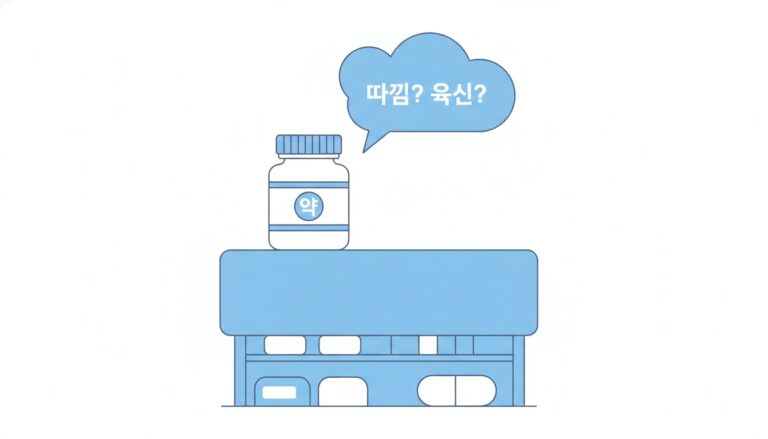
안녕하세요! This is your Daily Hangul Editor.
Have you ever stood in front of a Korean pharmacist, pointing at your stomach and just repeating “아파요 (Apayo – It hurts)”? 😰
We’ve all been there. But here’s the truth: In Korea, saying “it hurts” is like going to a restaurant and ordering “food.” It’s too vague! Korean has a incredibly rich vocabulary for pain (often based on sound symbolism), and using the wrong word might get you a digestion pill when you actually have gastritis.
Today, we are leveling up your medical Korean from Survival (A1) to fluent Patient (B2). By the end of this post, you’ll be able to tell the doctor exactly how it hurts, ensuring you get the right care.
Phase 2: Deep Dive into Pain Expressions (B2 Level)
At the intermediate level, we stop using generic words and start describing the texture of the pain.
1. 욱신거리다 (Uksin-georida)
- Pronunciation: [Uk-sin-geo-ri-da]
- Sound Analogy: Think of a deep, heavy bass beat: Uk-sin, Uk-sin.
- Meaning: Throbbing, aching (usually with a pulse).
- Editor’s Insight: Use this for toothaches, inflamed wounds, or muscle pain where you can feel your heartbeat in the pain. It implies a deep, heavy ache rather than a sharp surface cut.
- Situation Check: 🏥 Medical / 💬 Casual
2. 따끔하다 (Ttakkeum-hada)
- Pronunciation: [Tta-kkeum-ha-da]
- Sound Analogy: The ‘Tt’ is a sharp, popping sound. Like a needle prick.
- Meaning: Stinging, pricking, smarting.
- Editor’s Insight: This is perfect for a sore throat (when swallowing feels like glass), a paper cut, or when the doctor gives you an injection.
- Situation Check: 🏥 Medical / 💬 Casual
3. 속이 쓰리다 (Sogi sseurida)
- Pronunciation: [So-gi sseu-ri-da]
- Meaning: To have heartburn / burning sensation in the stomach.
- Editor’s Insight: Do not say “배가 아파요” (stomach hurts) for this. “쓰리다” specifically means that burning, raw feeling you get when you’re hungry, stressed, or ate too much spicy tteokbokki. It’s essential for pharmacy visits.
- Situation Check: 🏥 Medical / 💬 Casual
Phase 3: Textbook vs. Real Life
Textbooks teach you to be correct. We teach you to be understood instantly.
| Textbook Korean (Standard) | Real Korean (Natural & Specific) |
|---|---|
| 목이 아파요. (My throat hurts.) | 침 삼킬 때마다 목이 따끔거려요. (My throat stings every time I swallow.) |
| 이가 아파요. (My tooth hurts.) | 이가 계속 욱신거려요. (My tooth keeps throbbing.) |
| 배가 아파요. (My stomach hurts.) | 위가 콕콕 쑤셔요. (My stomach feels like it’s being poked with a needle.) |
- Editor’s Note: At B2 level, try to combine the action (swallowing) with the sensation (stinging).
Phase 4: Cultural Context – The Art of “Eom-sal” (엄살)
In Korea, describing symptoms involves a lot of Onomatopoeia (Sound words). Doctors actually expect this!
Also, be aware of “몸살 (Mom-sal)”. This is a unique Korean concept roughly translating to “body ache from fatigue or a cold.” If you say “몸살 기운이 있어요” (I have ‘momsal’ energy/feeling), the pharmacist understands immediately: you are overworked, shivering, and your whole body aches. It generates instant sympathy!
Manner Tip: When receiving medicine or a prescription, always receive it with two hands. Even if you are sick, showing respect (politeness) is hardwired into the culture.
Phase 5: Roleplay Script (At the Pharmacy)
- Setting: A pharmacy (약국 – Yakguk) near a subway station.
- Characters: Min-ji (Foreigner, B2 level), Pharmacist (Korean).
Min-ji: (Walking in looking tired)
안녕하세요, 약사님. 감기약 좀 주세요.
(Hello, pharmacist. Please give me some cold medicine.)
Pharmacist:
어디가 제일 불편하세요? 열도 있나요?
(Where is the most uncomfortable? Do you have a fever too?)
Min-ji: (Rubbing her neck)
열은 없는데, 목이 너무 따끔거리고 온몸이 욱신거려요.
(I don’t have a fever, but my throat really stings and my whole body creates a throbbing ache.)
Pharmacist:
아, 몸살 감기네요. 진통제랑 같이 드릴게요.
(Ah, it’s ‘momsal’ cold. I’ll give you painkillers with it.)
Phase 6: 10-Second Shadowing Drill
Read this aloud to practice intonation. Focus on the pause after the condition.
“침을 삼킬 때마다 / 목이 따끔거려서 / 잠을 못 잤어요.”
(Every time I swallow / my throat stings so / I couldn’t sleep.)Chim-eul sam-kil ttae-ma-da / mo-gi tta-kkeum-geo-ryeo-seo / ja-meul mot ja-sseo-yo.
Phase 7: FAQ & Troubleshooting
- Q: Can I use these “sound words” (prick, throb) with a doctor?
- A: YES! Absolutely. Doctors prefer “It feels like needles (콕콕 쑤셔요)” over a vague “It hurts.” It helps diagnosis significantly.
- Q: What if I forget the specific word?
- A: Use gestures! If it’s a squeezing pain, clench your fist over the area. If it’s a stinging pain, make a poking motion. But today, try to use 따끔 (sting) or 욱신 (throb)!
Phase 8: Wrap-up & Mission
One-Liner Summary:
Stop saying “Apayo” for everything; use 욱신거리다 for deep aches and 따끔하다 for surface stinging.
🔥 Today’s Mission:
Check your medicine cabinet. If you have any Korean ointments (like Fucidin or Madecassol), look at the box. Does it say 상처 (wound)? Imagine explaining why you need it using “따끔거려요!”
Have you ever had a funny misunderstanding at a Korean hospital? Tell me in the comments!
Phase 9: Pop Quiz
1. Which expression best describes the feeling of a paper cut or a sore throat?
a) 욱신거려요 (Uksin-georyeoyo)
b) 따끔거려요 (Ttakkeum-georyeoyo)
c) 시원해요 (Siwonhaeyo)
2. You ate too much spicy food and your stomach burns. You say:
a) 속이 쓰려요 (Sogi sseuryeoyo)
b) 다리가 아파요 (Dariga apayo)
c) 머리가 띵해요 (Meoriga ttinghaeyo)
3. What is the unique Korean term for “body ache from severe fatigue/cold”?
a) 몸살 (Momsal)
b) 엄살 (Eomsal)
c) 뱃살 (Baetsal)
(Answers: 1. b, 2. a, 3. a)
Frequently Asked Questions (FAQ)
Q: What does "욱신거리다 (Uksin-georida)" mean in Korean and how do you pronounce it?
A: In Korean, "욱신거리다 (Uksin-georida)" is pronounced [Uk-sin-geo-ri-da] and means: a key conversational Korean expression covered in this lesson.
Q: What does "따끔하다 (Ttakkeum-hada)" mean in Korean and how do you pronounce it?
A: In Korean, "따끔하다 (Ttakkeum-hada)" is pronounced [Tta-kkeum-ha-da] and means: a key conversational Korean expression covered in this lesson.
Q: What does "속이 쓰리다 (Sogi sseurida)" mean in Korean and how do you pronounce it?
A: In Korean, "속이 쓰리다 (Sogi sseurida)" is pronounced [So-gi sseu-ri-da] and means: To have heartburn / burning sensation in the stomach.