

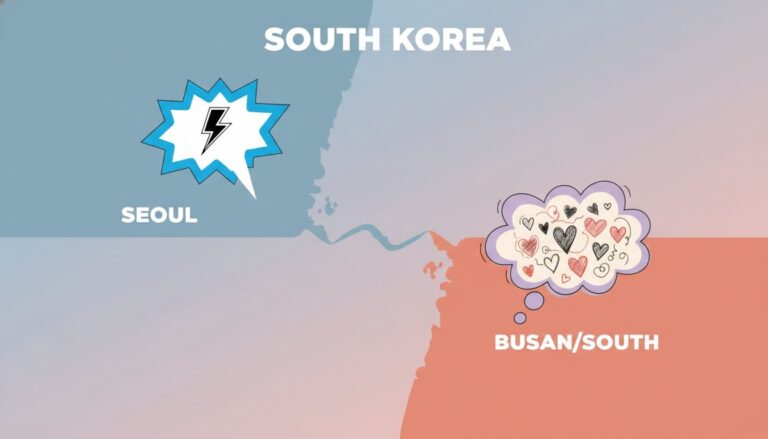
K-Drama Swear Words: Why a “Curse” in Busan Can Be a Sign of Love
Phase 1: Introduction
Hello! It’s your Daily Hangul Chief Editor.
Have you ever watched a Korean movie like Friend (친구) or a drama set in the countryside and felt confused? The subtitles say [Curses] or [Damn it], but the characters seem… happy? Or maybe they are crying while hugging?
Here is the truth: In Korea, not all swear words are created equal.
At the B2 (Intermediate) level, you need to understand the temperature of the language. Standard Seoul swearing is often sharp, cold, and aggressive. However, Dialect (Satoori) swearing—especially from Gyeongsang or Jeolla provinces—can sometimes carry a nuance of intimacy, frustration, or even deep affection, commonly known as Jeong (정).
Today, we are decoding the nuance difference between Standard Korean swearing and Dialect swearing. This is the stuff textbooks won’t teach you, but your Korean friends will be shocked you know.
Phase 2: Deep Dive (Core Expressions)
Here are three expressions that show the drastic difference between “Standard” and “Dialect” vibes.
1. 씨발 (Ssibal) – The Standard Standard
- Pronunciation: [Ssibal] (Sound analogy: A sharp hiss like a snake, followed by ‘bal’)
- Meaning: Fuck / Damn it (Literal: To copulate)
- Editor’s Insight: This is the “Kimchi of Swear Words”—it’s everywhere. In Seoul (Standard), it is used as a punctuation mark for anger. It feels sharp, direct, and often aggressive. If you hear this in a quiet tone in Seoul, run.
- Situation Check: 🔴 Anger/Frustration (Avoid using unless extremely close or alone).
2. 문디 / 문디 가시나 (Mundi / Mundi Gasina) – Gyeongsang Dialect
- Pronunciation: [Moon-dee] (The ‘Mun’ is short and blunt)
- Meaning: Leper / Dummy (Literal: Historical term for a person with leprosy, but evolved)
- Editor’s Insight: If you translate this literally, it’s horrific. But in Gyeongsang-do (Busan, Daegu), if a grandmother says this to her granddaughter (“Aigo, Mundi gasina!”), it means “Oh, you silly/lovely little rascal.” It is rough but full of affection.
- Situation Check: 🟡 Intimate/Affectionate (Used mostly by older generations to younger ones, or very close friends).
3. 염병 (Yeombyeong) – Jeolla Dialect
- Pronunciation: [Yeom-byeong] (Stress the ‘Yeom’ heavily)
- Meaning: To catch typhoid fever / To screw up
- Editor’s Insight: In Jeolla province, this acts like a “power-up” adjective. It emphasizes a situation. While it can be an insult, it’s often used to express extreme frustration at a situation rather than a person. It has a rhythmic, singing quality in the Jeolla dialect.
- Situation Check: 🟠 Rough Emphasis (Very common in movies; sounds earthy and rugged).
Phase 3: Textbook vs. Real Life (Nuance Check)
Let’s see how a “Textbook” insult transforms into real street talk.
| Textbook (Standard) | Real Life (Seoul Slang) | Real Life (Dialect Nuance) |
|---|---|---|
| 바보 (Babo) (Fool/Dummy – Very mild) |
멍청이 / 븅신 (Meongcheong-i / Byung-sin) (Idiot / Moron – Sharper) |
빙시 / 등신 (Bingsi / Deung-sin) (Half-wit – Often sounds friendlier in Satoori context) |
| 죽을래? (Jugeullae?) (Do you want to die?) |
뒤지고 싶냐? (Dwijigo simnya?) (Wanna drop dead? – Aggressive) |
주 디 뜯기나? (Judi tteutgina?) (Wanna get your mouth ripped? – Gyeongsang slang, very descriptive) |
Note: Byung-sin (Standard) is very offensive regarding disability. Bingsi (Dialect variation) is still offensive, but between close Busan friends, it often functions like “You idiot~” when a friend makes a funny mistake.
Phase 4: Cultural Context & Manners
The “Swearing Grandma” (욕쟁이 할머니)
In Korea, there is a famous restaurant concept called “Yok-jaeng-i Halmeoni” (Swearing Grandma). Why would people pay to eat where the owner swears at them?
It represents authenticity. Standard polite Korean (Seoul style) can sometimes feel distant or cold. A grandmother screaming, “Just eat the damn soup, you skinny thing!” in a thick dialect feels like a mother’s worry.
- The Rule of Eye Contact: When using standard swear words in anger, Koreans glare. But when using dialect swearing for affection, the eyes are often smiling or looking away casually.
Phase 5: Roleplay Script
Situation: Cheol-su (from Busan) is comforting his friend Min-ho (Standard speaker) who just failed a test.
(Cheol-su slaps Min-ho’s back hard)
- Cheol-su: 야 임마! 문디 자슥아, 고개 좀 들어라.
- (Ya imma! Mundi jaseug-a, gogae jom deureora.)
- “Hey dude! You silly rascal, lift your head up.”
- Min-ho: 아… 시험 완전히 망쳤어. 나 진짜 바본가 봐.
- (Ah… Siheom wanjeonhi mangchyeosseo. Na jinjja babon-ga bwa.)
- “Ah… I completely ruined the test. I guess I really am a fool.”
- Cheol-su: 아이고, 등신아! 술이나 한잔 하러 가자. 잊어삐라!
- (Aigo, deungsin-a! Sur-ina hanjan hareogaja. Ijeoppira!)
- “Oh, you moron (affectionate)! Let’s just go get a drink. Forget about it!”
- Min-ho: (Laughing) 욕 좀 그만해.
- (Yok jom geumanhae.)
- “Stop swearing at me.”
Phase 6: 10-Second Shadowing
Practice the intonation change. Standard is flat/falling. Dialect is wavy.
Sentence: “Oh, you idiot!” (Affectionate Busan Style)
Korean: 아이고 / 문디 / 자슥아!
Pronunciation: Ai-go / Mun-di / Ja-seug-a!Tip:
* Ai-go: Start high, drop low.
* Mun-di: Sharp accent on ‘Mun’.
* Ja-seug-a: Drag the end slightly (~aa).
Phase 7: FAQ (Troubleshooting)
- Q: Can I use “Mundi” or “Gasina” to my Korean friends?
- A: Maybe. If they are from Gyeongsang-do and you are very close, they might find it cute or funny coming from a foreigner. If they are from Seoul, they might just be confused. Never use it on strangers.
- Q: Is “Ssibal” ever acceptable?
- A: For a B2 learner, strictly speaking, no. You will hear it constantly, but using it carries a risk of sounding uneducated or overly aggressive. Stick to “Aish!” (아이씨!) which is the safer, frustration-only version.
Phase 8: Summary & Action
- One-Liner: Standard swearing expresses anger, but Dialect swearing often expresses intimacy (Jeong).
- Mission: Watch the movie “Friend” (Chingu) or the drama “Reply 1994”. Try to catch the word “Mundi” or “Yeombyeong” and see the facial expression of the speaker. Is it hate? Or is it love?
Phase 9: Quiz
- Which word is a Gyeongsang dialect term that literally means “Leper” but is used affectionately?
- a) Ssibal
- b) Mundi
- c) Babo
- If a “Yok-jaeng-i Halmeoni” (Swearing Grandma) swears at you while serving food, what does it likely mean?
- a) She hates foreigners.
- b) She wants you to leave.
- c) It is a sign of rough affection and authenticity.
- To whom can you use these dialect swear words?
- a) Your boss.
- b) A police officer.
- c) A very close friend from that region.
(Answers: 1-b, 2-c, 3-c)
Frequently Asked Questions (FAQ)
Q: What does "씨발 (Ssibal) - The Standard Standard" mean in Korean and how do you pronounce it?
A: In Korean, "씨발 (Ssibal) - The Standard Standard" is pronounced [Ssibal] and means: Fuck / Damn it (Literal: To copulate)
Q: What does "문디 / 문디 가시나 (Mundi / Mundi Gasina) - Gyeongsang Dialect" mean in Korean and how do you pronounce it?
A: In Korean, "문디 / 문디 가시나 (Mundi / Mundi Gasina) - Gyeongsang Dialect" is pronounced [Moon-dee] and means: Leper / Dummy (Literal: Historical term for a person with leprosy, but evolved)
Q: What does "염병 (Yeombyeong) - Jeolla Dialect" mean in Korean and how do you pronounce it?
A: In Korean, "염병 (Yeombyeong) - Jeolla Dialect" is pronounced [Yeom-byeong] and means: To catch typhoid fever / To screw up







