

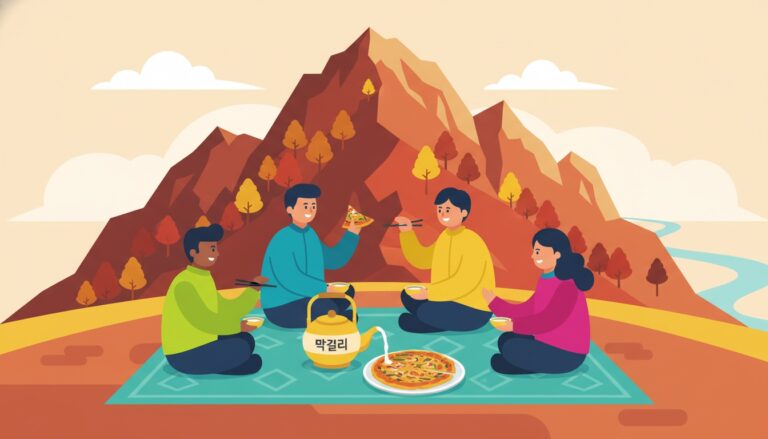
Phase 1: Introduction
안녕하세요! It’s your editor from Daily Hangul. 👋
So, you’ve decided to brave the Korean mountains. You might think, “It’s just walking uphill, right?” But let me tell you, hiking in Korea (등산 – Deungsan) is not just a sport; it is a full-blown social phenomenon, a fashion runway, and—most importantly—a gastronomic tour.
Imagine this: You join a local Hiking Club (산악회 – Sanakhoe) or a younger Running/Hiking Crew. You show up in sweatpants, but everyone else looks like they are about to conquer Everest in neon-colored gear. Then, someone hands you a cucumber. Suddenly, everyone is shouting “Fighting!”
If you don’t know the specific lingo used in these groups, you might feel like an outsider even if you reach the peak first. Today, we’re going to learn the B2-level expressions that will make you not just a foreign hiker, but a beloved member of the team. Let’s get you ready for the hike—and the party after!
Phase 2: Deep Dive into Key Expressions
Here are the three phrases that will earn you immediate respect in any hiking group.
1. 뒤풀이 (Dwipuri)
- Pronunciation: [Dwi-pu-ri] (Sounds like ‘Dwee-poo-ree’)
- Meaning: After-party / Post-activity gathering
- Editor’s Insight: In Western hiking culture, you might high-five and go home. In Korea? The hike is just the appetizer. The main course is the Dwipuri, usually involving Pajeon (green onion pancakes) and Makgeolli (rice wine). If you ask about this first, you’re instantly an insider.
- Situation Check: Casual ✅ | Formal ✅ (Used in business dinners too)
2. 민폐 끼치다 (Minpye kkichida)
- Pronunciation: [Min-pye kki-chi-da]
- Meaning: To cause a nuisance / To be a burden / To inconvenience others
- Editor’s Insight: Koreans value group harmony. If you are slower than the group, you might feel anxious. Using this phrase shows you have high emotional intelligence. It disarms people instantly because you are acknowledging the group’s pace.
- Situation Check: Very polite. Use this when you are lagging behind.
3. 당 충전 (Dang chungjeon)
- Pronunciation: [Dang chung-jeon]
- Meaning: Sugar recharge / Sugar rush
- Editor’s Insight: Halfway up the mountain, energy drops. This is when Koreans pass around chocolate, candy, or fruit. Instead of saying “I’m hungry,” say “I need a sugar recharge!” It sounds cute, energetic, and native.
- Situation Check: Casual ✅ | Friends ✅
Phase 3: Textbook vs. Real Life
Let’s upgrade your Korean from “Classroom Robot” to “Hiking Pro.”
| Textbook Korean (A bit stiff) | Real Korean (Natural & Cool) |
|---|---|
| 등산을 합시다. (Let’s hike.) | 산 타러 가요! (Let’s go ride/climb the mountain!) |
| 정상에 도착했어요. (We arrived at the peak.) | 정상 찍었다! (We hit/tagged the peak!) |
| 음식을 같이 먹어요. (Let’s eat food together.) | 간식 좀 나눠 먹어요. (Let’s share some snacks.) |
| 술을 마시러 갑시다. (Let’s go drink alcohol.) | 막걸리 한잔해야죠? (We gotta have a cup of Makgeolli, right?) |
💡 Bottom Note: At a B2 level, try using verbs like 타다 (to ride/climb) or 찍다 (to stamp/tag) instead of just 가다 (to go). It adds dynamism to your speech!
Phase 4: Cultural Context & Manners 🏔️
1. The “Sharing” Culture (Nunchi is Key!)
In a hiking club, never bring food just for yourself. If you bring a chocolate bar, bring a bag of mini-chocolates to share. When you reach a rest spot, open your pack and say, “드실 분?” (Anyone want some?). This is the fastest way to make friends.
2. Sanakhoe (산악회) vs. Crews
* Sanakhoe: Usually older crowd (40s-60s). Heavy drinking at the Dwipuri is common. Expect bright, colorful gear.
* Crew: Younger crowd (20s-30s). More focus on photography for Instagram and “healthy” vibes. Leggings are common here.
3. Music Etiquette
Some older hikers play trot music on loud Bluetooth speakers. As a younger member or foreigner, it’s polite not to complain openly, but do not do this yourself unless you want dirty looks from everyone else!
Phase 5: Roleplay Script 🎬
Setting: Rest stop halfway up Bukhansan Mountain.
Characters: Alex (Foreigner, B2 level) and Minji (Korean Club Member).
(Alex is panting heavily, leaning on a rock)
Alex: 아, 진짜 힘드네요. 제가 너무 늦어서 민폐 끼치는 거 아니에요?
(Ah, this is really hard. I hope I’m not being a burden because I’m so slow?)
Minji: 에이, 아니에요! 천천히 와도 돼요. 자, 여기 오이 좀 드세요. 당 충전 좀 해야죠.
(Ey, not at all! You can come slowly. Here, have some cucumber. You need a sugar recharge.)
Alex: (Taking the cucumber) 와, 감사합니다! 이거 먹고 힘내서 정상 찍고, 내려가서 뒤풀이 가야죠!
(Wow, thanks! I’ll eat this, gain strength to hit the peak, and then we have to go to the after-party!)
Minji: (Laughing) 맞아요! 오늘 파전에 막걸리 예약해 놨으니까 조금만 더 힘내요!
(Right! I reserved Pajeon and Makgeolli for today, so cheer up a little more!)
Phase 6: 10-Second Shadowing 🗣️
Practice this sentence to sound like a motivated team player!
“조금만 더 힘내서 / 정상 찍고 / 시원하게 막걸리 한잔하러 가요!”
- Breakdown: Jo-geum-man deo him-nae-seo / jeong-sang jjik-go / si-won-ha-ge mak-geol-li han-jan-ha-reo ga-yo!
- Meaning: Let’s cheer up a little more, hit the peak, and go for a refreshing cup of Makgeolli!
- Focus: Emphasize “Jjik-go” (snap/hit) and “Si-won-ha-ge” (refreshingly).
Phase 7: FAQ & Troubleshooting
Q: Can I refuse alcohol at the Dwipuri?
A: Yes! While drinking is a big part of hiking culture, forced drinking is disappearing (especially in younger crews). You can say: “전 오늘 사이다 마실게요! 분위기에 취하겠습니다!” (I’ll drink Sprite today! I’ll get drunk on the atmosphere!). This is a very witty B2 way to decline.
Q: Should I say hello to strangers on the mountain?
A: Yes! It is custom to nod or say “안녕하세요” or “수고하십니다” (You are working hard/Keep it up) to hikers passing by. It’s very friendly.
Phase 8: Wrap-up
- One-Liner Summary: Hiking in Korea is 30% walking, 30% sharing snacks, and 40% eating Pajeon at the Dwipuri.
- Action Mission: Next time you are physically tired with a friend, try saying, “나 당 충전이 필요해!” (I need a sugar recharge!) instead of just saying you are hungry.
Have you ever been hiking in Korea? What was your favorite snack on the mountain? Tell us in the comments! 👇
Phase 9: Quiz 📝
1. What is the Korean word for the “After-party” following a hike?
a) 앞풀이 (Appuri)
b) 뒤풀이 (Dwipuri)
c) 옆풀이 (Yeoppuri)
2. You want to politely express worry that you are slowing the group down. What do you say?
a) 나 때문에 민폐 끼치는 것 같아요. (I think I’m being a nuisance.)
b) 너네 왜 이렇게 빨라? (Why are you guys so fast?)
c) 나 먼저 갈게. (I’ll go first.)
3. Which verb makes you sound like a pro when talking about reaching the peak?
a) 가다 (To go)
b) 보다 (To see)
c) 찍다 (To hit/tag)
(Answers: 1-b, 2-a, 3-c)
Frequently Asked Questions (FAQ)
Q: What does "뒤풀이 (Dwipuri)" mean in Korean and how do you pronounce it?
A: In Korean, "뒤풀이 (Dwipuri)" is pronounced [Dwi-pu-ri] and means: After-party / Post-activity gathering
Q: What does "민폐 끼치다 (Minpye kkichida)" mean in Korean and how do you pronounce it?
A: In Korean, "민폐 끼치다 (Minpye kkichida)" is pronounced [Min-pye kki-chi-da] and means: To cause a nuisance / To be a burden / To inconvenience others
Q: What does "당 충전 (Dang chungjeon)" mean in Korean and how do you pronounce it?
A: In Korean, "당 충전 (Dang chungjeon)" is pronounced [Dang chung-jeon] and means: Sugar recharge / Sugar rush







