

Hello! This is your Daily Hangul Editor.
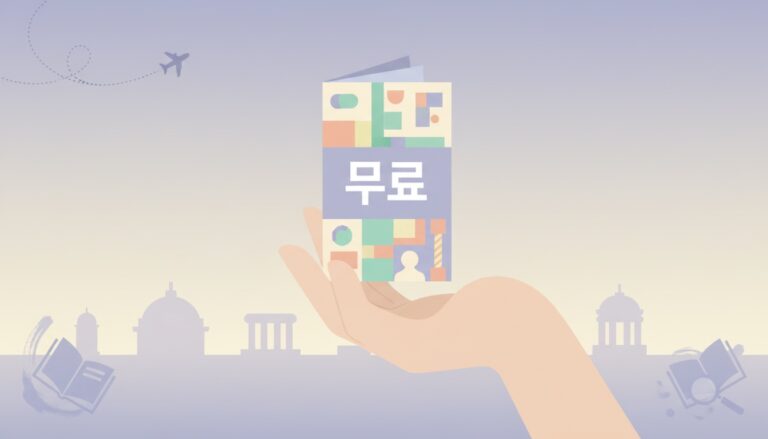
Have you ever stood in front of a stack of beautiful brochures at the National Museum of Korea, frozen in hesitation? You want to take one, but a little voice inside your head asks, “Is this free? Or will the security guard yell at me if I touch it?”
Or maybe you grabbed one, only to realize it’s entirely in Korean, and you’re too shy to go back to the desk and ask, “Do you have this in English?”
Don’t worry. This is a classic struggle for travelers and expats. Today, we are going to learn the simple, polite phrases you need to get that guide map without any awkwardness. As a tutor who has watched many students struggle with this, I promise: these three phrases are all you need to look like a pro.
Phase 1: Deep Dive (Key Expressions)
Here are the top 3 phrases you will need at the information desk.
1. 이거 가져가도 돼요? (Can I take this?)
- Pronunciation: [I-geo ga-jyeo-ga-do dwae-yo?]
- Sounds like: Ee-guh (like ‘ea’ in eagle) + ga-juh (ga + just) + ga-do + dweh-yo?
- Meaning: Literally “This / take / is it okay?”
- Editor’s Insight: This is the magic sentence. You can use this for brochures, free stickers, or even napkins at a cafe. It is polite but friendly.
- Situation Check: ✅ Staff (Polite) | ✅ Friend (Casual – remove ‘yo’)
2. 영어 팜플렛 있어요? (Do you have an English pamphlet?)
- Pronunciation: [Yeong-eo pam-peul-let i-sseo-yo?]
- Sounds like: Young-uh + Pam-peul-let (Konglish!) + ee-ssuh-yo?
- Meaning: “English pamphlet / do you have?”
- Editor’s Insight: Koreans use the word “Pamphlet” (팜플렛) or “Brochure” (브로슈어) very often. Don’t worry about perfect Korean pronunciation for “Pamphlet”—they will understand the English word!
- Situation Check: ✅ Staff (Polite)
3. 무료예요? (Is it free?)
- Pronunciation: [Mu-ryo-ye-yo?]
- Sounds like: Moo-ryo (roll the ‘r’ slightly) + yeh-yo?
- Meaning: “Free / is it?”
- Editor’s Insight: Some special exhibition guidebooks cost money. Use this to be safe so you don’t accidentally walk away with merchandise!
- Situation Check: ✅ Staff (Polite)
Phase 2: Textbook vs. Real Life
Textbooks often teach you formal language that sounds like a news anchor. In a busy museum lobby, you want to sound natural.
| Textbook (A bit stiff) 🤖 | Real Life (Natural) ✨ | Note 📝 |
|---|---|---|
| 이것을 가져가도 됩니까? (May I take this?) | 이거 가져가도 돼요? (Can I take this?) | “I-geo” is spoken Korean for “this.” |
| 영어 안내 책자가 있습니까? (Is there an English guide book?) | 영어 팜플렛 있어요? (Have an English pamphlet?) | Simple is best! |
| 얼마입니까? (How much is it?) | 이거 무료예요? (Is this free?) | Asking if it’s free is often safer than asking the price first. |
Phase 3: Cultural Context & Manners
The “Open Hand” Rule
When you ask, “Can I take this?” and point to the brochure, do not use just your index finger. In Korea, pointing with one finger can sometimes seem aggressive or rude.
Instead, use your whole hand (palm facing up) to gesture toward the item. It looks elegant and respectful.
The “Nunchi” (Eye-measure) Check
* Situation A: The brochures are stacked high on a table outside the ticket booth? -> Usually free.
* Situation B: They are behind the glass or held by the staff? -> Definitely ask first!
Phase 4: Roleplay Script
Imagine you are at the ticket counter at the Seoul Museum of Art (SeMA).
- Characters: Alex (You), Staff (Korean Employee)
(Alex walks up to the desk. He sees a map but it is in Korean.)
Alex: 저기요, 영어 팜플렛 있어요?
(Jeo-gi-yo, yeong-eo pam-peul-let i-sseo-yo?)
(Excuse me, do you have an English pamphlet?)
Staff: 네, 여기 있습니다.
(Ne, yeo-gi i-sseum-ni-da.)
(Yes, here it is.)
Alex: 아, 감사합니다! 혹시 이거 무료예요?
(Ah, gam-sa-ham-ni-da! Hok-shi i-geo mu-ryo-ye-yo?)
(Ah, thank you! By any chance, is this free?)
Staff: 네, 가져가셔도 돼요.
(Ne, ga-jyeo-ga-shyeo-do dwae-yo.)
(Yes, you can take it.)
Phase 5: 10-Second Shadowing
Let’s practice the most useful sentence. Read this aloud three times. Focus on raising your tone at the end to sound polite.
“Excuse me, can I take this?”
저기요, / 이거 / 가져가도 / 돼요? ⤴
(Jeo-gi-yo, / i-geo / ga-jyeo-ga-do / dwae-yo?)
Key Point: Pause after “Jeo-gi-yo” to get their attention!
Phase 6: FAQ & Troubleshooting
Q: Can I use “Isseo-yo?” (있어요?) for people older than me?
A: Yes! Adding “-yo” makes it polite enough for most service interactions. You don’t need to use the super-formal “Isseumnikka?” unless you are talking to the President.
Q: What if they don’t have English?
A: They might say “Eop-seo-yo” (없어요 – We don’t have it). In that case, just smile and say “Ah, ne. Gam-sa-ham-ni-da.” (Ah, okay. Thank you.) and walk away coolly.
Phase 7: Wrap-up
- Summary: Today we learned how to ask for permission (ga-jyeo-ga-do dwae-yo?) and check for English materials (Yeong-eo… isseo-yo?).
- Mission: Next time you see a free flyer, magazine, or map at a cafe or station, ask a staff member: “I-geo mu-ryo-ye-yo?” even if you know it is!
Have you ever accidentally taken something that wasn’t free? Tell me your story in the comments!
Phase 8: Quick Quiz
1. How do you say “Is this free?”
a) I-geo eop-seo-yo?
b) I-geo mu-ryo-ye-yo?
c) I-geo bi-ssa-yo?
2. Which hand gesture is most polite when pointing at the pamphlet?
a) Pointing with your index finger
b) Using your chin
c) Using an open hand (palm up)
3. If you want to ask if they have an English version, you say:
a) English isseo-yo?
b) English ga-jyeo-ga-yo?
c) English an-nyung-ha-se-yo?
(Answers: 1-b, 2-c, 3-a)
Frequently Asked Questions (FAQ)
Q: What does "이거 가져가도 돼요? (Can I take this?)" mean in Korean and how do you pronounce it?
A: In Korean, "이거 가져가도 돼요? (Can I take this?)" is pronounced [I-geo ga-jyeo-ga-do dwae-yo?] and means: a key conversational Korean expression covered in this lesson.
Q: What does "영어 팜플렛 있어요? (Do you have an English pamphlet?)" mean in Korean and how do you pronounce it?
A: In Korean, "영어 팜플렛 있어요? (Do you have an English pamphlet?)" is pronounced [Yeong-eo pam-peul-let i-sseo-yo?] and means: a key conversational Korean expression covered in this lesson.
Q: What does "무료예요? (Is it free?)" mean in Korean and how do you pronounce it?
A: In Korean, "무료예요? (Is it free?)" is pronounced [Mu-ryo-ye-yo?] and means: a key conversational Korean expression covered in this lesson.







