

Phase 1: Welcome to Daily Hangul! 👋
“Did you eat rice?”
Hello! This is your Senior Editor at Daily Hangul.
Imagine this: You walk into your Korean language class or meet your Korean friend in the morning. The first thing they ask isn’t “How are you?” but “Achim meogeosseoyo?” (Did you eat breakfast?).
As a tutor, I’ve seen so many students panic here. They think, “Wait, why are they asking about my diet? Should I list the ingredients of my cereal?”
Don’t worry! In Korea, asking about meals is a form of greeting, like “How are you doing?” If you can answer this smoothly, you instantly signal, “I understand Korean culture, not just the language.”
Today, we will master how to talk about your breakfast menu without sounding like a robot. This guide is based on real questions from students just like you.
Phase 2: Core Expressions (Deep Dive) 🍳
Here are the top 3 ways to answer “What did you eat?” at an A2 (Elementary) level.
1. 저는 [Food] 먹었어요.
(Jeoneun [Food] meogeosseoyo.)
- Pronunciation: Jeo-neun … muh-guh-ssuh-yo
- Tip: The ‘eo’ in meogeosseoyo sounds like the ‘uh’ in “Uh-oh.” It’s deep in your throat!
- Meaning: I ate [Food].
- Editor’s Insight: This is your bread-and-butter phrase. It works for everyone—your boss, your teacher, or the barista.
- Situation Check: ✅ Casual / ✅ Polite
2. 아침 안 먹었어요.
(Achim an meogeosseoyo.)
- Pronunciation: Ah-chim an …
- Meaning: I didn’t eat breakfast.
- Editor’s Insight: Let’s be honest. Modern Koreans are busy. Skipping breakfast is very common. If you say this, the likely response will be a sympathetic “Aigoo… why?” (It shows they care!)
- Situation Check: ✅ Casual / ✅ Polite
3. 간단하게 먹었어요.
(Gandan-hage meogeosseoyo.)
- Pronunciation: Gan-dan-ha-ge
- Meaning: I just had a quick bite / I ate simply.
- Editor’s Insight: This is a magic phrase. Did you just have an apple? A protein bar? Leftover pizza? You don’t need to explain everything. Just say “I ate simply.”
- Situation Check: ✅ Casual / ✅ Polite
Phase 3: Textbook vs. Real Life 🇰🇷
Textbooks are great, but sometimes they make you sound like a historical drama character. Let’s update your software.
| Textbook (Robot Style 🤖) | Real Korean (Local Style 😎) | Meaning |
|---|---|---|
| 저는 빵을 먹었습니다. (Jeoneun ppang-eul meogeot-seumnida) | 그냥 빵 먹었어요. (Geunyang ppang meogeosseoyo) | I just ate bread. |
| 아침 식사를 하지 않았습니다. (Achim siksareul haji anat-seumnida) | 늦잠 자서 못 먹었어요. (Neut-jam ja-seo mot meogeosseoyo) | I overslept, so I couldn’t eat. |
| 무엇을 드셨습니까? (Mueoseul deusyeot-seumnikka?) | 뭐 드셨어요? (Mwo deusyeosseoyo?) | What did you eat? |
Editor’s Note: Notice how in real life, we often drop the object particles like ‘ul/reul’ (을/를) when the context is clear. It sounds much more natural!
Phase 4: Cultural Context (Nunchi & Manners) 🧘
1. The “Soup” Factor
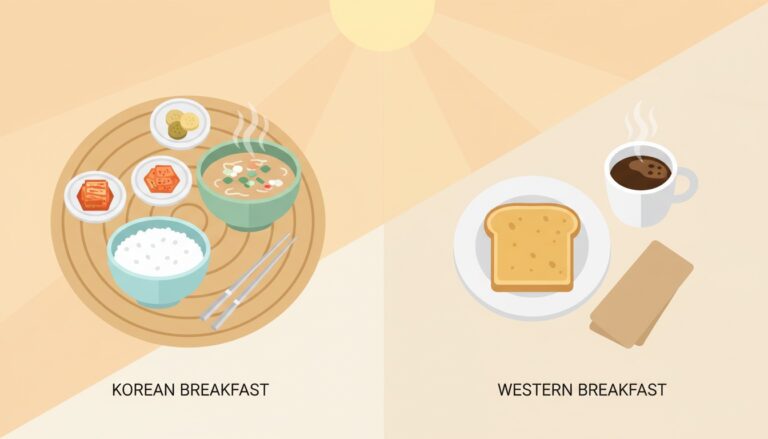
While Western breakfast is often sweet (cereal, pancakes), traditional Korean breakfast is savory—usually rice, soup, and side dishes. If you tell an older Korean you ate “Cake” for breakfast, they might look shocked. It’s not “wrong,” just culturally different!
2. The Reaction Matters
If someone says, “I didn’t eat breakfast,” don’t just say “Okay.” That’s a bit cold in Korea.
Try saying:
* “배고프겠어요.” (Baegopeugesseoyo) – You must be hungry.
* This small reaction shows you have Nunchi (social sense).
Phase 5: Roleplay Scenario 🎬
Setting: Monday morning at the office pantry.
Characters: Minji (Korean Colleague) vs. Alex (Expat Employee).
Minji: 알렉스 씨, 좋은 아침이에요! 아침 드셨어요?
(Alex-ssi, good morning! Did you eat breakfast?)
Alex: (Rubbing stomach) 아니요, 늦잠 자서 안 먹었어요. 민지 씨는요?
(No, I overslept so I didn’t eat. How about you, Minji?)
Minji: 저는 간단하게 사과 먹었어요. 우리 점심 맛있는 거 먹어요!
(I simply ate an apple. Let’s eat something delicious for lunch!)
Alex: 좋아요!
(Sounds good!)
Phase 6: 10-Second Shadowing 🗣️
Let’s train your muscle memory. Read this out loud. Focus on the pauses /.
“Today, I simply ate a sandwich.”
오늘 아침은 / 간단하게 / 샌드위치 먹었어요.
[O-neul a-chim-eun / gan-dan-ha-ge / saen-deu-wi-chi meo-geo-sseo-yo]
- Key Point: Don’t rush “Gandan-hage.” Pronounce every syllable clearly: Gan-Dan-Ha-Ge.
Phase 7: FAQ (Troubleshooting) ❓
Q: Can I use the English word “Toast”?
A: Yes! Koreans use “To-seu-teu” (토스트), “Be-i-geul” (베이글 – Bagel), and “Si-ri-eol” (시리얼 – Cereal). You don’t need to translate these.
Q: What if I only drank coffee? Do I say “I drank coffee” or “I ate coffee”?
A: In English, you “drink” coffee. In Korean, we use the verb 마시다 (masida) for drink.
* Correct: “커피 마셨어요.” (Keopi masyeosseoyo.)
* However, casually, some Koreans just say “Coffee meogeosseoyo” (ate coffee) to mean they consumed it, but stick to masyeosseoyo to be safe!
Phase 8: Wrap-up & Mission 🎁
One-Liner Summary:
When asked about breakfast, you can simply say “[Menu] meogeosseoyo” or use the magic phrase “Gandan-hage meogeosseoyo” (I ate simply).
Your Mission for Today:
Next time you enter a convenience store or cafe in Korea (or a Korean town), try saying “Achim-eun deusyeosseoyo?” (Did you eat breakfast?) to the staff if you are regulars. Watch their faces light up!
Comment below:
What did YOU eat for breakfast today? Write it in Korean! (e.g., 저는 베이글 먹었어요!)
Phase 9: Pop Quiz 📝
1. How do you say “I ate simply”?
a) Bap meogeosseoyo.
b) Gandan-hage meogeosseoyo.
c) Manhi meogeosseoyo.
2. Which is the most natural way to say you skipped breakfast?
a) Breakfast no eat.
b) Achim an meogeosseoyo.
c) Achim hate.
3. True or False: It is rude to ask someone if they ate breakfast.
a) True
b) False (It’s a caring greeting!)
(Scroll down for answers)
Click to see answers
1. b
2. b
3. b
Frequently Asked Questions (FAQ)
Q: What does "마시다" mean in Korean and how do you pronounce it?
A: In Korean, "마시다" is pronounced [masida] and means: for drink.







