

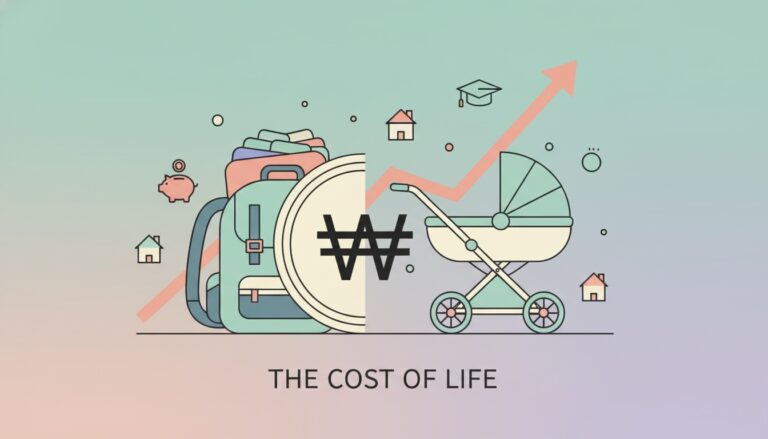
Phase 1: Welcome to the Real Conversation
Hello, language enthusiasts! This is your Head Editor at Daily Hangul. 👋
If you have reached the C2 level, you are no longer just asking “Where is the bathroom?” or “How much is this?” You are likely engaging in deep conversations about society, politics, and the realities of life in Korea. Today, we are tackling a hot topic that dominates Korean news and dinner table conversations alike: The low birth rate crisis and government policies.
Specifically, we are looking at the expansion of child allowance (아동 수당) and the crushing weight of child-rearing costs (양육비).
Imagine you are having coffee with your Korean colleagues, and someone sighs about the cost of hagwons (private academies). If you can jump in and discuss the effectiveness of the latest government subsidy using sophisticated vocabulary, you won’t just be a ‘foreigner who speaks Korean’—you will be seen as an insightful member of the community. Let’s dive deep.
Phase 2: Deep Dive into Core Expressions
1. 피부에 와닿다 (Pibu-e wa-dat-da)
- Pronunciation: Pee-bu-eh wah-dat-da (Imagine saying “Pee” + “Boo” + “Eh” quickly. ‘Wa-dat’ sounds like a drum beat.)
- Meaning: Literally “to touch the skin.” Real nuance: “To tangibly feel the effect of something” or “to hit home.”
- Editor’s Insight: This is a quintessential C2 idiom. When the government announces a new policy (like giving more money), but the amount is too small to help with inflation, Koreans say, “It doesn’t touch my skin” (support isn’t felt). Conversely, if prices rise, you feel it on your skin immediately.
- Situation Check: Perfect for debates, news discussions, or serious conversations with friends.
2. 등골이 휘다 (Deung-gol-i hwi-da)
- Pronunciation: Deung-gol-ee hwee-da (‘Hwi’ sounds like a sharp whistle of wind.)
- Meaning: Literally “spine bends/warps.” Real nuance: “To be back-breakingly expensive” or “to work one’s fingers to the bone to pay for something.”
- Editor’s Insight: This is the most common idiom used to describe education costs in Korea. Parents will often say their spines are bending because of their children’s tuition. It carries a sense of sacrifice and burden.
- Situation Check: Very common in both casual venting and formal editorials.
3. 실효성 (Sil-hyo-seong)
- Pronunciation: Sil-hyo-sung (The ‘hyo’ is soft, like exhaling.)
- Meaning: Effectiveness or Validity (of a policy or law).
- Editor’s Insight: You won’t hear this in a K-drama romance, but you will hear it on the 9 PM News every night. When discussing the expanded child allowance age, the key question is always: “Is this policy actually effective (실효성이 있나요)?”
- Situation Check: Formal discussions, business meetings, academic settings.
Phase 3: Textbook vs. Real Life (C2 Edition)
At the advanced level, it’s not about correctness, it’s about sophistication and idiomatic flavor.
| Textbook Korean (Formal & Dry) | Real Korean (Insightful & Native) |
|---|---|
| 아이를 키우는 데 돈이 많이 들어요. (It costs a lot to raise a child.) | 양육비 부담이 만만치 않아요. (The burden of child-rearing costs is formidable/not easy.) |
| 정부가 돈을 더 줘서 좋아요. (It’s good that the government gives more money.) | 지원 정책이 확대된 건 환영할 일이죠. (It is a welcome matter that support policies have expanded.) |
| 그 돈으로는 부족해요. (That money is not enough.) | 언 발에 오줌 누기예요. (Idiom: It’s like peeing on frozen feet – a temporary fix that doesn’t solve the root problem.) |
Editor’s Note: Using idioms like “언 발에 오줌 누기” instantly signals that your understanding of Korean culture runs deep.
Phase 4: Cultural Context – The “Edu-Poor” Phenomenon
In Korea, the phrase “Edu-Poor” (에듀푸어) refers to parents who are house-poor or struggle financially because they spend nearly all their income on their children’s education.
When discussing child allowance (아동 수당), you need to understand the Nunchi (context). Currently, the government provides roughly 100,000 KRW (approx. $75) per month per child. However, an average English kindergarten in Seoul can cost 1.5 million to 2 million KRW a month.
Cultural Tip: If someone asks, “What do you think about the allowance expansion?”, do not just say “It’s good.” Acknowledge the gap. Say, “It’s a start, but considering the private education costs (사교육비), it might not be enough to encourage more births.”
Phase 5: Real-Life Scenario (The Debate)
Setting: Two colleagues having lunch, discussing a recent news report on low birth rates.
Characters:
* Mark (You): An expat who follows Korean current affairs.
* Minji: A Korean working mom worried about expenses.
Dialogue:
(Minji puts down her spoon with a sigh)
Minji: 뉴스 봤어요? 아동 수당 지급 연령을 높인다는데, 사실 피부에 와닿지는 않네요.
(Did you see the news? They say they’re raising the age for child allowance, but honestly, I don’t really feel the impact.)
Mark: 맞아요. 월 10만 원으로는 학원비 내기도 빠듯하잖아요. 언 발에 오줌 누기 식인 것 같아요.
(Right. 100,000 won a month is barely enough for academy fees. It feels like a stopgap measure.)
Minji: 그러니까요. 아이 하나 키우는 데 등골이 휜다는 말이 괜히 있는 게 아니에요.
(Exactly. The saying that your spine bends while raising a child doesn’t exist for no reason.)
Mark: 현금 지원도 좋지만, 사교육비 문제를 해결할 근본적인 대책이 필요한 시점이죠.
(Cash support is good, but it’s time for fundamental measures to solve the private education cost issue.)
Phase 6: 10-Second Shadowing Drill
Let’s practice sounding like a news commentator. Focus on the pause after ‘확대에도 불구하고’ to build tension.
“아동 수당 지급 대상 확대에도 불구하고 / 양육비 부담을 실질적으로 덜어주기엔 / 역부족이라는 지적이 많습니다.”
- Phonetics: [A-dong su-dang ji-geup dae-sang hak-dae-e-do bul-gu-ha-go / yang-yuk-bi bu-dam-eul sil-jil-jeok-eu-ro deol-eo-ju-gi-en / yeok-bu-jok-i-ra-neun ji-jeok-i man-seum-ni-da.]
- Translation: “Despite the expansion of child allowance eligibility, many point out that it is insufficient to substantially alleviate the burden of child-rearing costs.”
Phase 7: FAQ & Troubleshooting
Q: Can I use idioms like “등골이 휜다” (spine breaking) to my boss?
A: Maybe. If you are close and complaining about a shared third-party situation (like the economy), it’s okay. But don’t use it to complain about your own salary to your boss! That implies they aren’t paying you enough.
Q: Is “양육비” (Child-rearing cost) the same as “생활비” (Living expenses)?
A: No. 생활비 is general living costs (rent, food). 양육비 specifically targets costs related to the child (diapers, education, clothes). In divorce settlements, ‘child support’ is also called 양육비.
Phase 8: Wrap-up & Action Item
Today’s Takeaway: Raising a child in Korea involves complex financial dynamics. Key terms: 피부에 와닿다 (Feel the impact), 등골이 휜다 (Financial burden), and 실효성 (Effectiveness).
Your Mission:
Go to YouTube and search for “한국 저출생 대책” (Korea low birth rate measures). Watch a 3-minute news clip. Can you catch the word ‘부담’ (burden) or ‘지원’ (support)? Share what you heard in the comments!
Phase 9: Pop Quiz
1. Which idiom best describes a policy that is too small to solve a big problem?
a) 누워서 떡 먹기 (Eating rice cake while lying down)
b) 언 발에 오줌 누기 (Peeing on frozen feet)
c) 금강산도 식후경 (Even Diamond Mountain comes after eating)
2. How would you sophisticatedly say “It costs too much money to raise kids”?
a) 아이가 비싸요. (The kid is expensive.)
b) 양육비 부담이 만만치 않아요. (The burden of child-rearing is formidable.)
c) 돈이 없어서 힘들어요. (It’s hard because I have no money.)
3. What does “피부에 와닿다” mean in a policy context?
a) The policy causes a skin rash.
b) The policy is touching and emotional.
c) You can tangibly feel the practical effects of the policy.
(Answers: 1-b, 2-b, 3-c)
Frequently Asked Questions (FAQ)
Q: What does "피부에 와닿다 (Pibu-e wa-dat-da)" mean in Korean and how do you pronounce it?
A: In Korean, "피부에 와닿다 (Pibu-e wa-dat-da)" is pronounced [Pee-bu-eh wah-dat-da (Imagine saying "Pee" + "Boo" + "Eh" quickly. 'Wa-dat' sounds like a drum beat.] and means: Literally "to touch the skin." Real nuance: "To tangibly feel the effect of something" or "to hit home."
Q: What does "등골이 휘다 (Deung-gol-i hwi-da)" mean in Korean and how do you pronounce it?
A: In Korean, "등골이 휘다 (Deung-gol-i hwi-da)" is pronounced [Deung-gol-ee hwee-da ('Hwi' sounds like a sharp whistle of wind.] and means: Literally "spine bends/warps." Real nuance: "To be back-breakingly expensive" or "to work one's fingers to the bone to pay for something."
Q: What does "실효성 (Sil-hyo-seong)" mean in Korean and how do you pronounce it?
A: In Korean, "실효성 (Sil-hyo-seong)" is pronounced [Sil-hyo-sung (The 'hyo' is soft, like exhaling.] and means: Effectiveness or Validity (of a policy or law).







