

Introduction: So, You’re at a Wine Bar in Seoul…
Hello! I’m your Senior Editor at Daily Hangul.
Imagine this: You are sitting at a sophisticated wine bar in Hannam-dong or Cheongdam-dong. The sommelier approaches and asks, “어떤 스타일의 와인을 선호하세요?” (Which style of wine do you prefer?)
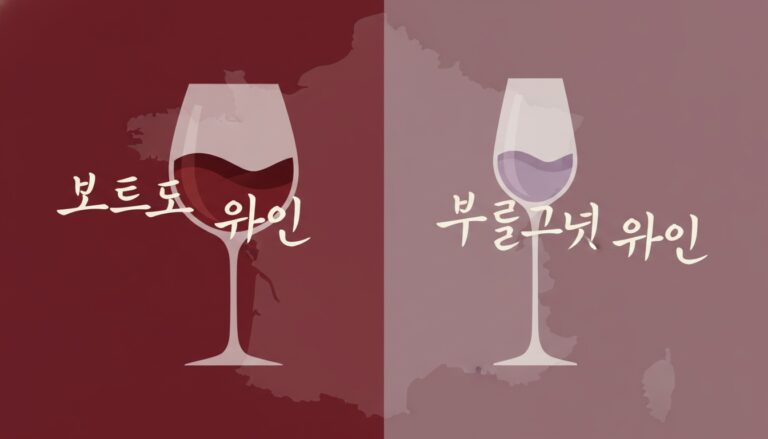
As a C1 learner, simply saying “레드 와인 주세요” (Red wine, please) is no longer enough. You want to express your refined taste. You want to explain that you prefer the bold structure of a Bordeaux or the delicate aroma of a Burgundy.
Today, we are moving beyond survival Korean into connoisseur Korean. I’ve compiled this guide based on real questions from advanced learners who felt frustrated when they couldn’t describe the texture and nuance of their favorite wines.
Phase 2: Deep Dive (Core Expressions)
Here are the three most critical expressions to distinguish between Bordeaux and Burgundy styles in Korean.
1. 바디감이 묵직하다 [badigami mukjikhada]
- Pronunciation: Ba-di-gam-i + Mook-jik-ha-da (The ‘Mook’ sounds heavy and abrupt, like dropping a thick book on a table.)
- Meaning: Full-bodied / Heavy body.
- Editor’s Insight: ‘묵직하다’ is an excellent adjective for advanced learners. It literally means heavy and weighty. Use this when describing a Cabernet Sauvignon-based Bordeaux blend.
- Situation: Formal/Casual (Use with respectful endings).
2. 섬세하고 복합적인 향 [seomsehago bokhapjeogin hyang]
- Pronunciation: Seom-se-ha-go + Bok-hap-jeok-in + Hyang
- Meaning: Delicate and complex aroma.
- Editor’s Insight: Burgundy wines (Pinot Noir) are all about subtlety. ‘섬세하다’ (delicate/detailed) implies that the wine isn’t just strong, but has layers. ‘복합적’ means complex.
- Situation: Describing high-quality wines to a sommelier.
3. 산미가 도드라지다 [sanmiga dodeurajida]
- Pronunciation: San-mi-ga + Do-deu-ra-ji-da
- Meaning: The acidity stands out / Prominent acidity.
- Editor’s Insight: Instead of just saying “시다” (It’s sour), which can sound negative, C1 learners should use ‘산미’ (acidity). ‘도드라지다’ means to stand out or be prominent in a positive or neutral way.
- Situation: Discussing the characteristic of Burgundy wines.
Phase 3: Textbook vs. Real Life (C1 Level)
At this level, we stop using basic descriptors and start using “Tasting Note” vocabulary.
| Textbook (Correct but Simple) | Real Life (Sophisticated & Natural) |
|---|---|
| 이 와인은 맛이 강해요. (This wine has a strong taste.) | 이 와인은 구조감이 탄탄해요. (This wine has a firm structure.) |
| 떫은 맛이 나요. (It tastes astringent.) | 타닌감이 풍부하게 느껴져요. (I can feel the rich tannins.) |
| 저는 섞은 와인이 좋아요. (I like mixed wine.) | 저는 보르도 스타일의 블렌딩을 선호해요. (I prefer Bordeaux-style blends.) |
Note: Notice the use of “~감” (feeling/sense) in words like 바디감 (body), 타닌감 (tannins), and 구조감 (structure). Adding this suffix makes you sound like an expert instantly.
Phase 4: Cultural Context & Manners
1. Pouring Etiquette (Even for Wine)
In Western culture, the sommelier pours, or you pour for yourself comfortably. In Korea, if you are with a Korean superior or elder, the two-hand rule still applies to wine glasses.
* Receiving: When an elder pours wine for you, lightly place your fingers on the base of the glass or hold the stem with two hands to show respect. Do not lift the glass off the table like you would with Soju; for wine, keeping it on the table is safer and acceptable, but the hand gesture is key.
2. The “Anju” (Side Dish) Matrix
Koreans believe heavily in food pairing (Maridaje).
* Bordeaux (Heavy): Suggest “한우 구이” (Grilled Hanwoo beef). The fat needs tannins.
* Burgundy (Light): Suggest “육회” (Korean beef tartare) or simple “치즈 플래터” (Cheese platter).
Phase 5: Real Scenario (Roleplay)
Setting: A wine bar in Seongsu-dong. Mark is asking the Sommelier for a recommendation.
Sommelier: 와인 리스트 보셨나요? 특별히 찾으시는 스타일 있으신가요?
(Have you looked at the wine list? Is there a particular style you are looking for?)
Mark (Client): 네, 오늘은 좀 섬세한 스타일이 당기네요. 보르도의 묵직한 바디감보다는, 부르고뉴의 화사한 향을 즐기고 싶어요.
(Yes, today I’m craving a delicate style. Rather than the heavy body of a Bordeaux, I want to enjoy the floral/bright aroma of a Burgundy.)
Sommelier: 아, 그러시면 이 ‘지브리 샹베르텡’은 어떠세요? 산미도 좋고 피니시가 아주 깁니다.
(Ah, then how about this ‘Gevrey-Chambertin’? The acidity is good and the finish is very long.)
Mark (Client): 오, 좋네요. 단일 품종이죠? 그걸로 부탁드릴게요.
(Oh, sounds good. It’s a single varietal, right? I’ll ask for that one.)
(Action: Mark hands the menu back with two hands.)
Phase 6: 10-Second Shadowing Drill
Read this sentence aloud to practice flow and emphasis. Focus on the pauses marked by /.
“오늘은 / 묵직한 타닌보다는 / 산미가 도드라지는 / 피노 누아가 / 마시고 싶어요.”
Translation: Today / rather than heavy tannins / (one where) acidity stands out / Pinot Noir / I want to drink.
Phase 7: FAQ & Troubleshooting
Q: Can I just use English words like ‘Body’, ‘Finish’, ‘Tannin’?
A: Yes, absolutely! These words are standard in the Korean wine scene. However, you must use the Koreanized pronunciation:
* Body -> 바디 [Ba-di]
* Finish -> 피니시 [Pi-ni-shi]
* Tannin -> 타닌 [Ta-nin]
* Terroir -> 떼루아 [Dde-ru-a]
Q: Is it rude to smell the wine cork?
A: Not rude, but in modern trendy bars in Seoul, it’s sometimes seen as a bit “old-fashioned” unless the wine is very old. Just smelling the wine in the glass is sufficient.
Phase 8: Wrap-up
Summary: To sound like a C1 speaker, replace “strong taste” with “묵직한 바디감” (heavy body) and “sour” with “산미가 도드라지다” (prominent acidity).
Action Mission: Next time you drink any beverage (even coffee!), try to describe it using “산미” (acidity) or “바디감” (body). “이 커피는 산미가 강하네요.” (This coffee has strong acidity.)
Question: Are you Team Bordeaux or Team Burgundy? Tell me in the comments using the expressions you learned today!
Phase 9: Quiz
- Which word best describes the “heavy” feeling of a Bordeaux wine?
A) 가볍다 (Light)
B) 묵직하다 (Heavy/Bold)
C) 싱겁다 (Bland) -
How do you say “Single Varietal” in Korean?
A) 단일 품종
B) 섞은 술
C) 하나 포도 -
Which expression is the most sophisticated way to say a wine is “sour”?
A) 너무 셔요.
B) 산미가 느껴져요.
C) 식초 같아요.
(Answers: 1. B / 2. A / 3. B)
Frequently Asked Questions (FAQ)
Q: What does "바디감이 묵직하다 [badigami mukjikhada]" mean in Korean and how do you pronounce it?
A: In Korean, "바디감이 묵직하다 [badigami mukjikhada]" is pronounced [Ba-di-gam-i + Mook-jik-ha-da (The 'Mook' sounds heavy and abrupt, like dropping a thick book on a table.] and means: Full-bodied / Heavy body.
Q: What does "섬세하고 복합적인 향 [seomsehago bokhapjeogin hyang]" mean in Korean and how do you pronounce it?
A: In Korean, "섬세하고 복합적인 향 [seomsehago bokhapjeogin hyang]" is pronounced [Seom-se-ha-go + Bok-hap-jeok-in + Hyang] and means: Delicate and complex aroma.
Q: What does "산미가 도드라지다 [sanmiga dodeurajida]" mean in Korean and how do you pronounce it?
A: In Korean, "산미가 도드라지다 [sanmiga dodeurajida]" is pronounced [San-mi-ga + Do-deu-ra-ji-da] and means: The acidity stands out / Prominent acidity.







