

Phase 1: Introduction (Introduction)
Greeting: 안녕하세요! Hello, Daily Hangul family! This is your editor, guiding you through the jungle of real-life Korean.
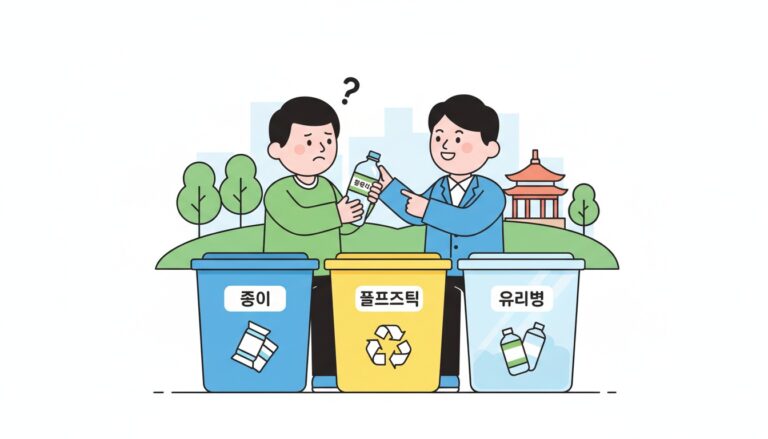
Scenario Setup: Picture this: You just finished a refreshing iced Americano on the streets of Seoul. You walk up to a row of trash bins, but instead of one simple “Trash” can, you see four different colored bins with Hangeul written on them. You freeze. A busy ajumma is waiting behind you. Panic sets in. Which one is for the plastic cup? Which one is for the lid?
The ‘Why’: Korea takes Recycling (분리수거 – Bun-li-su-geo) extremely seriously. It’s not just about the law; it’s about being a respectful neighbor. If you throw a glass bottle into the general waste bin, you might get a scolding (or a glare)! But don’t worry, knowing just 3 key phrases will turn you from a “confused foreigner” into an “eco-friendly insider.”
Transparency: Today’s guide is based on frantic text messages I received from my student, Alex, who stood in front of his apartment’s recycling bins for 10 minutes last Tuesday.
Phase 2: Deep Dive (Core Expressions)
Here are the top 3 expressions you need to survive recycling day.
1. 이거 캔이에요? (Is this a can?)
- Pronunciation: [I-geo Can-i-e-yo?] Sounds like: E-go Can-e-eh-yo?
- Meaning: “Is this a can?” (Literal/Real)
- Editor’s Insight: Sometimes packaging is tricky. Is it aluminum? Is it hard plastic? If you are unsure, just ask this. You can replace 캔 (Can) with 유리 (Glass – Yu-ri) or 플라스틱 (Plastic – Puel-la-seu-tik).
- Situation Check: ✅ Casual & ✅ Polite (The ‘yo’ ending makes it safe for strangers).
2. 내용물을 비워 주세요. (Please empty the contents.)
- Pronunciation: [Nae-yong-mu-reul bi-wo ju-se-yo]
- Meaning: “Please empty what’s inside.”
- Editor’s Insight: This is the Golden Rule of Korean recycling. You will hear this from building guards or see it on signs. If there is coffee left in your cup, you cannot throw it away yet.
- Key Word: 비우다 (Bi-u-da) = To empty.
3. 라벨을 제거하세요. (Remove the label.)
- Pronunciation: [La-be-reul je-geo-ha-se-yo]
- Meaning: “Please take off the label.”
- Editor’s Insight: Especially for transparent PET bottles (like water bottles), you must peel off the plastic wrapper before recycling. Most Korean bottles now have a special dotted line to make this easy!
- Situation Check: Usually written on signs or said by officials.
Phase 3: Textbook vs. Real Life
Books teach you grammar, but the streets teach you survival. Let’s compare.
| Textbook (Correct but stiff) | Real Life (Natural & Quick) |
|---|---|
| 분리수거함이 어디에 있습니까? (Where is the separate collection bin?) |
쓰레기장 어디예요? (Where is the trash area?) |
| 이 병은 여기에 버려도 됩니까? (May I dispose of this bottle here?) |
이거 여기요? (This one, here?) |
| 분리배출을 해야 합니다. (You must do separate discharge.) |
따로 버려야 돼요. (You gotta throw it separately.) |
Editor’s Note: In busy situations (like at a convenience store), shorter is better. “이거 여기요?” (This one here?) while pointing is the ultimate survival phrase.
Phase 4: Cultural Context (Manners)
1. The Sound of Crushing:
When recycling cans or plastic bottles, you shouldn’t just toss them in. Crush them (찌그러뜨리다) to save space. If you hear a loud CRUNCH sound at the recycling station, that is the sound of a good citizen!
2. The “Nunchi” (눈치) Game:
If you approach the bins and don’t know which is which (and you can’t read the Hangeul), use your Nunchi. Look inside the bins. If Bin A has Coke cans and Bin B has Soju bottles, follow the pattern. Do not be the first person to break the pattern!
Phase 5: Roleplay Script (Real Scenario)
Setting: Outside a convenience store (편의점). Jason is holding an empty Coke bottle.
Characters: Jason (Student), Clerk (Part-time worker).
Jason: (Holding the bottle, looking confused)
저기요, 이거 어디에 버려요?
(Excuse me, where do I throw this away?)
[Jeo-gi-yo, i-geo eo-di-e beo-ryeo-yo?]
Clerk: (Pointing to the bins)
아, 뚜껑은 일반 쓰레기고요, 병은 저기에요.
(Ah, the cap is general waste, and the bottle goes over there.)
[Ah, ttu-kkeong-eun il-ban sseu-re-gi-go-yo, byeong-eun jeo-gi-e-yo.]
Jason: (Walking to the bin)
라벨도 떼야 돼요?
(Do I have to take off the label too?)
[Ra-bel-do tte-ya dwae-yo?]
Clerk: (Nodding)
네, 비닐은 따로 버려 주세요.
(Yes, please throw the vinyl/plastic wrap separately.)
[Ne, bi-ni-reun tta-ro beo-ryeo ju-se-yo.]
Phase 6: 10-Second Shadowing
Let’s practice the most common request you’ll hear. Repeat this until it flows naturally!
“내용물은 / 비우고 / 버려 주세요.”
(Empty the contents / and then / throw it away.)Focus:
* Pause: Pause slightly after ‘내용물은’ and ‘비우고’.
* Intonation: Drop your pitch at the end (주세요) to sound polite but firm.
Phase 7: FAQ & Troubleshooting
- Q: Can I throw a bottle with a little bit of soda left in it?
- A: No! Absolute No. You must empty it (rinse it if possible) before recycling. Liquids can attract bugs and smell, making the cleaning ajummas very unhappy.
- Q: What if I really can’t find the right bin?
- A: Look for the General Waste (일반 쓰레기) bag. It is better to put it there than to contaminate the “Can” bin with a dirty plastic cup.
Phase 8: Wrap-up
One-Liner Summary: Recycling in Korea is all about Emptying (비우기), Removing Labels (라벨 제거), and Crushing (찌그러뜨리기).
Action Mission: Next time you buy a bottle of water, look for the recycling mark on the label. Find the dotted line to peel the label off. Peel it off before you throw it away!
Tell me: Have you ever been scolded for recycling wrong in Korea? Tell me your story in the comments!
Phase 9: Quiz
1. What should you say if you don’t know where to throw your trash?
A) 이거 얼마예요? (How much is this?)
B) 이거 어디에 버려요? (Where do I throw this?)
C) 이거 맛있어요? (Is this delicious?)
2. Before recycling a bottle, what must you do with the liquid inside?
A) 비워 주세요 (Empty it)
B) 마시지 마세요 (Don’t drink it)
C) 사 주세요 (Please buy it)
3. True or False: You should keep the label on a PET bottle when recycling it in Korea.
A) True
B) False
(Answers: 1. B, 2. A, 3. B)
Frequently Asked Questions (FAQ)
Q: What does "이거 캔이에요? (Is this a can?)" mean in Korean and how do you pronounce it?
A: In Korean, "이거 캔이에요? (Is this a can?)" is pronounced [I-geo Can-i-e-yo?] and means: "Is this a can?" (Literal/Real)
Q: What does "내용물을 비워 주세요. (Please empty the contents.)" mean in Korean and how do you pronounce it?
A: In Korean, "내용물을 비워 주세요. (Please empty the contents.)" is pronounced [Nae-yong-mu-reul bi-wo ju-se-yo] and means: "Please empty what's inside."
Q: What does "라벨을 제거하세요. (Remove the label.)" mean in Korean and how do you pronounce it?
A: In Korean, "라벨을 제거하세요. (Remove the label.)" is pronounced [La-be-reul je-geo-ha-se-yo] and means: "Please take off the label."







