

Phase 1: Introduction
Hello! This is your Senior Editor from Daily Hangul.
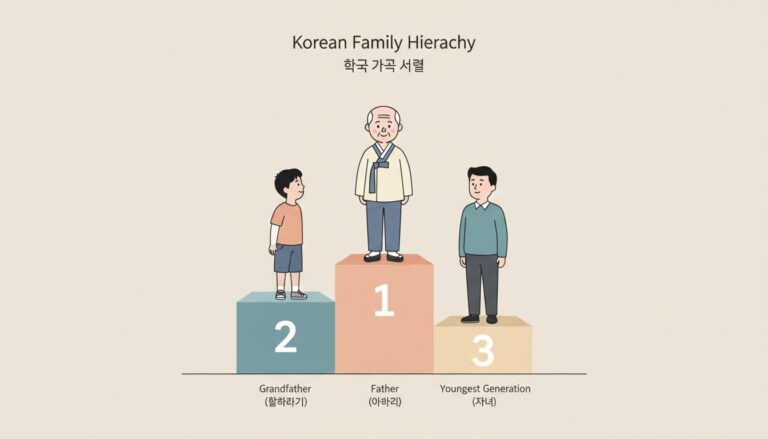
Imagine this scenario: You are visiting your Korean partner’s family for the holidays. You are sitting across from the Grandfather (the patriarch), and he asks you, “Where is your father-in-law?”
Your palms start sweating. You know you have to use honorifics for your father-in-law because he is older than you. BUT, you are talking to the Grandfather, who is even higher in the hierarchy.
Do you lift the father up? Or do you push him down out of respect for the grandfather?
This specific headache is called Apjonbeop (압존법). It literally means “The method of suppressing respect.” It is one of the trickiest parts of Korean culture, even for native speakers. Mastering this doesn’t just improve your grammar; it proves you truly understand the deep-rooted Confucian hierarchy of Korea.
Don’t worry—today’s guide is based on real questions from students who wanted to survive family gatherings without offending anyone. Let’s dive in!
Phase 2: Deep Dive into Apjonbeop
In standard Korean, we add -(으)시- (-(eu)si-) to verbs or use 께서 (kkesseo) to show respect. However, Apjonbeop dictates that when speaking to a listener who is superior to the subject of your sentence, you must NOT use honorifics for the subject, even if the subject is your superior.
1. 할아버지, 아버지가 아직 안 왔어요.
(Grandfather, Father has not come yet.)
- Pronunciation: [Har-a-beo-ji, A-beo-ji-ga a-jik an wa-sseo-yo]
- Tip: ‘Ga’ sounds like the ‘ga’ in ‘garden’. Do not use the honorific particle ‘Kkesseo’.
- Meaning:
- Literal: Grandfather, father didn’t come.
- Nuance: “Grandfather, out of respect for your highest status, I am treating Father as a ‘lower’ person in this conversation.”
- Editor’s Insight: If you used 오셨어요 (O-syeo-sseo-yo) here, traditional grandfathers might think, “How dare you raise your father to my level?” You are intentionally suppressing the honorific ‘-(eu)si-‘ suffix.
- Situation Check: 🟢 Family (Traditional) | 🟡 Workplace (Controversial)
2. 부장님, 과장님은 자리에 없습니다.
(General Manager, the Section Manager is not at his desk.)
- Pronunciation: [Bu-jang-nim, Gwa-jang-nim-eun ja-ri-e eop-seum-ni-da]
- Meaning:
- Literal: Boss, the manager isn’t at the seat.
- Nuance: “I acknowledge the Section Manager is my boss, but you (General Manager) are the bigger boss.”
- Editor’s Insight: Notice we used 없습니다 (plain form) instead of 안 계십니다 (honorific form). This is the classic rule. However, in modern society, this is changing (see Phase 3).
Phase 3: Textbook vs. Real Life
Here is where it gets interesting. The rules are changing!
| Context | Textbook / Traditional Rule (Strict Apjonbeop) | Real Life / Modern Trend (B1 Level Tip) |
|---|---|---|
| Family | “할아버지, 아버지가 왔습니다.” (Suppressing honorifics for Dad completely.) |
“할아버지, 아버지 오셨습니다.” (Many families now allow honorifics for parents even in front of grandparents. It’s softer.) |
| Office | “사장님, 김 부장은 외근 나갔습니다.” (Calling the manager by name/title only, no respect.) |
“사장님, 김 부장님은 외근 나가셨습니다.” (Important: The gov’t guidelines changed! In the office, mutual respect is now preferred. You usually don’t need to apply Apjonbeop strictly at work anymore.) |
Bottom Note: If you are unsure, usually using honorifics (Modern Trend) is safer for a foreigner. Being “too polite” is better than appearing rude. But for family, ask your partner how strict their grandfather is!
Phase 4: Cultural Context & Manners
The Art of “Nunchi” (Eye-measure)
Apjonbeop is the ultimate test of Nunchi. You have to instantly calculate the age and rank of everyone in the room.
- Non-Verbal Tip: Even if you lower the words (grammar), do not lower your attitude.
- When saying “Father has not come” to Grandfather, keep your posture humble.
- Eye Contact: Do not stare directly into the Grandfather’s eyes the whole time. Glance at his chin or neck area occasionally to show deference.
Phase 5: Roleplay Script
Setting: Chuseok (Korean Thanksgiving). Min-su (Foreigner) is talking to the very traditional Grandfather.
Characters:
* Min-su: Wants to be polite.
* Grandpa: Very strict about tradition.
(Min-su enters the room and bows lightly)
Grandpa: 민수야, 네 장인어른(father-in-law) 어디 갔냐?
(Min-su-ya, where did your father-in-law go?)
Min-su: (Hands gathered politely in front)
아, 할아버지. 아버지는 잠시 화장실에 갔습니다.
(Ah, Har-a-beo-ji. A-beo-ji-neun jam-si hwa-jang-sil-e ga-sseum-ni-da.)
[Ah, Grandfather. Father went to the restroom for a moment.]
Grandpa: 그래? 알았다.
(Really? Okay.)
Min-su’s Thought: Phew! I didn’t say ‘가셨습니다’ (honorific). I survived!
Phase 6: 10-Second Shadowing
Let’s practice the flow. Remember, we are deliberately being “plain” about the middle person.
Sentence: “Grandfather, Father is doing the dishes.”
할아버지, / 아버지가 / 설거지하고 / 있어요.
[Har-a-beo-ji, / A-beo-ji-ga / seol-geo-ji-ha-go / i-sseo-yo.]
- Key Point: Do NOT say
아버님께서(A-beo-nim-kke-seo) or계세요(Gye-se-yo). keep it flat and simple.
Phase 7: FAQ & Troubleshooting
Q: If I use Apjonbeop at my company, will I sound smart?
A: You might sound… too old-fashioned. In 2024, most young Korean companies prefer mutual respect. If you say “The Manager is out” (plain form) to the CEO, the CEO might think you are disregarding the Manager. Strategy: Use standard honorifics at work unless corrected.
Q: Does this apply to my older brother vs. my Dad?
A: Yes! If talking to Dad about your older brother: “Dad, Hyung (older brother) is sleeping.” (Don’t use honorifics for Hyung in front of Dad).
Phase 8: Wrap-up
One-Liner Summary:
When speaking to a “Big Boss,” you must treat the “Middle Boss” like a friend (no honorifics), traditionally speaking.
Action Mission:
Next time you watch a historical K-Drama (Sageuk), listen closely when a minister talks to the King about another minister. Count how many times they drop the honorifics!
Let’s Chat:
Does your language have a complex hierarchy system like this? Tell me in the comments!
Phase 9: Pop Quiz
Scenario: You are talking to your Grandmother. You want to say your Mother is at the market.
Which sentence follows strict traditional Apjonbeop?
- 할머니, 어머니께서 시장에 가셨어요.
- 할머니, 어머니가 시장에 갔어요.
- 할머니, 엄마가 시장에 가셨습니다.
(Scroll down for the answer)
.
.
.
Answer: 2. (In strict tradition, Mother is lower than Grandmother, so we remove ‘-(eu)si-‘ and ‘kkesseo’.)
Frequently Asked Questions (FAQ)
Q: What does "께서" mean in Korean and how do you pronounce it?
A: In Korean, "께서" is pronounced [kkesseo] and means: to show respect. However,







