

Phase 1: Introduction
Greeting: Hello, everyone! This is your Chief Editor at Daily Hangul. 👋
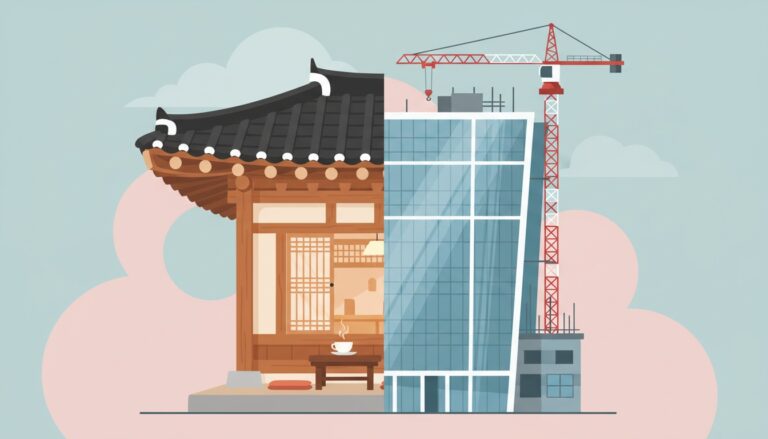
Scenario Setup: You finally return to that charming, hidden café in Seongsu-dong or Ikseon-dong that you discovered two years ago. You loved its peeling paint, the smell of old wood, and the indie owner who hand-dripped your coffee. But when you arrive, the building is gone. In its place stands a shiny, generic building housing a massive global coffee chain.
The ‘Why’: You feel a mix of disappointment and confusion. This is the reality of Urban Gentrification in Seoul. As a C1 (Advanced) learner, simply saying “The rent is expensive” (비싸요) isn’t enough to express your complex feelings about urban regeneration and the loss of cultural identity.
Transparency: Today’s lesson is based on a real debate I had with my advanced students about the rapid changes in Seoul’s cityscape. We are going deep into the social vocabulary used by Korean intellectuals and urban planners.
Phase 2: Deep Dive into Core Expressions
1. 둥지 내몰림 (Dungji naemollim)
- Pronunciation: [Dung-ji nae-mol-lim]
- Sound Analogy: Think of ‘Dung’ (like dung beetle) + ‘Gee’ (as in gee whiz). ‘Nae’ (like neigh) + ‘Mol’ (like mole) + ‘Lim’ (like limb).
- Meaning:
- Literal: Being driven out of one’s nest.
- Real Nuance: This is the localized, poetic, and sociologically loaded term for involuntary displacement due to gentrification. It implies helplessness and the loss of a home/base.
- Editor’s Insight: Using the loanword “젠트리피케이션” (Jenteuripikeisyeon) is fine, but using 둥지 내몰림 shows you read Korean newspapers and care about social issues. It sounds much more empathetic.
- Situation Check: Used in serious discussions, news analysis, or deeper conversations about society. (Formal/Written/Intellectual)
2. 임대료가 천정부지로 치솟다 (Imdaeryoga cheonjeongbujiro chisotda)
- Pronunciation: [Im-dae-ryo-ga cheon-jeong-bu-ji-ro chi-sot-da]
- Key Sound: ‘Cheon’ rhymes with ‘Bun’ but with a Ch. ‘Sot’ sounds sharp, like the word ‘sot’ (drunkard) but ends abruptly.
- Meaning:
- Literal: Rent soars knowing no ceiling.
- Real Nuance: Rents are skyrocketing through the roof. ‘천정부지’ (ceiling-unknown) is a high-level idiom used when prices (stocks, real estate) go up uncontrollably.
- Editor’s Insight: Just saying “비싸졌다” (became expensive) is too weak for C1. Use this phrase to emphasize the impossibility of staying in the area.
- Situation Check: Can be used in both casual ranting (between friends) and formal reporting.
3. 특색을 잃다 (Teuksaegeul ilta)
- Pronunciation: [Teuk-sae-geul il-ta]
- Sound Analogy: ‘Teuk’ sounds like the sound you make when something hits a desk lightly. ‘Il-ta’ sounds like ‘Eel’ + ‘Ta’.
- Meaning:
- Literal: To lose one’s special color/characteristic.
- Real Nuance: To become commercialized, generic, or cookie-cutter. It’s the critique that a neighborhood has lost its ‘soul’ or ‘vibe’.
- Editor’s Insight: Koreans value the ‘Vibe’ (감성 – Gamseong) of a place. This phrase is the ultimate critique of failed urban regeneration.
- Situation Check: Universal.
Phase 3: Textbook vs. Real Life
Here is how to sound like a local insider versus a textbook robot.
| Textbook Korean (Correct but Dry) | Real Korean (Natural & Nuanced) |
|---|---|
| 임대료가 많이 올랐어요. (The rent increased a lot.) |
월세가 감당이 안 될 정도로 올랐대요. (They said the monthly rent went up to a level they can’t handle.) |
| 가게가 없어지고 큰 빌딩이 생겼어요. (The shop disappeared and a big building appeared.) |
그 가게 젠트리피케이션 때문에 밀려났어요. (That shop got pushed out because of gentrification.) |
| 이 거리는 이제 재미없어요. (This street is not fun now.) |
여기 이제 프랜차이즈한테 잠식당해서 예전 느낌이 아니야. (This place has been encroached upon by franchises, so it’s not the old vibe.) |
Bottom Note: Notice the word 잠식당하다 (encroached/eaten away). This is a C1 level verb that perfectly captures the aggressive nature of commercialization.
Phase 4: Cultural Context & Manners
🇰🇷 The Speed of “Hot Places” (핫플)
In Korea, the lifecycle of a trendy neighborhood is incredibly short due to the “Ppalli-ppalli” (Hurry, hurry) culture.
- Gwolligeum (권리금): When talking about shops closing, you might hear this word. It’s “Key Money” or a premium paid for the location/customer base. Often, when landlords raise rent, tenants lose this huge sum of money.
- Nunchi Tip: If you are talking to a business owner in a trendy area, never ask “Business is booming, right? You must be rich!” High revenue doesn’t mean high profit due to the killer rent. Instead, show empathy: “요즘 임대료 때문에 힘드시죠?” (It’s tough because of rent these days, right?)
Phase 5: Roleplay Script
Setting: Two friends walking through Seochon (an old neighborhood near Gyeongbokgung Palace).
Characters: Min-ji (Korean Local), Alex (You, C1 Learner).
Min-ji: 어? 여기 있던 그 독립 서점 어디 갔지? 내가 진짜 좋아하던 곳인데.
(Huh? Where did that indie bookstore go? It was a place I really loved.)
Alex: 아, 그 서점? 지난달에 둥지 내몰림으로 문 닫았다고 들었어.
(Ah, that bookstore? I heard they closed down last month due to displacement.)
Min-ji: 진짜? 와, 너 그런 표현도 알아? 맞아, 요즘 여기 임대료가 천정부지로 치솟아서 버티기 힘들대.
(Really? Wow, you know that expression? You’re right, I heard rent here is skyrocketing through the roof, so it’s hard to endure.)
Alex: 응, 너무 아쉬워. 대기업 카페가 들어오면서 동네가 특색을 잃어가는 것 같아.
(Yeah, it’s such a shame. As big corporate cafes move in, it feels like the neighborhood is losing its character.)
Min-ji: (끄덕이며) 내 말이 그 말이야. 옛날 그 감성이 그립다.
((Nodding) That’s exactly what I’m saying. I miss the old vibe.)
Phase 6: 10-Second Shadowing Drill
Read this aloud to practice your intonation and rhythm. Pause at the slashes /.
“지나친 상업화로 / 동네 고유의 / 매력이 사라지는 게 / 너무 안타까워요.”
(Jinachin sangeop-hwaro / dongne goyu-ui / maeryeogi sarajineun ge / neomu antakkawoyo.)
Meaning: “It is so regrettable that the neighborhood’s unique charm is disappearing due to excessive commercialization.”
Phase 7: FAQ & Troubleshooting
Q: Can I use the word ‘Gentrification’ in Korean?
A: Yes! 젠트리피케이션 is widely used in the media and daily life. However, if you want to sound more academic or poetic about the human cost, use 둥지 내몰림.
Q: Is it rude to discuss rent prices?
A: Asking a specific person “How much is your rent?” is rude. But discussing the market trend (e.g., “Rent here is crazy, right?”) is a very common small talk topic among adults. It builds solidarity against the ‘hardships of life.’
Phase 8: Wrap-up
- One-Liner Summary: To discuss urban changes like a pro, remember: 둥지 내몰림 (Displacement), 천정부지 (Sky-high), and 특색을 잃다 (Losing character).
- Action Mission: Next time you see a new franchise building in a hip area, turn to your friend and sigh, “아, 여기도 이제 특색을 다 잃었네.” (Ah, this place has lost all its character now.) You will sound like a true Seoulite critic.
- Engagement: Has your favorite spot in Korea disappeared? Tell me in the comments where it was!
Phase 9: Quiz
1. Which word best fits the blank?
“임대료가 ______로 치솟아서 결국 가게를 뺐어.”
(A) 옹기종기 (Ongi-jonggi)
(B) 천정부지 (Cheonjeongbuji)
(C) 알록달록 (Allok-dallok)
2. What is the ‘pure Korean’ term for involuntary displacement due to gentrification?
(A) 둥지 내몰림
(B) 둥지 틀기
(C) 둥지 짓기
3. True or False?
It is considered very rude to complain about rising market rents with a shop owner.
(A) True
(B) False (It shows empathy)
(Answers: 1. B, 2. A, 3. B)
Frequently Asked Questions (FAQ)
Q: What does "둥지 내몰림 (Dungji naemollim)" mean in Korean and how do you pronounce it?
A: In Korean, "둥지 내몰림 (Dungji naemollim)" is pronounced [Dung-ji nae-mol-lim] and means: a key conversational Korean expression covered in this lesson.
Q: What does "임대료가 천정부지로 치솟다 (Imdaeryoga cheonjeongbujiro chisotda)" mean in Korean and how do you pronounce it?
A: In Korean, "임대료가 천정부지로 치솟다 (Imdaeryoga cheonjeongbujiro chisotda)" is pronounced [Im-dae-ryo-ga cheon-jeong-bu-ji-ro chi-sot-da] and means: a key conversational Korean expression covered in this lesson.
Q: What does "특색을 잃다 (Teuksaegeul ilta)" mean in Korean and how do you pronounce it?
A: In Korean, "특색을 잃다 (Teuksaegeul ilta)" is pronounced [Teuk-sae-geul il-ta] and means: a key conversational Korean expression covered in this lesson.







