

👋 Phase 1: Introduction
“Wait, why is my rice purple? Did it go bad?”
Hello! I’m your Senior Editor at Daily Hangul.
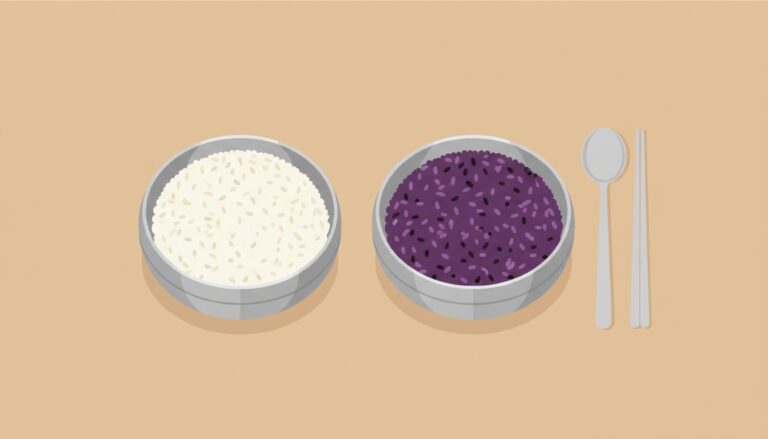
If you’ve ever walked into a local Korean restaurant (식당), opened the stainless steel bowl, and found purple or speckled rice instead of the snowy white rice you expected, don’t panic! You haven’t been served spoiled food. You’ve just encountered a staple of modern Korean dietary culture.
Today, we are diving into the Great Rice Debate: White Rice (흰 쌀밥) vs. Multigrain Rice (잡곡밥).
For B2 (Intermediate) learners, simply asking for “bap” isn’t enough anymore. Understanding the difference between these two not only prevents dining surprises but also marks you as someone who understands the Korean obsession with “Well-being” (health). Let’s learn how to order exactly what you want!
🧠 Phase 2: Deep Dive into Key Expressions
Here are the three essential terms you need to survive a Korean meal.
1. 흰 쌀밥 [Huin-ssal-bap]
- Pronunciation: Huin-ssal-bap [Sounds like: Hwin-sahl-bap]
- Meaning: White rice (Literal: White uncooked rice + cooked rice)
- Editor’s Insight: This is the classic. It’s fluffy, slightly sweet, and goes perfectly with spicy stews like Kimchi-jjigae. However, in modern Korea, eating only white rice is sometimes seen as “less healthy” due to carbs.
- Situation Check: Everywhere. From convenience stores to funerals.
2. 잡곡밥 [Japgok-bap]
- Pronunciation: Jap-gok-bap [Sounds like: Jap-goke-bap]
- Meaning: Multigrain rice (Literal: Mixed grain cooked rice)
- Editor’s Insight: This is the umbrella term for any rice mixed with beans, barley, or millet. If you visit a Korean home, the mother will likely serve this to show she cares about your health. It has a chewier texture.
- Situation Check: Home-cooked meals, school cafeterias, and health-focused restaurants.
3. 흑미밥 [Heungmi-bap]
- Pronunciation: Heung-mi-bap [Sounds like: Hung-me-bap]
- Meaning: Black rice (which turns purple when cooked)
- Editor’s Insight: This is the culprit behind the “Purple Rice” phenomenon! We mix a little black rice with white rice, and the anthocyanin turns the whole pot a beautiful violet color. It tastes nutty and savory.
- Situation Check: Very common in restaurants replacing standard white rice.
🆚 Phase 3: Textbook vs. Real Life
Textbooks are great, but they don’t teach you how to be picky at a restaurant. Let’s look at how to sound like a local.
| Textbook Korean (Polite but robotic) | Real Life Korean (Natural & Useful) |
|---|---|
| 밥 주세요. (Please give me rice.) | 공깃밥 하나 추가해 주세요. (Please add one bowl of rice.) |
| 흰 쌀밥 있어요? (Do you have white rice?) | 혹시 흰밥으로 주실 수 있나요? (By any chance, can you give me white rice?) |
| 잡곡밥을 좋아해요. (I like multigrain rice.) | 저는 잡곡밥이 더 고소해서 좋아요. (I like multigrain rice because it’s nuttier.) |
💡 Note: Koreans often shorten ‘흰 쌀밥’ to just ‘흰밥’ (Huin-bap) in conversation. Also, the stainless steel bowl rice is served in is called a 공기 (Gonggi), hence 공깃밥 (Gonggi-bap).
🍵 Phase 4: Cultural Context & Manners
The “Well-being” Obsession
In the past, white rice was a symbol of wealth. Today, the tables have turned. 잡곡밥 (Multigrain rice) is the premium choice because of the health trend in Korea.
Nunchi (Eye-measure) Tip:
If you are invited to a Korean’s house and they serve you beans in your rice (Kong-bap), do not pick them out one by one in front of the host! It’s considered childish and a bit rude, implying their cooking isn’t to your taste. If you really can’t eat them, just eat around them quietly or say you have a slight allergy/digestion issue with beans.
🎬 Phase 5: Real-Life Roleplay
Setting: A bustling Baekban-jip (home-style meal restaurant). You want to order, but you prefer white rice over the healthy purple kind.
Characters:
* Alex: Foreigner who loves spicy food but dislikes beans.
* Imo-nim: Friendly restaurant owner (literally ‘Auntie’).
Dialogue:
Imo-nim: 어서 오세요! 뭐 드릴까요?
(Eoseo oseyo! Mwo deurilkkayo?)
(Welcome! What can I get for you?)
Alex: 김치찌개 하나 주세요. 아, 혹시 밥은 잡곡밥으로 나오나요?
(Kimchi-jjigae hana juseyo. Ah, hokshi babeun japgok-bap-euro naonayo?)
(One Kimchi stew, please. Ah, by any chance, does the rice come as multigrain?)
Imo-nim: 네, 우리 집은 흑미 섞은 잡곡밥이에요.
(Ne, uri jibeun heungmi seokkeun japgok-bap-ieyo.)
(Yes, our house serves multigrain mixed with black rice.)
Alex: (smiling apologetically) 죄송한데, 제가 콩을 잘 못 먹어서요. 흰 쌀밥으로 주실 수 있나요?
(Joesonghande, jega kongeul jal mot meogeoseoyo. Huin-ssal-bap-euro jusil su innayo?)
(I’m sorry, but I can’t eat beans very well. Could you give me white rice instead?)
Imo-nim: 그럼요! 흰밥으로 갖다 줄게요.
(Geureomyo! Huin-bap-euro gatda julgeyo.)
(Of course! I’ll bring you white rice.)
🗣️ Phase 6: 10-Second Shadowing Drill
Practice this sentence to explain your preference politely. Focus on the pauses!
“Honestly, I prefer the taste of white rice over multigrain rice.”
솔직히 / 저는 잡곡밥보다 / 흰 쌀밥이 / 더 입에 맞아요.
[Soljiki / jeoneun japgok-bap-boda / huin-ssal-bapi / deo ibe majayo.]
- Tip: “입에 맞아요” (fits my mouth) is a B2-level idiom meaning “it suits my taste.”
❓ Phase 7: FAQ & Troubleshooting
Q: Is it rude to ask for white rice if they serve purple rice by default?
A: No! Most restaurants have a huge rice cooker of white rice on standby for dishes like Bibimbap. Just ask politely: “흰밥 있나요?” (Do you have white rice?). However, small mom-and-pop shops might only have one type prepared. If they say no, try the purple rice—it’s delicious!
Q: What if the rice is yellow?
A: That’s likely 조밥 (Jo-bap), which is rice mixed with millet. It has a slightly rougher texture but is very healthy.
🎁 Phase 8: Wrap-up & Mission
Summary:
* White Rice: Huin-ssal-bap (Soft, classic).
* Multigrain/Purple: Japgok-bap / Heungmi-bap (Healthy, nutty).
Your Mission:
Next time you go to a Korean restaurant or convenience store, look at the ready-made rice (Haetban) section. Can you spot the difference between 흰밥 and 잡곡밥? Try buying the 흑미밥 (Black rice) version and taste the difference!
Leave a comment below: Are you Team #WhiteRice or Team #PurpleRice? 🍚💜
📝 Phase 9: Pop Quiz
1. Which word refers to the “Purple Rice” often served in restaurants?
(a) 흰 쌀밥 (Huin-ssal-bap)
(b) 흑미밥 (Heungmi-bap)
(c) 볶음밥 (Bokkeum-bap)
2. How do you politely say “It suits my taste”?
(a) 입에 아파요 (Ibe apayo)
(b) 입에 맞아요 (Ibe majayo)
(c) 입에 없어요 (Ibe eopseoyo)
3. True or False: It is considered very polite to pick out beans from your rice in front of a Korean elder.
(a) True
(b) False
Click to see answers
1. (b) 흑미밥
2. (b) 입에 맞아요
3. (b) False (It’s considered rude!)
Frequently Asked Questions (FAQ)
Q: What does "흰 쌀밥 [Huin-ssal-bap]" mean in Korean and how do you pronounce it?
A: In Korean, "흰 쌀밥 [Huin-ssal-bap]" is pronounced [Huin-ssal-bap [Sounds like: Hwin-sahl-bap] and means: White rice (Literal: White uncooked rice + cooked rice)
Q: What does "잡곡밥 [Japgok-bap]" mean in Korean and how do you pronounce it?
A: In Korean, "잡곡밥 [Japgok-bap]" is pronounced [Jap-gok-bap [Sounds like: Jap-goke-bap] and means: Multigrain rice (Literal: Mixed grain cooked rice)
Q: What does "흑미밥 [Heungmi-bap]" mean in Korean and how do you pronounce it?
A: In Korean, "흑미밥 [Heungmi-bap]" is pronounced [Heung-mi-bap [Sounds like: Hung-me-bap] and means: Black rice (which turns purple when cooked)







