

👋 Hello! This is your Senior Editor at Daily Hangul.
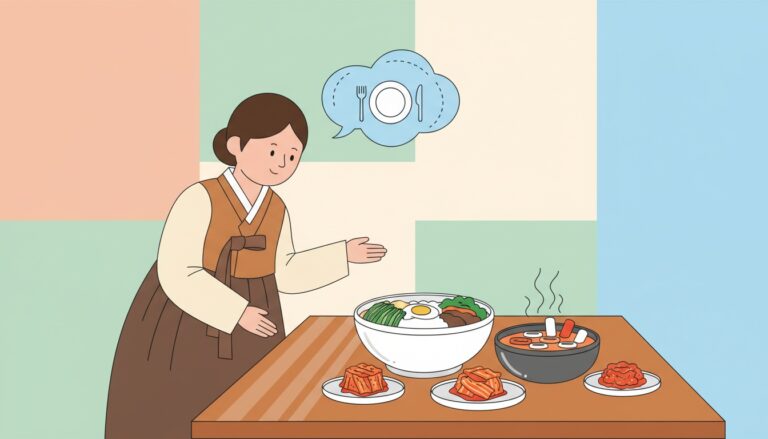
Imagine this: You’ve been invited to a Korean friend’s house for dinner. You walk in, and your jaw drops. The table is groaning under the weight of Bulgogi, Japchae, Kimchi stew, and five different side dishes. It looks like a royal feast.
But then, your host looks down shyly and says:
“차린 건 없지만 많이 드세요.”
(Charin geon eopjiman mani deuseyo)
Translation: “I haven’t prepared anything, but please eat a lot.”
Wait, what? Nothing? Are they seeing the same table you are? 😲
This is one of the most confusing moments for my B1 level students. One student, Mark from Texas, once told me, “I thought she was being sarcastic because I arrived late!”
Don’t worry. It’s not sarcasm, and it’s not a lie. It is the heart of Korean Humility (Gyeomson). Today, let’s decode this essential phrase so you can become the most polite guest (or host) in the room.
🔍 Deep Dive: The Art of Humble Hosting
Here are the top 3 expressions you need for a home visit scenario.
1. 차린 건 없지만 많이 드세요
(Charin geon eopjiman mani deuseyo)
- Pronunciation: Cha-rin-gon-up-ji-man, ma-ni-deu-se-yo
- Tip: The ‘Eo’ in ‘Eop’ sounds like the ‘uh’ in “Uh-oh.”
- Literal Meaning: Although there is nothing prepared, eat a lot.
- Real Nuance: “I wish I could have prepared a grander feast for a special guest like you, but this is all I have. Please enjoy it anyway.”
- Editor’s Insight: This is the ultimate magic phrase. Even if you cooked for 12 hours, you say this. It lowers yourself to elevate your guest.
- Situation: Formal & Casual (Use ‘많이 먹어’ for close friends).
2. 입에 맞으실지 모르겠어요
(Ibe majeushilji moreugesseoyo)
- Pronunciation: Eeb-eh-ma-jeu-shil-ji-mo-reu-ge-sso-yo
- Literal Meaning: I don’t know if this fits your mouth.
- Real Nuance: “I hope this suits your taste buds.”
- Editor’s Insight: This gives the guest an “out.” If the food is too spicy or salty, you’ve already apologized in advance! It removes pressure from the guest.
3. 와 줘서 고마워요
(Wa jwoseo gomawoyo)
- Pronunciation: Wa-jwo-seo-go-ma-wo-yo
- Meaning: Thank you for coming.
- Editor’s Insight: Simple, warm, and essential. Always start or end with this.
🆚 Textbook vs. Real Life
How does a “Korean robot” speak versus a “Seoul Insider”?
| Textbook Korean (Too stiff) | Real Korean (Natural & Friendly) |
|---|---|
| 음식을 많이 준비했습니다. (I prepared a lot of food.) | 차린 건 없지만, 맛만 좀 봐. (There’s nothing prepared, but just have a taste.) |
| 맛있게 드십시오. (Please eat deliciously.) | 식기 전에 얼른 드세요! (Eat quickly before it gets cold!) |
| 방문해 주셔서 감사합니다. (Thank you for visiting.) | 오느라 고생했지? (You suffered coming here, right? = Thanks for the trip.) |
💡 Editor’s Note: Notice the shift? Real Korean focuses on worrying about the guest (Did you have a hard trip? Is the food cold?) rather than stating facts.
🍵 Cultural Context: The “Nunchi” of Accepting Food
In Korea, words are often the opposite of the visual reality to show politeness.
- The Reaction Rule: When a host says “I prepared nothing,” NEVER agree. (e.g., “Yeah, it’s okay though.”) This is a disaster! 😱
- The Correct Response: You must protest!
- Say: “와! 진수성찬이네요!” (Wa! Jinsuseongchanineyo! – Wow! It’s a royal feast!)
- Say: “뭘 이런 걸 다 준비하셨어요?” (Mwol ireon geol da junbi-ha-syeo-sseo-yo? – Why did you prepare all of this?)
🎭 Real-Life Scenario: The Housewarming Party
Setting: Mark (Foreigner) arrives at Minji’s (Korean) new apartment for a Jipdeuri (Housewarming).
(Mark enters and sees a table full of food. Minji is wiping her hands on an apron.)
Minji: 어서 와요, 마크 씨! 배고프죠?
(Eoseo wayo, Mark-ssi! Baegopeujyo?)
Welcome, Mark! You’re hungry, right?
Mark: 네, 냄새가 너무 좋아요.
(Ne, naemsaega neomu joayo.)
Yes, the smell is amazing.
Minji: 차린 건 없지만 많이 드세요. 식기 전에요.
(Charin geon eopjiman mani deuseyo. Sikgi jeoneyo.)
I haven’t prepared much, but please eat a lot. Before it gets cold.
Mark: (Widening eyes) 무슨 소리예요? 완전 진수성찬인데요! 잘 먹겠습니다!
(Museun soriyeyo? Wanjeon Jinsuseongchanindeyo! Jal meokgesseumnida!)
What are you talking about? It’s a complete feast! Thank you for the meal!
🗣️ 10-Second Shadowing Drill
Let’s practice the rhythm. Read this aloud, pausing at the / marks.
“차린 건 없지만 / 입에 맞으실지 / 모르겠어요.”
(Cha-rin-gon-up-ji-man / ib-eh-ma-jeu-shil-ji / mo-reu-ge-sso-yo)
Focus: drop your tone slightly at the end to sound modest.
❓ FAQ & Troubleshooting
Q: Can I say “차린 건 없지만…” if I just ordered Pizza and Chicken delivery?
A: Absolutely! It adds a humorous and sensible touch. It implies, “I didn’t cook this personally, so it’s not ‘my’ effort, but please enjoy.”
Q: Can I use this with my boss?
A: Yes. It is very polite and humble, perfect for guests superior to you in age or rank.
🎁 Wrap-up & Mission
One-Liner Summary: Korean hosts say “I prepared nothing” to lower themselves and elevate you—respond with a compliment about the “Feast”!
🔥 Your Mission: Next time you give someone a small gift (even a candy bar), try saying:
“별건 아니지만, 드세요.” (Byeolgeon anijiman, deuseyo – It’s not much, but have this.)
See how their expression changes!
Have you ever been confused by a Korean friend’s “humble lie”? Tell me in the comments! 👇
📝 Pop Quiz
- What does “차린 건 없지만” literally mean?
a) The food is tasteless.
b) I haven’t prepared anything.
c) I bought this at the store. -
If a host says “Charin geon eopjiman…”, what is the BEST response?
a) “Yeah, I’ll order a pizza then.”
b) “It’s okay, I’m on a diet.”
c) “Wow, it looks like a royal feast! (Jinsuseongchan)” -
“입에 맞으실지 모르겠어요” implies…
a) The host doesn’t know what you like to eat.
b) The host is worried the food might not suit your taste.
c) The host forgot to add salt.
(Answers: 1-b, 2-c, 3-b)







