

안녕하세요! Hello, Daily Hangul family! 👋
This is your head editor at Daily Hangul.
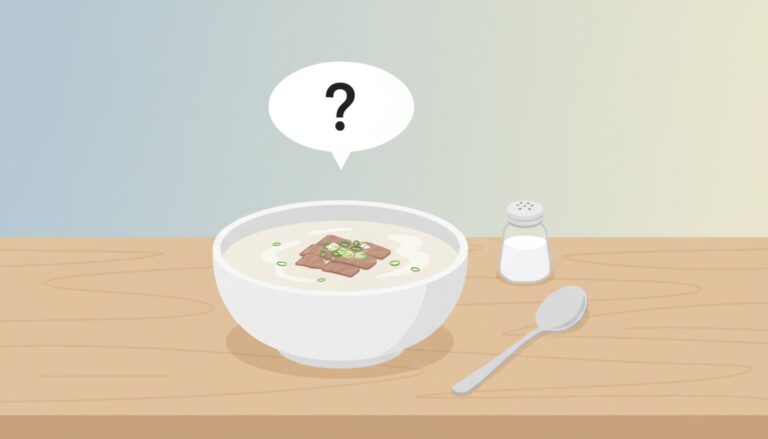
Imagine this: You finally sat down at a famous Seollongtang (Ox Bone Soup) restaurant in Seoul. The steam is rising, it looks delicious. You take your first spoonful… and pause. 😕
“It… tastes like nothing? Is it just hot water?”
Don’t panic! Many Korean soups are served unseasoned so you can customize them to your taste. But if you don’t know how to express that it’s tasteless, you might end up eating a very sad bowl of soup.
Today, we will learn the survival phrase for when your food lacks that kick. This guide is based on real questions from our A1 students who were too shy to ask for salt!
Phase 1: Deep Dive (Key Expressions)
Here are the top 3 expressions you need to save your meal.
1. 싱거워요 (Sing-geo-wo-yo)
- Pronunciation: [Sing-geo-wo-yo]
- Sound trick: “Sing” (like a song) + “Guh” (like disgust) + “War” + “Yo”.
- Meaning: It’s bland / It’s tasteless / It needs seasoning.
- Editor’s Insight: This isn’t necessarily a complaint! In Korea, saying something is sing-geo-wo-yo is just stating a fact about your taste preference. It means the salt level is too low.
- Situation Check: ✅ Casual / ✅ Polite (The ‘Yo’ makes it polite enough for restaurants).
2. 소금 좀 주세요 (So-geum jom ju-se-yo)
- Pronunciation: [So-geum jom ju-se-yo]
- Sound trick: “So” + “Gum” (chewing gum) + “Jom” + “Ju-se-yo”.
- Meaning: Please give me some salt.
- Editor’s Insight: ‘Jom’ literally means ‘a little bit,’ but in requests, it acts as a magical softener. It makes you sound much more polite and less demanding.
- Situation Check: ✅ Restaurant / ✅ Dining with elders.
3. 짜요 (Jja-yo)
- Pronunciation: [Jja-yo]
- Sound trick: “Jja” (Strong ‘J’ sound, tense your mouth) + “Yo”.
- Meaning: It’s salty.
- Editor’s Insight: This is the opposite of sing-geo-wo-yo. If you added too much salt… well, now you know this word too!
Phase 2: Textbook vs. Real Life
Textbooks can be a bit stiff. Let’s see how we talk in the real world.
| Textbook Korean (Safe but Robot-like 🤖) | Real Korean (Natural & Cool 😎) |
|---|---|
| 소금을 칠 수 있습니까? (Can I sprinkle salt?) |
소금 있어요? (Do you have salt?) |
| 음식이 맛이 없습니다. (The food has no taste.) |
좀 싱거운데요. (It’s a bit bland, though.) |
| 소금 좀 주시겠습니까? (Would you please give me salt?) |
저기요! 여기 소금 좀 주세요! (Excuse me! Salt here, please!) |
💡 Editor’s Note: For A1 beginners, sticking to “소금 주세요” (Salt, please) is perfectly fine and polite!
Phase 3: Cultural Context (Manners & Tips)
🧂 Look for the Hidden Stash!
Before you shout for the waiter, look at the table first. In soup restaurants (Gukbap or Seollongtang places), there is usually a small pot of salt, black pepper, and sometimes spicy red paste (Dadaegi) right on the table.
🤲 The Two-Hand Rule
If the server hands you the salt shaker, or if you hand it to a Korean friend:
* Receive with two hands (or support your right wrist with your left hand).
* It shows respect and good manners. Even for a salt shaker? Yes, even for a salt shaker!
Phase 4: Roleplay Script (Scenario)
Setting: A Seollongtang restaurant. You (Alex) are eating with a Korean friend (Minji).
(Alex takes a sip of the white soup and looks confused.)
Alex: 민지야, 이거 맛이… 음… 싱거워요.
(Minji-ya, igeo masi… eum… Sing-geo-wo-yo.)
[Minji, the taste is… um… it’s bland.]
Minji: 아, 설렁탕은 원래 간이 안 되어 있어.
(Ah, Seollongtang is originally unseasoned.)
[Ah, Seollongtang usually doesn’t come seasoned.]
Alex: 아, 진짜요? 소금 필요해요.
(Ah, jinjja-yo? So-geum piryo-haeyo.)
[Ah, really? I need salt.]
Minji: (Pointing to a small jar) 여기 있어! 소금 넣으세요.
(Yeogi isseo! So-geum neo-eu-se-yo.)
[It’s right here! Put some salt in.]
Phase 5: 10-Second Shadowing Drill 🗣️
Let’s practice! Read this out loud. Focus on the pause (/) to sound natural.
“Excuse me, it’s a bit bland. Please give me salt.”
저기요, / 이거 좀 싱거워요. / 소금 좀 주세요.
[Jeo-gi-yo, / i-geo jom sing-geo-wo-yo. / So-geum jom ju-se-yo.]
- Tip: Raise your tone slightly at “Jeo-gi-yo” to get attention!
Phase 6: FAQ (Troubleshooting)
Q: If I say “Sing-geo-wo-yo” to the chef, will they be offended?
A: Generally, no! Everyone has different taste buds. However, it’s softer to say “소금 좀 주시겠어요?” (Could you give me salt?) instead of directly complaining about the taste. But for soup? It’s 100% expected.
Q: What if it’s too spicy?
A: That is 매워요 (Mae-wo-yo). But today, let’s focus on the salt!
Phase 7: Wrap-up & Mission
📝 Summary:
* It’s bland = 싱거워요 (Sing-geo-wo-yo).
* Salt please = 소금 주세요 (So-geum ju-se-yo).
🚀 Today’s Mission:
Next time you eat something (even at home!), taste it and ask yourself: “Is this Sing-geo-wo-yo or Jja-yo?” Practice deciding the taste in Korean!
Tell us in the comments: What is the saltiest Korean food you’ve ever eaten? 👇
Phase 8: Pop Quiz 🧠
1. Which word describes a soup that tastes like plain water?
A) Jja-yo
B) Sing-geo-wo-yo
C) Mae-wo-yo
2. How do you polite ask for salt?
A) So-geum!
B) So-geum jom ju-se-yo.
C) So-geum aniyo.
3. True or False: You should hide your hands under the table when asking for salt.
A) True
B) False (Use two hands!)
(Scroll down for answers)
Answers: 1. (B), 2. (B), 3. (B)
Frequently Asked Questions (FAQ)
Q: What does "싱거워요 (Sing-geo-wo-yo)" mean in Korean and how do you pronounce it?
A: In Korean, "싱거워요 (Sing-geo-wo-yo)" is pronounced [Sing-geo-wo-yo] and means: a key conversational Korean expression covered in this lesson.
Q: What does "소금 좀 주세요 (So-geum jom ju-se-yo)" mean in Korean and how do you pronounce it?
A: In Korean, "소금 좀 주세요 (So-geum jom ju-se-yo)" is pronounced [So-geum jom ju-se-yo] and means: a key conversational Korean expression covered in this lesson.
Q: What does "짜요 (Jja-yo)" mean in Korean and how do you pronounce it?
A: In Korean, "짜요 (Jja-yo)" is pronounced [Jja-yo] and means: a key conversational Korean expression covered in this lesson.







