

Phase 1: Introduction
Hello! This is your Senior Editor at Daily Hangul.
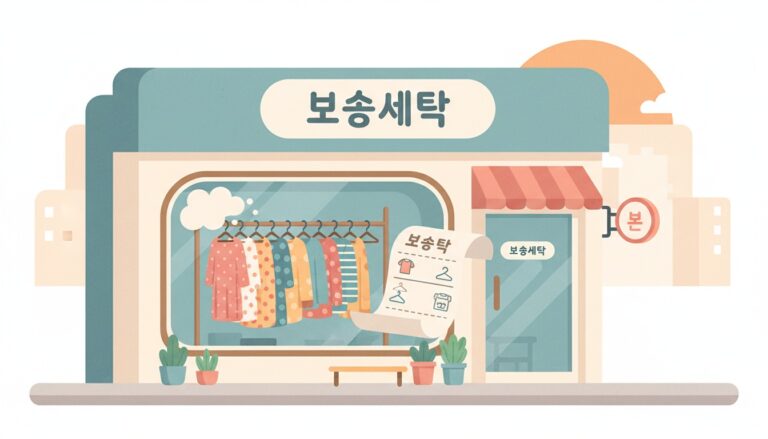
Imagine this: You’ve just dropped off your favorite winter coat at the local 세탁소 (Setakso – Dry Cleaners). The owner, a friendly Ajusshi, nods and takes your clothes to the back. You stand there for a moment, suddenly realizing… “Wait, how do I prove this coat is mine when I come back?”
If you walk away without a receipt, you might face a confusing game of charades next week trying to describe your beige trench coat among fifty other beige trench coats.
Today, we are going to learn the simple yet powerful phrase that saves you from lost laundry and confusion. As a tutor, I’ve seen students shy away from asking for receipts because they fear the pronunciation, but today we fix that!
(Transparency Note: This guide is based on real questions from our ‘Survival Korean’ weekend class participants.)
Phase 2: Deep Dive (Core Phrases)
Here are the top 3 phrases you need to survive the Setakso interaction.
1. 영수증 주세요 (Please give me a receipt)
- Pronunciation: [Yeong-su-jeung ju-se-yo]
- Sound Analogy: Young (as in young person) + Sue (the name) + Jeung (sounds like the ‘jung’ in jungle) + Ju-se-yo.
- Meaning: “Receipt, give please.”
- Editor’s Insight: The word 영수증 (Yeongsujeung) can be a mouthful. If you struggle, just focus on the rhythm: Young-Sue-Jeung. It’s a standard, polite request used everywhere from Starbucks to the dry cleaner.
- Situation Check: ✅ Polite / ✅ Casual (with ‘yo’)
2. 언제 돼요? (When will it be done?)
- Pronunciation: [Eon-je dwae-yo?]
- Sound Analogy: Un-jay (sounds like ‘undies’ without the ‘d’) + Day-yo.
- Meaning: “When does it become (finished)?”
- Editor’s Insight: You don’t need complex future tense grammar here. Just asking “When okay?” is enough. This helps you know exactly when to return.
- Situation Check: ✅ Standard Polite
3. 얼마예요? (How much is it?)
- Pronunciation: [Eol-ma-ye-yo?]
- Sound Analogy: All-ma-yeah-yo?
- Meaning: “How much is it?”
- Editor’s Insight: In Korea, some dry cleaners ask for payment upfront (seon-bul), while others ask for it when you pick up (hu-bul). It’s good to ask this right away to avoid awkward silence.
- Situation Check: ✅ Essential
Phase 3: Textbook vs. Real Life
Textbooks often teach you the most formal version, but if you say that to the friendly neighborhood laundry owner, you might sound like a news anchor!
| Textbook Korean 📚 | Real Life Korean (Insa Style) 😎 |
|---|---|
| 영수증을 주시겠습니까? (Would you formally grant me a receipt?) |
영수증 좀 주세요. (Receipt, please.) |
| 이것은 언제 완료됩니까? (When will this be completed?) |
언제 찾으러 와요? (When do I come to pick it up?) |
💡 Editor’s Note for A1: The magic word here is 좀 (Jom). Literally, it means “a little,” but when you add it to a request (Receipt jom juseyo), it softens your tone instantly. It makes you sound much more native!
Phase 4: Cultural Context & Manners
The “Handover” Etiquette
In Korea, giving and receiving items is a subtle dance of respect. When the owner hands you the receipt:
- Don’t snatch it with one hand while looking at your phone.
- Use two hands to receive it, or support your right elbow with your left hand.
- The Bow: A slight nod of the head as you take it is the universal sign of “Thank you.”
The “Nunchi” (Reading the Room)
If the owner is rushing around and looks busy, keep your request short. If they are chatting with a neighbor, a quick “Yeongsujeung juseyo” with a smile is perfect. Don’t be afraid to ask; in Korea, receipts are often not given automatically for small amounts unless requested.
Phase 5: Real-Life Scenario (Roleplay)
Setting: A small neighborhood dry cleaner (Setakso). It smells like steam and fabric softener.
Characters: Alex (Foreigner, A1 level) and Sajangnim (Owner).
(Alex puts a shirt on the counter)
Alex: 안녕하세요. (Hello.)
[An-nyeong-ha-se-yo]
Sajangnim: 네, 어서오세요. 이거 드라이(cleaning) 해요? (Yes, welcome. Dry clean this?)
Alex: 네. 언제 돼요? (Yes. When will it be ready?)
[Ne. Eon-je dwae-yo?]
Sajangnim: 모레 오세요. (Come day after tomorrow.)
Alex: 네, 알겠습니다. 아! 영수증 좀 주세요. (Okay, I understand. Ah! Please give me a receipt.)
[Ne, al-get-seum-ni-da. Ah! Yeong-su-jeung jom ju-se-yo.]
Sajangnim: (Handing paper with two hands) 네, 여기요. (Yes, here you go.)
Alex: (Receiving with two hands) 감사합니다. (Thank you.)
Phase 6: 10-Second Shadowing
Let’s practice the most important sentence. Read this aloud three times. Focus on the pauses.
“Yeong-su-jeung / jom / ju-se-yo.”
(Receipt / please / give me.)
- Tip: Don’t stress the “yo” at the end too much. Make the “Jeung” slightly higher in pitch.
Phase 7: FAQ & Troubleshooting
- Q: Can I use this phrase at a convenience store or restaurant too?
- A: Absolutely! 영수증 주세요 works 100% of the time, anywhere money is exchanged.
- Q: What if the owner asks: “Yeongsujeung piryohaseyo?”
- A: They are asking, “Do you need a receipt?” You can simply reply “Ne!” (Yes) or “Gwaenchana-yo” (It’s okay/No thanks).
- Q: Is it rude if I don’t use ‘Jom’?
- A: Not at all. It’s perfectly polite without it, but using Jom just makes you sound softer and friendlier.
Phase 8: Wrap-up
One-Liner Summary:
Always protect your clothes by asking “Yeongsujeung juseyo” (Receipt please) with a slight nod!
Your Mission:
Check your pockets! Before you go to the dry cleaners, make sure you didn’t leave any tissues or cash in your pockets. Then, go practice asking for a receipt at your local convenience store today!
Let’s Chat:
Have you ever had a funny misunderstanding at a Korean shop? Tell me in the comments!
Phase 9: Quiz
1. What is the “magic word” that makes your request sound softer?
a) Ya (야)
b) Jom (좀)
c) Palli (빨리)
2. How should you receive the receipt to show good manners?
a) With one hand while walking away
b) With two hands
c) You shouldn’t take it
3. What does “Eonje dwaeyo?” mean?
a) How much is it?
b) When will it be ready?
c) Where is the bathroom?
(Answers: 1-b, 2-b, 3-b)
Frequently Asked Questions (FAQ)
Q: What does "영수증 주세요 (Please give me a receipt)" mean in Korean and how do you pronounce it?
A: In Korean, "영수증 주세요 (Please give me a receipt)" is pronounced [Yeong-su-jeung ju-se-yo] and means: a key conversational Korean expression covered in this lesson.
Q: What does "언제 돼요? (When will it be done?)" mean in Korean and how do you pronounce it?
A: In Korean, "언제 돼요? (When will it be done?)" is pronounced [Eon-je dwae-yo?] and means: a key conversational Korean expression covered in this lesson.
Q: What does "얼마예요? (How much is it?)" mean in Korean and how do you pronounce it?
A: In Korean, "얼마예요? (How much is it?)" is pronounced [Eol-ma-ye-yo?] and means: a key conversational Korean expression covered in this lesson.







