

Phase 1: Hello from Daily Hangul! 👋
Hello, Daily Hangul readers! This is your Senior Editor.
Imagine this: You have walked 20 minutes under the hot sun to find that famous Tonkatsu place in Yeonnam-dong. You arrive at 2:50 PM, hungry and excited. The door is open, but when you walk in, the staff looks at you with an awkward smile and makes an ‘X’ with their arms.
Panic sets in. “Is it closed? Forever? Did I do something wrong?”
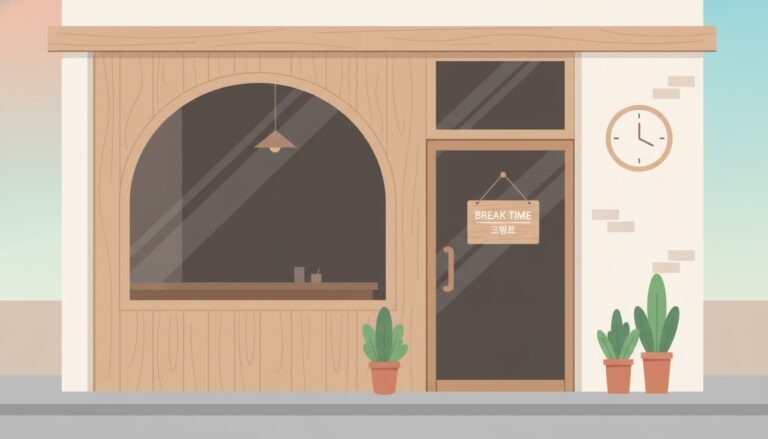
Don’t worry! You just encountered the infamous “Break Time” (브레이크 타임). In Korea, especially in trendy areas, almost all good restaurants stop serving between 3:00 PM and 5:00 PM to prep for dinner.
Knowing how to check this before you sit down will save you from awkwardness and hunger. Today, we look at the most natural ways to ask, “Can we still eat?”
Phase 2: Deep Dive into Key Expressions 🧐
Here are the three phrases that will make you sound like a local regular, not just a tourist.
1. 식사 되나요? (Is dining possible?)
- Pronunciation: [Sik-sa Dwae-na-yo?]
- Sik-sa sounds like “Sick-Saw”.
- Dwae sounds very similar to the English word “Day” but with your mouth wider open.
- Meaning: Literally “Is a meal possible?” / Real nuance: “Are you still serving food right now?”
- Editor’s Insight: This is the MVP of restaurant phrases. Instead of asking “Are you open?” (which might be technically yes, but the kitchen is closed), this asks if you can actually get food. It’s polite and perfect for B1 learners.
- Situation Check: ✅ Casual ✅ Formal
2. 지금 브레이크 타임인가요? (Is it break time now?)
- Pronunciation: [Ji-geum Break-Time In-ga-yo?]
- Ji-geum (Now).
- In-ga-yo is a soft question ending, sounding like “In-guy-yo?”
- Meaning: “Is it break time right now?”
- Editor’s Insight: Korean uses the English loanword “Break Time” directly! But remember the Korean accent: it’s not “Break Time”, it’s “Bu-rei-keu Ta-im” (5 syllables). If you say it with a heavy American accent, they might not catch it instantly.
- Situation Check: ✅ Casual ✅ Formal
3. 저녁 영업 몇 시부터예요? (What time does dinner service start?)
- Pronunciation: [Jeo-nyeok Yeong-eop Myeot-si Bu-teo-ye-yo?]
- Meaning: “From what time is the evening business?”
- Editor’s Insight: Use this when you’ve already been rejected. Instead of walking away sadly, show your determination to come back! It signals, “I’ll be back because your food is worth it.”
- Situation Check: ✅ Casual ✅ Formal
Phase 3: Textbook vs. Real Life 🆚
Textbooks often teach you grammatically correct but slightly robotic phrases. Let’s see how they compare to what you hear on the streets of Seoul.
| Textbook Korean (Grammatically correct but stiff) | Real Life Korean (Natural & Native) |
|---|---|
| 문 열었습니까? (Did you open the door?) | 지금 식사 돼요? (Can we eat now?) |
| 휴식 시간입니까? (Is it rest time?) | 지금 브레이크 타임이에요? (Is it break time?) |
| 주문 가능합니까? (Is ordering possible?) | 주문 마감됐나요? (Is the ‘Last Order’ finished?) |
Note: “Last Order” (라스트 오더) is another Konglish word you must know. It is usually 30~60 minutes before the Break Time starts.
Phase 4: Cultural Context & Manners 🍶
The “Nunchi” (Eye Measure) of Break Time
If you enter a restaurant at 2:50 PM and the Break Time starts at 3:00 PM, technically they are open. However, Nunchi (reading the room) is key here.
- The Look: If the staff are wiping tables and arranging cutlery, they are ready to rest.
- The Question: Even if the door is unlocked, always make eye contact and ask “Siksa doenayo?” before sitting down. It shows respect for their rest time.
- The “X” Sign: If a staff member makes an X with their arms, don’t try to negotiate. It means the kitchen is strictly closed.
Phase 5: Real-Life Scenario (Roleplay) 🎬
Setting: A popular Pasta bar in Seongsu-dong. It is 2:55 PM. Break time starts at 3:00 PM.
Characters:
* Alex (Guest): Hungry tourist.
* Staff (Local): Tired part-timer.
(Alex walks in and hesitates near the entrance.)
Alex: 저기요, 혹시 지금 식사 되나요?
(Excuse me, is dining possible right now?)
[Jeogiyo, hoksi jigeum siksa doenayo?]
Staff: (Looking apologetic) 아, 죄송해요. 저희 3시부터 브레이크 타임이라서요.
(Ah, I’m sorry. We have break time starting from 3.)
[Ah, joesonghaeyo. Jeohi sesi-buteo break time-iraseoyo.]
Alex: 아, 그렇구나. 그럼 저녁 영업은 몇 시부터예요?
(Ah, I see. Then what time does dinner service start?)
[Ah, geureokuna. Geureom jeonyeok yeong-eop-eun myeot-si buteo-yeyo?]
Staff: 5시부터 입장 가능하세요.
(You can enter starting from 5 o’clock.)
[Daseot-si buteo ipjang ganeung-haseyo.]
Phase 6: 10-Second Shadowing Drill 🎧
Don’t just read it, say it! Practice the rhythm. In Korean, the verb usually carries a rising intonation in questions.
“Excuse me, is it break time right now?”
죄송한데, / 지금 / 브레이크 타임 / 인가요?
[Joe-song-han-de, / ji-geum / bu-rei-keu-ta-im / in-ga-yo?]
- Point: Pause slightly after “Jeo-song-han-de” (Excuse me/Sorry but…) to soften your approach.
Phase 7: FAQ & Troubleshooting 🛠️
Q: Can I just sit inside the restaurant and wait until 5 PM if it’s hot outside?
A: Generally, No. Break time is often when staff eat their own lunch or take a nap on the tables. It is considered rude to stay inside. It’s better to find a nearby cafe.
Q: Do franchise restaurants (like McDonald’s or Kimbap Cheonguk) have break times?
A: Usually No. Break times are mostly for private restaurants, fine dining, or trendy spots. Fast food and 24-hour places (like Kimbap shops) run non-stop.
Phase 8: Wrap-up & Mission 🎯
One-Liner Summary:
If you arrive between 2:30 PM and 5:00 PM, always ask “Siksa Doenayo?” before taking a seat!
Your Mission Today:
Open Naver Maps or Kakao Maps, find a restaurant you want to visit, and look for the “Break Time” label in the info section. It usually looks like “브레이크타임 15:00 ~ 17:00”. Spotting this before you go makes you a pro traveler!
Have you ever been kicked out (politely) because of Break Time? Tell us your story in the comments! 👇
Phase 9: Pop Quiz 🧠
1. What is the most natural way to ask if you can eat right now?
A) 밥 먹어도 돼요? (Can I eat rice?)
B) 식사 되나요? (Is dining possible?)
C) 문 열었나요? (Is the door open?)
2. When is the typical Break Time in Korea?
A) 12:00 PM – 1:00 PM
B) 3:00 PM – 5:00 PM
C) 9:00 PM – 10:00 PM
3. If the staff says “Last Order is finished,” what should you do?
A) Beg them to let you in.
B) Ask what time dinner service starts and come back later.
C) Sit down anyway.
(Answers: 1. B, 2. B, 3. B)







