

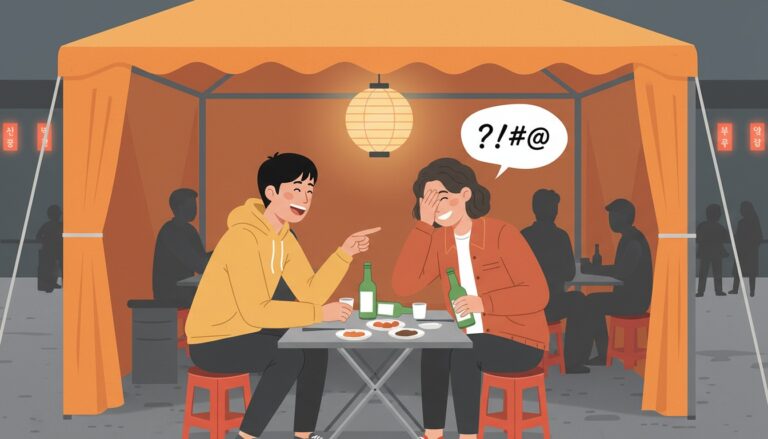
Introduction: Why Are They Yelling?
Hello! This is your editor from Daily Hangul.
Picture this: You are watching your favorite K-Drama on Netflix. The main character, visibly frustrated, shouts something that sounds like “Ya! Michin-nom-a!” The subtitles politely translate it as “Hey! You jerk!” or even “Oh my goodness!”
As a veteran tutor, I see my students get confused here all the time. The subtitles often fail to capture the intensity, the affection, or the sheer rage behind these words. If you only learn Korean from polite textbooks, you will miss 50% of the emotion in these scenes.
Today, we are going to look behind the curtain. We aren’t just learning “bad words” to insult people (please don’t!); we are learning to understand the nuance of the B2-level emotional spectrum. This is how you move from a student to an Insider.
Phase 2: Deep Dive into Drama Classics
Here are three expressions you hear in almost every episode, but often misunderstand.
1. 미친 (Michin)
- Pronunciation: Michin [Sounds like ‘Me’ + ‘Chin’]
- Meaning: Crazy / Insane
- Editor’s Insight: Literally, it comes from 미치다 (to go crazy). But in dramas, it’s a chameleon.
- Negative: “Are you out of your mind?” (Anger)
- Positive: “This food is michin!” (It’s insanely good)
- Shock: “Ha… michin…” (Disbelief/Speechless)
- Situation Check: Only with close friends or when talking to yourself. Never to a boss!
2. 새끼 (Saekki / Saggi)
- Pronunciation: Saekki [Strong ‘S’ sound, almost spitting the air out]
- Meaning: Offspring / Young one / Jerk / Bastard
- Editor’s Insight: This is the most confusing word for foreigners.
- If a gangster says it: It’s a serious insult (“You bastard”).
- If a grandma says it to her grandson: It’s pure love (“My little puppy/brat”).
- If a friend says it: It’s playful (“Hey dude”).
- Situation Check: Context is King. Listen to the tone, not just the word.
3. 죽을래? (Jugeullae?)
- Pronunciation: Ju-geul-lae? [Intonation goes up sharply at the end]
- Meaning: Do you want to die?
- Editor’s Insight: This isn’t a death threat! It is the Korean equivalent of saying, “Knock it off,” “Stop teasing me,” or “I’m so embarrassed because of you, please stop.” It is often used between siblings or couples in a “teasing” fight.
Phase 3: Textbook vs. Real Life (Drama Edition)
Let’s see how a textbook robot speaks versus a K-Drama protagonist.
| Textbook Korean (Standard) | K-Drama / Real Life (Nuanced) |
|---|---|
| 정말 화가 나요. (I am very angry.) | 아, 열받네 진짜! (Ah, my heat is rising, seriously!) |
| 그건 말도 안 돼요. (That makes no sense.) | 개소리 하지 마. (Don’t make “dog sounds” / Don’t talk nonsense.) |
| 제발 그만하세요. (Please stop doing that.) | 적당히 좀 해라. (Do it moderately / That’s enough.) |
Note: As a B2 learner, you should understand the right column, but mostly stick to speaking the left column until you are very close with someone!
Phase 4: Cultural Context & Manners
The Art of “Nunchi” (Eye Measure)
In Korea, how you say a swear word matters more than what you say.
- Eye Contact: If you say “Jugeullae?” while smiling and hitting your friend’s shoulder lightly, it’s flirting or joking. If you say it with a frozen face and unblinking eyes (Jjaeryeobogi – the death glare), it’s a warning.
- The “Ya!” Factor: “Ya!” (Hey!) often precedes these words. The length of the “Ya” determines the anger level. Short “Ya!” = Attention. Long, loud “Yaaaaaa!” = You are in big trouble.
Phase 5: Real-Life Scenario (Roleplay)
Setting: Two close friends, Min-ji and Jason, at a café. Jason just spilled coffee on Min-ji’s new phone by accident.
Min-ji: 야! 미친 거 아니야?
(Ya! Michin geo aniya?)
(Hey! Are you crazy?)
Jason: 아, 미안, 미안! 일부러 그런 거 아냐.
(Ah, mian, mian! Ilbureo geureon geo anya.)
(Ah, sorry, sorry! I didn’t mean to.)
Min-ji: (Wiping phone) 너 진짜… 죽을래? 이거 어제 산 거라고!
(Neo jinjja… jugeullae? Igeo eoje san georago!)
(You really… wanna die? I bought this yesterday!)
Jason: 내가 밥 살게. 봐주라.
(Naega bap salge. Bwajura.)
(I’ll buy you dinner. Let me off the hook.)
Phase 6: 10-Second Shadowing Drill
Let’s practice the “annoyed but friendly” tone. Do not sound robotic!
Sentence: “Hey, stop talking nonsense and just sit down.”
Korean: “야, / 개소리 좀 그만하고 / 그냥 앉아.”
Romanization: “Ya, / gaesori jom geuman-hago / geunyang anja.”
Tips:
1. Ya: Sharp and short.
2. Gaesori: Stress the ‘Gae’.
3. Anja: Drop your pitch at the end to sound firm.
Phase 7: FAQ & Troubleshooting
- Q: Can I use “Saekki” (Jerk/Brat) with a junior at work if we are friendly?
- Answer: No. Even if you are close, in a workplace setting (Office), it is considered harassment or very unprofessional. Keep it for drinking places (Pocha) outside of work hours.
- Q: Drama characters say “Aish!” all the time. Is that a bad word?
- Answer: It’s more of a sound of frustration, like “Darn it!” or “Ugh!” It is not a swear word, but it is rude to do it in front of elders or teachers.
Phase 8: Wrap-up
Today’s Summary: Korean swear words in dramas are often about intimacy and context, not just insults. “Crazy” (Michin) can mean “Amazing,” and “Wanna die?” (Jugeullae) can mean “Stop teasing.”
Your Mission: Watch one episode of a K-Drama today. Every time you hear “Michin,” “Saekki,” or “Jugeullae,” pause and ask yourself: Is this anger, shock, or affection?
Tell me in the comments: What is the most confusing Korean phrase you’ve heard in a drama? I’ll explain it in the next post! 👋
Phase 9: Pop Quiz
1. Your friend tells a joke that is not funny at all. What is a “slangy” way to say “Don’t talk nonsense”?
a) 하지 마 (Haji ma)
b) 개소리 하지 마 (Gaesori haji ma)
c) 안녕하세요 (Annyeonghaseyo)
2. Which phrase literally means “Do you want to die?” but is used to say “Cut it out”?
a) 사랑해 (Saranghae)
b) 죽을래? (Jugeullae?)
c) 갈래? (Gallae?)
3. True or False: You should use “Michin” (Crazy) to compliment your boss’s tie.
a) True
b) False (Please, never do this!)
Click to see answers
1. b) 개소리 하지 마
2. b) 죽을래?
3. b) False
Frequently Asked Questions (FAQ)
Q: What does "미친 (Michin)" mean in Korean and how do you pronounce it?
A: In Korean, "미친 (Michin)" is pronounced [Michin [Sounds like 'Me' + 'Chin'] and means: Crazy / Insane
Q: What does "새끼 (Saekki / Saggi)" mean in Korean and how do you pronounce it?
A: In Korean, "새끼 (Saekki / Saggi)" is pronounced [Saekki [Strong 'S' sound, almost spitting the air out] and means: Offspring / Young one / Jerk / Bastard
Q: What does "죽을래? (Jugeullae?)" mean in Korean and how do you pronounce it?
A: In Korean, "죽을래? (Jugeullae?)" is pronounced [Ju-geul-lae? [Intonation goes up sharply at the end] and means: Do you want to die?







