

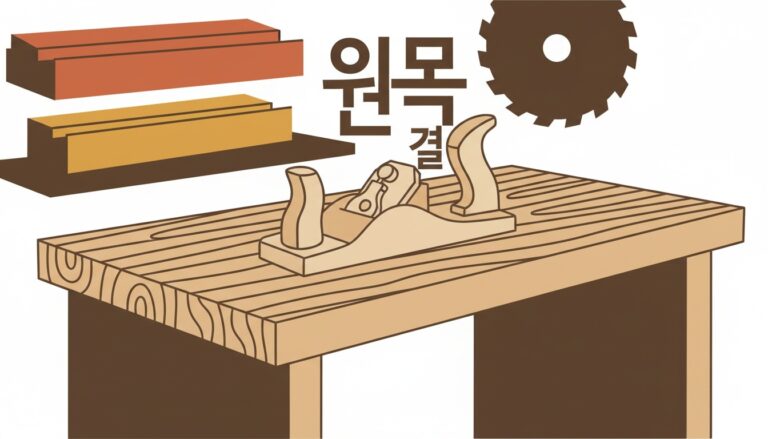
Phase 1: Introduction
Hello! This is your Head Editor at Daily Hangul.
Imagine this: You’ve finally decided to build that custom coffee table you’ve been dreaming of. You walk into a Korean timber mill (목재소) or a DIY workshop (공방), confident in your design. But when the master carpenter asks you about the wood grain or its reaction to humidity, you freeze. You know the word “나무” (tree/wood), but suddenly that feels like A1-level baby talk.
In the world of Korean DIY and carpentry, vocabulary is specific, technical, and surprisingly poetic. At the C1 Advanced Level, simply pointing and saying “this one” won’t get you the respect of the artisan, nor will it get you the right material for Korea’s distinct four seasons.
Today, we are moving beyond basic survival Korean. We are going to talk about density, grain, and the soul of the wood. This guide is strictly for those who want to discuss craftsmanship like a local pro.
Phase 2: Deep Dive into Core Expressions
Here are the three critical terms you need to discuss wood characteristics intelligently.
1. 견고하다 (Gyeong-go-ha-da)
- Pronunciation: [gyeon-go-ha-da] Think of ‘Gun’ + ‘Go’ + ‘Ha’ + ‘Da’. The ‘G’ is soft, like ‘gate’.
- Meaning: To be sturdy, solid, or robust.
- Editor’s Insight: While “튼튼하다” (teun-teun-ha-da) is the common word for “strong,” 견고하다 implies a higher level of structural integrity and quality. You wouldn’t use this for a cheap plastic chair; you use it for a piece of solid oak furniture that will last a generation.
- Situation Check: Very appropriate for formal discussions with carpenters or when complimenting a finished piece.
2. 뒤틀림 (Dwi-teul-lim)
- Pronunciation: [dwi-teul-lim] ‘Dwi’ sounds like the French ‘oui’ with a D in front.
- Meaning: Warping or twisting.
- Editor’s Insight: This is the #1 enemy in Korean woodworking due to the humid summers and dry winters (On-dol heating systems). If you ask about 뒤틀림, the seller will immediately recognize you as a knowledgeable buyer.
- Example: “이 나무는 뒤틀림이 심한가요?” (Does this wood warp easily?)
- Situation Check: Essential technical term. Use it when selecting raw materials.
3. 나뭇결 (Na-mut-gyeol)
- Pronunciation: [na-mut-gyeol] Pronounced as if it is written [나묻껼].
- Meaning: Wood grain / Texture of the wood.
- Editor’s Insight: Koreans value the visual flow of the wood. It’s not just about the color; it’s about the 결 (gyeol – the wave/flow). You might say the grain is “beautiful” (아름답다) or “rough” (거칠다).
Phase 3: Textbook vs. Real Life (C1 Edition)
At this level, we replace general nouns with industry-specific terminology.
| Textbook / General (Generic) | Real Life / Workshop (Pro) | Nuance Difference |
|---|---|---|
| 나무 (Namu) | 원목 (Won-mok) | ‘Namu’ is a tree outside. ‘Won-mok’ is solid wood material. |
| 단단해요 (Dan-dan-hae-yo) | 내구성이 좋아요 (Nae-gu-seong-i jo-a-yo) | ‘Hard’ vs. ‘Has good durability’. |
| 부드러워요 (Bu-deu-reo-wo-yo) | 마감이 잘 됐어요 (Ma-gam-i jal dwaet-seo-yo) | ‘Soft’ vs. ‘The finishing is done well’. |
| 가짜 나무 (Ga-jja namu) | 합판 / MDF (Hap-pan) | Using specific terms for Plywood/MDF shows expertise. |
Editor’s Note: Using 원목 (solid wood) instead of just ‘wood’ changes the entire price point and conversation level.
Phase 4: Cultural Context & Manners
The “Ondol” Factor
In Western carpentry, you might worry about rain. In Korea, you must worry about the Ondol (floor heating). When discussing wood characteristics, mentioning the heating system shows deep cultural insight.
* Tip: Ask, “온돌 바닥에서도 괜찮을까요?” (Will this be okay even on a heated floor?)
The Tactile Etiquette
In a Gongbang (workshop), never run your hands over finished wood pieces without asking, especially if the oil finish is drying. However, for raw wood (lumber), looking closely at the 옹이 (knots) and checking for straightness is expected behavior for a serious buyer.
Phase 5: Real Scenario Roleplay
Setting: A woodworking workshop in Seongsu-dong. You are consulting with the Head Carpenter (실장님) about a dining table.
Characters:
* You: Advanced Learner
* Carpenter: Expert Artisan
You: (Touching a slab of Walnut) 이 월넛으로 식탁을 만들고 싶은데요, 변형이 걱정돼서요.
(I want to make a dining table with this Walnut, but I’m worried about deformation.)
[I wol-neot-eu-ro sik-tak-eul man-deul-go si-peun-de-yo, byeon-hyeong-i geok-jeong-dwae-seo-yo.]
Carpenter: 월넛은 하드우드라 견고해서 뒤틀림이 거의 없어요. 아주 좋은 선택입니다.
(Walnut is a hardwood, so it’s sturdy and has almost no warping. It’s a very good choice.)
[Wol-neot-eun ha-deu-u-deu-ra gyeon-go-hae-seo dwi-teul-lim-i geo-ui eop-seo-yo.]
You: 다행이네요. 그리고 나뭇결이 좀 자연스럽게 살아있으면 좋겠어요.
(That’s a relief. Also, I would like the wood grain to feel natural and vivid.)
[Da-haeng-i-ne-yo. Geu-ri-go na-mut-gyeol-i jom ja-yeon-seu-reop-ge sa-ra-it-seu-myeon jo-ket-seo-yo.]
Carpenter: 그럼 오일 마감으로 결을 살려드릴게요.
(Then I will bring out the grain using an oil finish.)
Phase 6: 10-Second Shadowing Drill
Read this aloud to practice flow and intonation. This is a complex C1 sentence.
“Hardware is important, / but understanding the contraction and expansion of the wood itself / is the most critical part.”
철물도 중요하지만, / 원목 자체의 수축과 팽창을 이해하는 것이 / 가장 핵심입니다.
[Cheol-mul-do jung-yo-ha-ji-man, / won-mok ja-che-ui su-chuk-gwa paeng-chang-eul i-hae-ha-neun geo-si / ga-jang haek-sim-im-ni-da.]
Focus Point: Be careful with 수축 (contraction) and 팽창 (expansion). These are high-level Sino-Korean words.
Phase 7: FAQ & Troubleshooting
- Q: Can I use the word “나무” (Namu) at all?
- A: Yes, but it sounds generic. In a workshop, referring to the material as 목재 (Mok-jae – lumber/timber) or 원목 (Won-mok – solid wood) sounds much more professional. Use Namu when talking about the living tree or in a poetic sense.
- Q: How do I say “plywood” without sounding rude?
- A: Plywood is 합판 (Hap-pan). It’s not a bad word! It’s a valid material. Just don’t confuse it with Won-mok.
Phase 8: Wrap-up
One-Liner Summary:
To sound like a pro in a Korean workshop, swap “strong” for “견고하다”, ask about “뒤틀림” (warping), and appreciate the “나뭇결” (grain).
Action Mission:
Find a wooden furniture item in your house. Touch it and describe it in Korean: “이 가구는 견고하지만 나뭇결이 잘 안 보여요.” (This furniture is sturdy, but the grain isn’t very visible.)
Join the conversation:
What’s your favorite type of wood? Oak (참나무)? Walnut (호두나무)? Tell us in the comments!
Phase 9: Pop Quiz
1. Which word best describes the “warping” or “twisting” of wood due to humidity?
A) 수축 (Su-chuk)
B) 뒤틀림 (Dwi-teul-lim)
C) 마감 (Ma-gam)
2. You want to praise the “sturdiness” or “structural integrity” of a table. What is the best C1 word?
A) 딱딱하다 (Ttak-ttak-ha-da)
B) 견고하다 (Gyeong-go-ha-da)
C) 무겁다 (Mu-geop-da)
3. Which term refers to “Solid Wood” as opposed to plywood or MDF?
A) 원목 (Won-mok)
B) 합판 (Hap-pan)
C) 가짜 나무 (Ga-jja namu)
(Answers: 1. B, 2. B, 3. A)
Frequently Asked Questions (FAQ)
Q: What does "견고하다 (Gyeong-go-ha-da)" mean in Korean and how do you pronounce it?
A: In Korean, "견고하다 (Gyeong-go-ha-da)" is pronounced [gyeon-go-ha-da] and means: To be sturdy, solid, or robust.
Q: What does "뒤틀림 (Dwi-teul-lim)" mean in Korean and how do you pronounce it?
A: In Korean, "뒤틀림 (Dwi-teul-lim)" is pronounced [dwi-teul-lim] and means: Warping or twisting.
Q: What does "나뭇결 (Na-mut-gyeol)" mean in Korean and how do you pronounce it?
A: In Korean, "나뭇결 (Na-mut-gyeol)" is pronounced [na-mut-gyeol] and means: Wood grain / Texture of the wood.







