

Hello! This is your Daily Hangul Editor.
Welcome back to the master class. If you are reading this, you are likely not just ordering bibimbap anymore. You are probably watching the 9 PM News (9시 뉴스), reading editorials in the Chosun Ilbo or Hankyoreh, or perhaps finding yourself in a heated dinner debate with Korean colleagues about the geopolitical destiny of the Korean Peninsula.
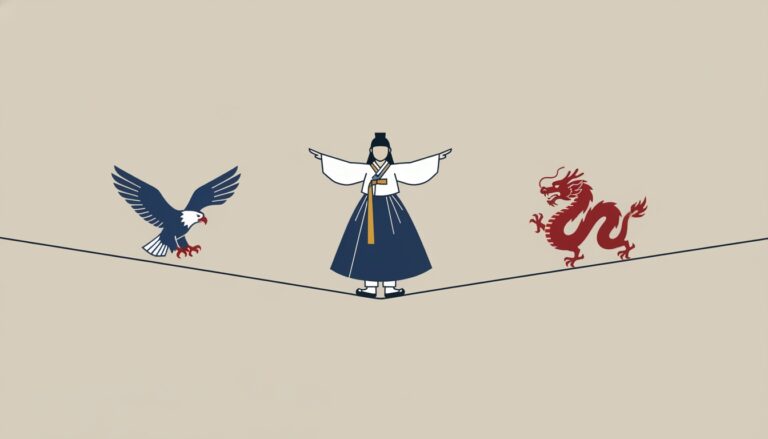
Today’s topic is the “Ultimate Dilemma” of Korean politics: The balancing act between the ROK-US Alliance (한미동맹) and ROK-China Relations (한중관계).
To a foreigner, it might look like Korea is just indecisive. But to Koreans, this is a desperate survival strategy known as “Balanced Diplomacy” (균형 외교). If you can use the expressions below effectively, Koreans won’t just see you as a fluent speaker—they will respect you as an intellectual (지식인) who truly grasps the soul of Korea’s geopolitical anxiety.
This guide is based on real debates heard in Yeouido (Korea’s political center) and high-level business meetings. Let’s dive deep.
Phase 2: Deep Dive into Key Expressions
1. 전략적 모호성 (Strategic Ambiguity)
- Pronunciation: Jeollyakjeok Mohoseong [Jeol-lyak-jeok Mo-ho-seong]
- Tip: The ‘Jeol’ sounds sharp, like the word ‘Jolt’. ‘Mohoseong’ flows smoothly like a fog.
- Meaning:
- Literal: Strategic ambiguity.
- Real Nuance: This is the magic shield of Korean diplomacy. It means deliberately not taking a clear side between the US and China to avoid retaliation from either. It’s not “being confused”; it’s “calculated silence.”
- Editor’s Insight: If someone asks, “So, does Korea support the US or China on this issue?” and you answer, “It seems like a case of strategic ambiguity (전략적 모호성),” you will instantly sound like a political analyst.
- Situation Check: Formal & Professional. (Too heavy for a casual pocha drink, perfect for a seminar).
2. 안미경중 (Security with US, Economy with China)
- Pronunciation: Anmigyeongjung [An-mi-gyeong-jung]
- Tip: Treat it as a four-character idiom (Sajeoseong-eo). Say it with rhythm: An-Mi / Gyeong-Jung.
- Meaning:
- Literal: Anbo (Security) = Miguk (USA); Gyeongje (Economy) = Jungguk (China).
- Real Nuance: This phrase defined Korean diplomacy for years. It acknowledges the uncomfortable reality: We need American guns for defense, but we need Chinese markets to eat.
- Editor’s Insight: While this term is becoming slightly dated as the geopolitical landscape shifts, it remains the best concise summary of the Korean dilemma. Use this to explain the history of the situation.
- Situation Check: Formal/Debate. Great for summarizing complex articles.
3. 줄타기 외교 (Tightrope Diplomacy)
- Pronunciation: Jultagi Oegyo [Jul-ta-gi We-gyo]
- Tip: ‘Jul’ sounds like ‘Jewel’. ‘Tagi’ is ‘riding’. Imagine walking a thin line.
- Meaning:
- Literal: Rope-riding diplomacy.
- Real Nuance: A vivid metaphor for “Balanced Diplomacy.” It implies high risk—one wrong step, and you fall.
- Editor’s Insight: This is much more evocative than simply saying “Middle ground.” It captures the nervousness and skill required.
- Situation Check: All Situations. You can use this in casual conversation or formal writing.
Phase 3: Textbook vs. Real Life (C2 Edition)
At the C2 level, we move from “describing facts” to “analyzing nuance.”
| Textbook Korean (Standard) | Real Intellectual Korean (Insightful) |
|---|---|
| 한국은 미국과 중국 사이에서 고민하고 있어요. (Korea is worrying between the US and China.) | 한국은 미중 패권 경쟁 속에서 실리 외교를 추구해야 합니다. (Korea must pursue pragmatic diplomacy amidst the US-China hegemonic competition.) |
| 양쪽 모두와 친하게 지내야 해요. (We need to be close to both sides.) | 어느 한쪽으로 치우치지 않는 균형감각이 필수적이죠. (A sense of balance not leaning to one side is essential.) |
| 상황이 복잡해요. (The situation is complex.) | 신냉전 기류가 흐르고 있어서 셈법이 복잡해졌어요. (With the currents of a New Cold War, the calculation has become complex.) |
Editor’s Note: Notice the word ‘셈법’ (method of calculation/calculus) in the last row. In politics, we rarely say just ‘thinking’ (생각); we say ‘political calculus’ (정치적 셈법).
Phase 4: Cultural Context & Manners
The “Shrimp” Complex (새우 콤플렉스)
You cannot understand Korean diplomacy without this proverb:
“고래 싸움에 새우 등 터진다.”
(A shrimp’s back explodes in a fight between whales.)
Historically, Korea has suffered whenever great powers (Whales: China, Japan, Russia, US) fought.
- The Nunchi (눈치) of a Nation: Just as a junior employee reads the room between two angry bosses, Korea exercises national-level Nunchi.
- Advice for You: When discussing this, show empathy (공감) rather than judgment. Don’t say, “Why doesn’t Korea just pick a side?” That sounds arrogant. Instead, say, “It must be a difficult position geopolitically (지정학적으로).” This acknowledges their historical trauma and strategic reality.
Phase 5: Real-Life Scenario (The Debate)
Setting: A networking dinner with Korean journalists and business executives.
Characters: Alex (Foreign specialist, C2 level), Min-su (Korean Journalist).
(Alex puts down his wine glass gently, looking thoughtful.)
Min-su: 이번 한미 정상회담 결과에 대해서 어떻게 생각하세요? 중국이 꽤 민감하게 반응하던데…
(What do you think about the results of this ROK-US summit? China reacted quite sensitively…)
Alex: 글쎄요, 한국 입장에서는 불가피한 선택 아니었을까요?
(Well, wasn’t it an inevitable choice from Korea’s perspective?)
Min-su: 오, 그렇게 보시나요?
(Oh, is that how you see it?)
Alex: 네, 안보를 위해서는 동맹을 강화해야 하지만, 경제적으로는 중국을 무시할 수 없으니까요. 결국 국익을 최우선으로 하는 실리 외교가 중요하겠죠.
(Yes, for security, the alliance must be strengthened, but economically, China cannot be ignored. Ultimately, pragmatic diplomacy putting national interest first is what matters.)
Min-su: (nodding vigorously) 와, ‘실리 외교’라는 표현까지 쓰시다니! 한국 사람보다 더 한국 정세를 잘 아시네요.
(Wow, using the phrase ‘pragmatic diplomacy’! You know the Korean situation better than Koreans.)
Phase 6: 10-Second Shadowing (News Anchor Style)
Try to read this with a grave, serious tone, slightly lowering your pitch at the end of the sentence.
“정부는 / 미중 갈등 심화 속에서 / 전략적 모호성을 유지하며 / 국익을 극대화하는 방안을 / 고심하고 있습니다.”
- Phonetics: Jeongbu-neun / Mijung galdeung simhwa sogeseo / jeollyakjeok mohoseong-eul yujihamyeo / gugigeul geukdaehwahaneun banganeul / gosimhago isseumnida.
- Meaning: The government is / amidst deepening US-China conflict / maintaining strategic ambiguity / and pondering ways to maximize national interest.
Phase 7: FAQ & Troubleshooting
- Q: Can I discuss politics with older Koreans (Seniors)?
- A: Yes, BUT be careful. Unlike Western cultures where politics can be taboo, Korean men often love discussing politics over drinks. However, never criticize a specific party or politician aggressively. Stick to geopolitics (diplomacy) rather than domestic politics. Analyzing the US-China relation is safe; criticizing the President is risky.
- Q: Is ‘안미경중’ still used today?
- A: It is used, but often to criticize the past. Nowadays, many argue that economy and security cannot be separated (economic security). You can say, “안미경중은 이제 옛말이 된 것 같아요” (It seems Anmigyeongjung is a thing of the past) to sound very trendy.
Phase 8: Wrap-up
- One-Liner: In Korean diplomacy, silence isn’t empty; it’s Strategic Ambiguity (전략적 모호성).
- Action Mission: Next time you see a news clip about international relations, try commenting: “참 어려운 줄타기 외교네요.” (It’s truly a difficult tightrope diplomacy.)
- Your Turn: Have you ever felt like you had to use “Strategic Ambiguity” in your own life or workplace? Tell me in the comments!
Phase 9: Quiz (Test Your C2 Logic)
- Which term best describes the situation where Korea relies on the US for defense and China for trade?
- A) 내로남불 (Naeronambul)
- B) 안미경중 (Anmigyeongjung)
- C) 이열치열 (Iyeolchiyeol)
- What is the metaphorical animal representing Korea caught between great powers?
- A) Tiger (호랑이)
- B) Bear (곰)
- C) Shrimp (새우)
- Fill in the blank: “Korea must pursue ______ diplomacy to maximize national interest.”
- A) Romantic (낭만)
- B) Pragmatic/Practical (실리)
- C) Aggressive (공격)
(Answers: 1. B, 2. C, 3. B)
Frequently Asked Questions (FAQ)
Q: What does "'셈법'" mean in Korean and how do you pronounce it?
A: In Korean, "'셈법'" is pronounced [method of calculation/calculus] and means: in the last row. In politics, we rarely say just 'thinking' (생각); we say 'political calculus' (정치적 셈법).







