

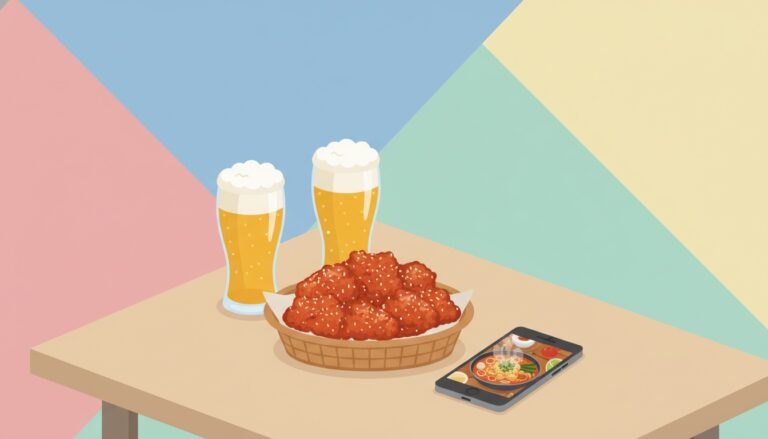
Introduction: Why is everyone eating on my screen?
안녕하세요! (Annyeonghaseyo!) This is your Senior Editor at Daily Hangul.
Have you ever found yourself at 2 AM, staring at your phone, watching a Korean YouTuber eat a mountain of spicy noodles or crispy fried chicken? You are not alone. This is the world of “Mukbang.”
But as you watch, you might hear words that you can’t find in your standard textbook. They scream “JMT!” or talk about “Chimaek.” If you look these up in a dictionary, you might come up empty-handed.
Today, we are going to learn the essential slang used in these eating shows. Knowing these words won’t just help you understand the videos; it will make you sound like a true “insider” (or ‘In-ssa’ as we say in Korea) when you go out for dinner with Korean friends.
Transparency Note: This guide is built based on questions from our beginner students who felt lost reading YouTube comments!
Deep Dive: The “Delicious” Vocabulary
Here are the top 3 expressions you need to survive a Korean food conversation.
1. 먹방 (Mukbang)
- Pronunciation:
[Meok-bang]- Meok: Sounds like the “muck” in “muck boots.”
- Bang: Sounds like “bang!” (the sound a gun makes).
- Meaning: Eating Show.
- Editor’s Insight: This is a combination of two words: 먹는 (Eating) + 방송 (Broadcast). It’s not just about eating; it’s about broadcasting the joy of eating. It’s now a word used globally!
- Situation Check: ✅ Casual / ✅ Formal (It’s a standard term now).
2. JMT (Jon-Mat-Tang)
- Pronunciation:
[Jay-Em-Tee](Read the alphabet letters) OR[Jon-Mat-Tang].- Jon: Like “John.”
- Mat: Like “Mat” in “Doormat.”
- Tang: Like “Tangy.”
- Meaning: Insanely Delicious.
- Editor’s Insight: This stands for 존나 (Jon-na – slang for ‘very/freaking’) + 맛 (Mat – taste) + 있땅 (It-tang – cute way of saying ‘there is’). It basically means “Freaking tasty!”
- Situation Check: ✅ Friends / ❌ Boss (Keep this for casual settings only!).
3. 치맥 (Chimaek)
- Pronunciation:
[Chi-maek]- Chi: Like “Chee” in “Cheese.”
- Maek: Like “Mac” in “Macbook.”
- Meaning: Chicken + Beer.
- Editor’s Insight: In Korea, fried chicken and beer are soulmates. You don’t just eat dinner; you “do Chimaek.” It’s a cultural ritual.
- Situation Check: ✅ Casual / ✅ Co-workers (Very common after work).
Textbook vs. Real Life
How does a beginner sound vs. how a local sounds?
| Situation | Textbook Korean (Safe but stiff) | Real Korean (Daily Hangul Style) |
|---|---|---|
| Ordering Food | 치킨하고 맥주 주세요. (Please give me chicken and beer.) |
오늘 치맥 콜? (Today, Chimaek, call/agree?) |
| Tasting Food | 정말 맛있어요. (It is really delicious.) |
와, 이거 완전 JMT! (Wow, this is total JMT!) |
| Watching TV | 음식 방송을 봐요. (I watch an eating broadcast.) |
나 먹방 봐. (I watch Mukbang.) |
Note for A1 Learners: “Masisseoyo” (It’s delicious) is perfect and polite. But if you want to emphasize how good it is with close friends, drop a “JMT!” with a thumbs up.
Cultural Context: The Sound of Flavor
In many Western cultures, making noise while eating is considered rude. Forget that rule when watching Mukbang!
In Korea, especially in Mukbang, slurping your noodles (called Myeon-chigi or “Noodle Hitting”) shows the chef that you are enjoying the meal passionately. The silence is often filled with enthusiastic “Mmm!” sounds.
The “Nunchi” (Social Sense) Tip:
While slurping is okay in a casual noodle shop, don’t overdo it in a quiet, high-end restaurant. Read the room (use your Nunchi)!
Real Life Roleplay
Setting: Friday night at a friend’s house. You are deciding what to order.
Characters:
* Alex (You): Hungry foreigner.
* Minji: Korean friend.
Minji: 배고파… 뭐 먹을까? (I’m hungry… what should we eat?)
Alex: (Showing phone screen) 나 이 먹방 보고 있어.
* [Na i Meok-bang bo-go i-sseo.]
* (I am watching this Mukbang.)
Minji: 오! 치킨이네? (Oh! Is that chicken?)
Alex: 응! 우리도 치맥 어때?
* [Eung! U-ri-do Chi-maek eo-ttae?]
* (Yeah! How about we do Chimaek too?)
Minji: 좋아! 여기 진짜 맛있어.
Alex: (Later, eating chicken) 와… 이거 진짜 JMT.
* [Wa… i-geo jin-jja JMT.]
* (Wow… this is totally JMT.)
10-Second Shadowing Drill
Let’s practice your rhythm. Read this aloud while imagining you are holding a crispy chicken leg.
“Watching / Mukbang / makes me hungry.”
먹방을 / 보니까 / 배고파요.
[Meok-bang-eul / bo-ni-kka / bae-go-pa-yo]
- Tip: Stress the “Meok” to emphasize the topic!
FAQ & Troubleshooting
Q: Can I use JMT with my Korean teacher or boss?
A: NO. JMT is slang. It’s like saying “This is kick-ass” in a business meeting. Stick to “Jeong-mal Ma-si-sseo-yo” (It’s really delicious) for superiors.
Q: Is Chimaek only for dinner?
A: Generally, yes. Drinking beer at lunch isn’t common on workdays, but on a weekend picnic at the Han River? Yes, Chimaek anytime!
Wrap-up
One-Liner Summary: Use Mukbang for the show, Chimaek for the food combo, and JMT when it tastes amazing.
Your Mission: Next time you eat something delicious, take a photo, post it on social media, and use the hashtag #JMT. See if your Korean friends notice!
Tell me in the comments: What is your favorite “Chimaek” spot in your city?
Quick Quiz
- What two words make up “Chimaek”?
A) Cheese + Milk
B) Chicken + Maekju (Beer)
C) Chocolate + Milk -
Which word should you NOT use with your boss?
A) Masisseoyo (Delicious)
B) Mukbang
C) JMT -
What does Mukbang literally mean?
A) Eating Room
B) Eating Broadcast
C) Big Stomach
(Answers: 1: B, 2: C, 3: B)
Frequently Asked Questions (FAQ)
Q: What does "안녕하세요!" mean in Korean and how do you pronounce it?
A: In Korean, "안녕하세요!" is pronounced [Annyeonghaseyo!] and means: This is your Senior Editor at






