

Phase 1: Introduction (Greeting & Empathy)
Hello! This is your Head Editor at Daily Hangul. 👋
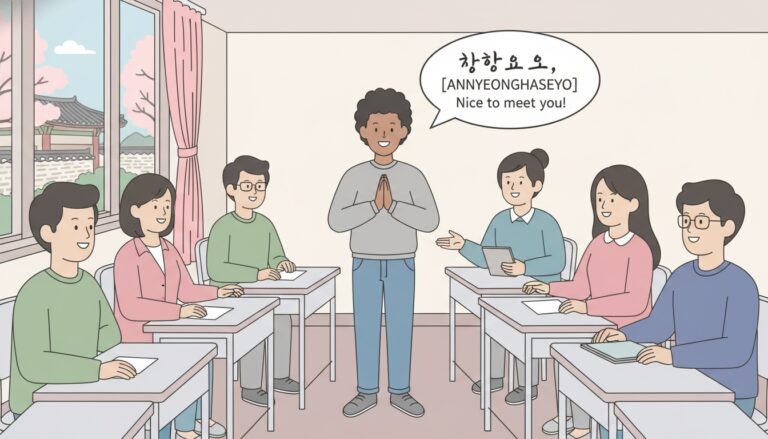
Picture this: It’s your first day at a Korean language school or university (Daehakgyo). You walk into the classroom, the air is thick with awkward silence, and the professor suddenly points at you: “Please introduce yourself.”
Your brain freezes. You remember the textbook line: “Je ireumeun [Name] imnida.”
You say it. It’s grammatically correct. But why does it feel so… robotic? Why does everyone else sound so much cooler and more natural?
I’ve seen this happen to hundreds of my students. The textbook isn’t wrong, but it often lacks the “human touch” that makes you approachable. Today, we’re going to fix that. I’ll teach you how to introduce yourself not just as a student, but as a potential friend.
(Transparnecy Note: This guide is curated based on real questions from our A2-level students living in Seoul.)
Phase 2: Deep Dive (Core Expressions)
Here are the top 3 expressions to make you sound like a local student.
1. 저는 [Name] (이)라고 해요.
(I am called [Name] / My name is [Name])
- Pronunciation:
Jeoneun [Name]-(i)rago haeyo - Sound Guide:
- Jeo: rhymes with ‘duh’ but softer.
- Rago: Roll the ‘R’ slightly, like a soft ‘L’.
- Meaning:
- Literal: I am called [Name].
- Real Nuance: “I go by [Name].” It sounds much softer and friendlier than the rigid “My name is…”
- Editor’s Insight: Use
이라고 해요 (irago haeyo)if your name ends with a consonant (e.g., David), and just라고 해요 (rago haeyo)if it ends with a vowel (e.g., Sara). This small detail shows you have a good grasp of Korean flow! - Situation Check: Perfect for classrooms, club meetings, and casual introductions.
2. [Country]에서 왔어요.
(I came from [Country])
- Pronunciation:
[Country]-eseo wass-eo-yo - Sound Guide:
- Wass: sounds like the English word “Was” but with a strong ‘SS’ hiss at the end.
- Eo-yo: imply a polite ending.
- Meaning: I came from [Country].
- Editor’s Insight: You can simply say “I am American” (저는 미국 사람이에요), but saying “I came from America” focuses more on your journey and background, which is a great conversation starter.
3. 잘 부탁드립니다.
(Please look after me / Let’s get along well)
- Pronunciation:
Jal bu-tak deu-rim-ni-da - Sound Guide:
- Eu: Make the sound you make when you step in gum—a disgusted “Eugh” but very short.
- Meaning:
- Literal: I ask you to take care of me well.
- Real Nuance: There is NO direct English translation. This is the magic phrase of Korea. It means “I am new here, I might make mistakes, please help me, and let’s have a good relationship.”
- Editor’s Insight: If you forget everything else, remember this. Saying this at the end of your intro guarantees you polite applause and warm smiles. It shows humility.
Phase 3: Textbook vs. Real Life (The “Insider” Test)
| Textbook Style (Robot Mode 🤖) | Real Korean Style (Insider Mode 😎) |
|---|---|
| 제 이름은 마이클입니다. (My name is Michael.) |
전 마이클이라고 해요. (I’m called Michael – softer) |
| 만나서 반갑습니다. (Nice to meet you.) |
반가워요! / 잘 부탁드려요! (Glad to meet you / Let’s get along) |
| 저는 학생입니다. (I am a student.) |
한국어 배우러 왔어요. (I came to learn Korean – explains purpose) |
Editor’s Note: For A2 learners, sticking to ~요 (yo) endings is perfectly fine in school. It’s polite but friendly. ~입니다 (imnida) can sometimes create too much distance between classmates.
Phase 4: Cultural Context & Manners (Nunchi 101)
Language is only 50% of communication. The rest is attitude.
- The “Bow” Factor: When saying “잘 부탁드립니다,” do a slight bow (about 15-30 degrees). You don’t need to fold in half like a laptop, just a respectful nod of the upper body.
- Eye Contact: unlike in the West, where piercing eye contact is confident, in Korea, it can be intense. Look at the person, but occasionally shift your gaze to their nose or mouth area to soften the look.
- Two Hands Rule: If you are exchanging name cards or handing over a paper during class, always use two hands. It screams “I respect you.”
Phase 5: Roleplay Script (Survival Mode)
Setting: University Exchange Student Orientation.
Characters: Alex (Foreign Student) & Minji (Korean Student/Buddy).
Minji: 안녕하세요! 혹시 새로 온 학생이세요? (Hello! Are you perhaps a new student?)
Alex: (Smiling and bowing slightly) 네, 안녕하세요! 저는 알렉스라고 해요. (Yes, hello! I’m called Alex.)
Minji: 반가워요 알렉스 씨. 어느 나라에서 오셨어요? (Nice to meet you, Alex. Which country did you come from?)
Alex: 저는 프랑스에서 왔어요. 한국 문화가 좋아서 왔어요. (I came from France. I came because I like Korean culture.)
Minji: 우와, 프랑스요? 멋지네요!
Alex: 아직 한국어 잘 못해요. 잘 부탁드립니다! (I can’t speak Korean well yet. Please treat me well!)
Phase 6: 10-Second Shadowing Drill
Read this out loud. Focus on the pauses / and the bolded stress.
“안녕하세요! / 저는 미국에서 온 / 제니라고 해요. / 잘 부탁드립니다!”
(An-nyeong-ha-se-yo! / Jeo-neun Mi-guk-e-seo on / Jenny-ra-go hae-yo. / Jal bu-tak deu-rim-ni-da!)
Phase 7: FAQ (Troubleshooting)
- Q: Can I use these phrases with my professor?
- A: Yes! But with a professor, end your sentences with
~입니다(Im-ni-da) instead of~요(Yo) to show extra respect. E.g., “알렉스입니다.”
- A: Yes! But with a professor, end your sentences with
- Q: Do I need to say my age?
- A: In a school setting? Often, yes. Age determines the hierarchy (who is Unnie/Oppa). If someone asks “몇 살이에요?” (How old are you?), don’t be offended. It’s just Korean social sorting!
Phase 8: Wrap-up & Action Item
One-Liner Summary: Instead of the robotic “My name is…”, use “(I)rago haeyo” and always finish with the magic phrase “Jal butak deurimnida.”
🔥 Today’s Mission:
Stand in front of a mirror (or your pet) and introduce yourself using the Phase 6 sentence, inserting your own name and country. Do the bow at the end!
Have you ever had an awkward introduction in Korea? Tell me in the comments below!
Phase 9: Pop Quiz
1. Which phrase sounds more natural for “My name is Sarah” in a friendly class setting?
A) 제 이름은 사라입니다. (Je ireumeun Sarah imnida)
B) 저는 사라라고 해요. (Jeoneun Sarah-rago haeyo)
2. What is the “Magic Phrase” to ask for kindness and help?
A) 사랑해요 (Saranghaeyo)
B) 잘 부탁드립니다 (Jal butak deurimnida)
C) 배고파요 (Baegopayo)
3. True or False: You should stare intensely into the other person’s eyes to show dominance.
A) True
B) False
(Answers: 1-B, 2-B, 3-B)






