

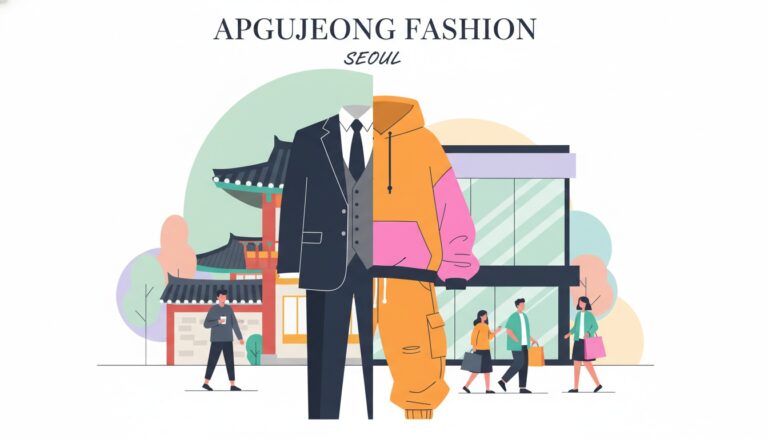
Introduction: When Hoodies Cost More Than Suits
Hello, language enthusiasts! It’s your Daily Hangul Senior Editor.
Imagine walking through Apgujeong-dong or Seongsu-dong, the heart of Seoul’s fashion scene. You see a long line of people camping out overnight. Are they waiting for a K-pop concert? No. They are waiting for a limited edition sneaker drop.
In the past, “luxury” meant tailored suits and silk dresses. Today, in Korea, if you want to sound like a sophisticated insider (C2 level), you can’t just say “The clothes are expensive.” You need to discuss how streetwear has hijacked the high-end market.
This isn’t just about shopping; it’s about social status, economics (Resell-tech), and cultural shifts. If you want to discuss fashion trends with Korean professionals or fashionistas without sounding like a textbook from the 90s, this lesson is for you.
Phase 2: Deep Dive into C2 Expressions
To reach the C2 level, we move beyond describing what people wear to analyzing why and how the market is moving. Here are three crucial expressions.
1. 장악하다 [Jang-ak-ha-da]
- Pronunciation: Jang-ak-ha-da [Sounds like: ‘Jang’ as in ‘Django’ + ‘ak’ like ‘arc’ + ‘ha-da’]
- Meaning: To dominate, seize, or takeover (a market or territory).
- Editor’s Insight: This is a strong, authoritative verb. You wouldn’t use this for a simple trend. You use it when a trend becomes the rule. It implies power.
- Situation Check: Perfect for business meetings, academic essays, or serious debates about fashion trends.
2. 경계가 허물어지다 [Gyeong-gye-ga Heo-mul-eo-ji-da]
- Pronunciation: Gyeong-gye-ga Heo-mul-eo-ji-da [Imagine saying ‘Gyoung-gye’ + ‘Huh-mool-uh-jee-da’]
- Meaning: The boundaries are crumbling/blurring.
- Editor’s Insight: This is the golden phrase for describing modern fashion. It explains the phenomenon where Louis Vuitton makes skate shoes, and Supreme sells suits. It sounds very poetic and intellectual.
- Situation Check: Formal/Casual. Use this to sound smart in a conversation.
3. 희소성을 극대화하다 [Hui-so-seong-eul Geuk-dae-hwa-ha-da]
- Pronunciation: Hui-so-seong-eul Geuk-dae-hwa-ha-da [Hwee-so-sung + Geuk-day-hwa]
- Meaning: To maximize scarcity.
- Editor’s Insight: Korean fashion is driven by the “Drop Culture.” Things are valuable because they are rare. This phrase explains the marketing strategy behind the hype.
- Situation Check: Business analysis or explaining to a friend why you paid 3x the price for a jacket.
Phase 3: Textbook vs. Real Life (C2 Edition)
At the C2 level, “Real Life” means sounding like an industry insider or a trend analyst.
| Textbook (Correct but simple) | Real Korean (Insightful & C2) |
|---|---|
| 스트릿 패션이 인기가 많아요. (Street fashion is popular.) | 스트릿 감성이 하이엔드 시장을 장악했어요. (Street sensibilities have dominated the high-end market.) |
| 이 옷은 명품하고 비슷해요. (These clothes are like luxury goods.) | 럭셔리와 스트릿의 경계가 모호해졌어요. (The boundary between luxury and street has become ambiguous.) |
| 사람들이 줄을 많이 서요. (People are standing in lines a lot.) | 오픈런 현상이 과열되고 있어요. (The ‘Open Run’ phenomenon is overheating.) |
Editor’s Note: “오픈런 (Open Run)” is Konglish for sprinting into a store as soon as it opens to buy limited items. It’s a standard term in Korea now.
Phase 4: Cultural Context – ‘Resell-Tech’ & Nunchi
In Korea, high-end street fashion isn’t just about looking cool; it’s an asset class. We call this 리셀테크 (Resell-Tech)—a portmanteau of Resell and Technology (Investment).
- The Nunchi of Flexing: While wearing a 5 million won hoodie is a ‘flex’, Korean culture values “꾸안꾸 (Kku-an-kku)”—which means “dressed up but like you didn’t try.”
- The Paradox: Even if you are wearing the most expensive limited-edition streetwear, acting too arrogant about it is frowned upon. The C2 level attitude is: “Oh, this? I just got lucky with the draw (raffle).” showing humility despite the obvious luxury.
Phase 5: Roleplay Script
Setting: A trendy cafe in Hannam-dong. Two fashion-conscious friends are talking about a new collaboration release.
Characters:
* Min-jun (Korean): A fashion enthusiast.
* Alex (Foreigner): Advanced Korean learner.
Dialogue:
Min-jun: 이번 슈프림이랑 버버리 콜라보 봤어? 리셀가 엄청 붙었더라.
(Did you see the Supreme and Burberry collab this time? The resell price has skyrocketed.)
Alex: 봤지. 솔직히 요즘은 스트릿 브랜드가 명품 시장을 완전히 장악한 것 같아.
(I saw it. Honestly, it seems like street brands have completely dominated the luxury market these days.)
Min-jun: 맞아. 예전엔 구분이 확실했는데, 이제는 그 경계가 다 허물어졌어.
(Right. The distinction used to be clear, but now those boundaries have all crumbled.)
Alex: (Sipping coffee) 결국은 희소성을 극대화해서 소장 욕구를 자극하는 거지 뭐.
((Sipping coffee) In the end, it’s just about maximizing scarcity to stimulate the desire to possess.)
Min-jun: 와, 너 한국 패션 업계 종사자 같네. 분석이 예리한데?
(Wow, you sound like you work in the Korean fashion industry. Sharp analysis!)
Phase 6: 10-Second Shadowing
Read this sentence aloud to practice flow and intonation. Focus on the pauses /.
“럭셔리 하우스들이 / 스트릿 브랜드를 적극 수용하면서, / 패션계의 판도가 / 완전히 뒤바뀌었습니다.”
- Romanization: “Luxury house-deul-i / street brand-reul jeok-geuk su-yong-ha-myeon-seo, / fashion-gye-ui pan-do-ga / wan-jeon-hi dwi-ba-kkwieot-seum-nida.”
- Translation: As luxury houses actively embrace street brands, the landscape of the fashion world has completely flipped.
Phase 7: FAQ & Troubleshooting
- Q: Can I use “장악하다” (Dominate) for small things?
- A: No. It sounds too aggressive. Don’t say “My cat dominated the sofa.” Use it for markets, trends, or military contexts. For casual situations, just use “차지하다” (occupy/take up).
- Q: Is “오픈런 (Open Run)” a bad word?
- A: No, it’s a neutral descriptive term used in news and casual conversation. It reflects passion (or obsession).
Phase 8: Wrap-up
- Summary: To sound like a C2 speaker, describe the blurring boundaries (경계가 허물어지다) and how street fashion has dominated (장악하다) the market through scarcity (희소성).
- Action Mission: Next time you see a long line in front of a store in Seoul, ask a Korean friend: “저기도 오픈런 하는 거야?” (Are they doing an open run there too?)
What’s the wildest fashion trend you’ve seen in Korea? Let me know in the comments!
Phase 9: Quick Quiz
- Which word best describes the “blurring” of lines between two concepts?
a) 장악 (Domination)
b) 오픈런 (Open Run)
c) 경계가 허물어지다 (Boundaries crumbling) -
What is the Korean portmanteau for “Investment via reselling”?
a) 리셀테크 (Resell-Tech)
b) 패션테크 (Fashion-Tech)
c) 머니테크 (Money-Tech) -
Which verb means to “seize” or “take over” a market powerfully?
a) 구매하다 (Purchase)
b) 장악하다 (Dominate)
c) 구경하다 (Look around)
(Answers: 1-c, 2-a, 3-b)
Frequently Asked Questions (FAQ)
Q: What does "장악하다 [Jang-ak-ha-da]" mean in Korean and how do you pronounce it?
A: In Korean, "장악하다 [Jang-ak-ha-da]" is pronounced [Jang-ak-ha-da [Sounds like: 'Jang' as in 'Django' + 'ak' like 'arc' + 'ha-da'] and means: To dominate, seize, or takeover (a market or territory).
Q: What does "경계가 허물어지다 [Gyeong-gye-ga Heo-mul-eo-ji-da]" mean in Korean and how do you pronounce it?
A: In Korean, "경계가 허물어지다 [Gyeong-gye-ga Heo-mul-eo-ji-da]" is pronounced [Gyeong-gye-ga Heo-mul-eo-ji-da [Imagine saying 'Gyoung-gye' + 'Huh-mool-uh-jee-da'] and means: The boundaries are crumbling/blurring.
Q: What does "희소성을 극대화하다 [Hui-so-seong-eul Geuk-dae-hwa-ha-da]" mean in Korean and how do you pronounce it?
A: In Korean, "희소성을 극대화하다 [Hui-so-seong-eul Geuk-dae-hwa-ha-da]" is pronounced [Hui-so-seong-eul Geuk-dae-hwa-ha-da [Hwee-so-sung + Geuk-day-hwa] and means: To maximize scarcity.






