

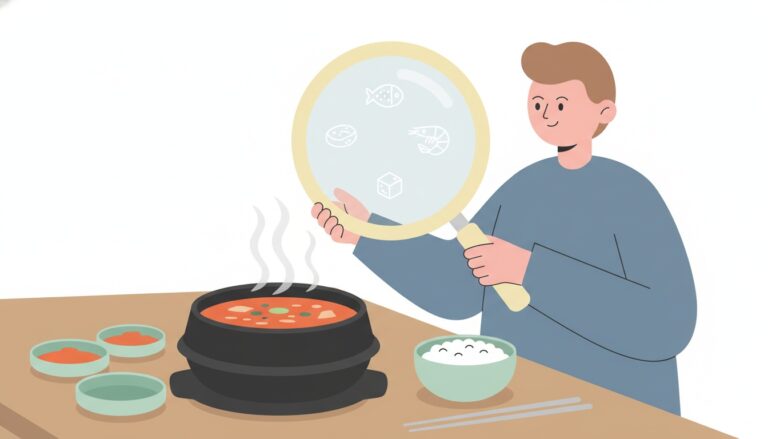
Phase 1: Greeting & Empathy
안녕하세요! This is your Daily Hangul editor. 👋
So, you’ve mastered ordering Bibimbap, but let me guess the scenario: You sat down, confidently told the Imo-nim (auntie/waitress) that you are a vegetarian, and yet… your stew arrived with a surprise floating piece of pork, or you realized that delicious kimchi was made with fermented shrimp sauce.
Frustrating, right? 😤
In Korea, the concept of “Vegetarian” (채식 – Chaeshik) exists, but definitions can be… flexible. For some older generations, “no meat” just means “no big chunks of beef,” but ham, fish cake, or beef broth might still be considered “fine.”
Today, we are going beyond the textbook “I am a vegetarian.” I will teach you the B2-level survival phrases to specify exactly what you can and cannot eat—whether you are Pesco, Lacto-Ovo, or Vegan. Let’s make sure you never have to fish unexpected meat out of your soup again!
Phase 2: Deep Dive (Core Expressions)
Here are the precise phrases to clarify your dietary restrictions without being rude.
1. 육수나 액젓 들어가나요?
(Does this contain meat broth or fish sauce?)
- Pronunciation: [Yuk-su-na / Aek-jeot / deu-reo-ga-na-yo?]
- Yuksu sounds like “Look” but with a Y -> Yook-su.
- Aekjeot (Fish sauce) is tricky. Think of the ‘a’ in “apple” + ‘jut’ -> Ack-jut.
- Meaning:
- Literal: Do broth or liquid salted seafood go in?
- Real Nuance: “Are there hidden animal products in the soup base?”
- Editor’s Insight: This is the game-changer expression. Many Koreans think a dish is vegetarian if there is no solid meat visible. Asking about Yuksu (broth) and Aekjeot (fish sauce) shows you know Korean food culture deep down.
- Situation Check: Essential at stew (Jjigae) or noodle restaurants. Formal enough for strangers.
2. 고기 빼고, 채소만 넣어 주실 수 있나요?
(Could you take out the meat and only put in vegetables?)
- Pronunciation: [Go-gi bbae-go / chae-so-man / neo-eo ju-sil su in-na-yo?]
- Meaning:
- Literal: Subtract meat, only vegetables, can you put in?
- Real Nuance: “Please customize this dish to be veggie-only.”
- Editor’s Insight: Use the verb 빼다 (to subtract/remove). It is universally understood. If you just say “No meat,” they might just serve you less meat. “Take it out” is clearer.
- Situation Check: Use this when ordering customizable dishes like Bibimbap or Kimbap.
3. 저는 해산물/유제품은 먹어요.
(I do eat seafood/dairy products.)
- Pronunciation: [Jeo-neun / hae-san-mul (or yu-je-pum) / eun / meo-geo-yo]
- Meaning: I eat seafood/dairy.
- Editor’s Insight: Since “vegetarian” is a broad term in Korea, clarifying what you DO eat is often more effective than listing what you don’t.
- Pesco: “해산물은 먹어요.” (I eat seafood.)
- Lacto-Ovo: “달걀이랑 우유는 먹어요.” (I eat eggs and milk.)
Phase 3: Textbook vs. Real Life
Textbooks teach you definitions; the streets teach you survival.
| Textbook Korean (Classroom) | Real Life Korean (Hongdae/Gangnam) |
|---|---|
| 저는 채식주의자입니다. (I am a vegetarian.) Sounds a bit stiff and overly formal. |
저 고기 못 먹어요. / 비건이에요. (I can’t eat meat / I’m Vegan.) Direct and practical. “Vegan” is widely understood by young staff. |
| 고기를 넣지 마세요. (Do not put meat in.) Grammatically correct but sounds like a command. |
고기 빼 주세요. (Please leave out the meat.) Much more natural and polite. |
| 이 음식에 무엇이 들어갑니까? (What goes into this food?) |
여기 혹시 ~ 들어가요? (By chance, does ~ go in here?) Softer, polite inquiry. |
Note for B2 Learners: While younger Koreans know the word “Vegan” (비건), older restaurant owners might not. In traditional markets, stick to “고기 못 먹어요” (I can’t eat meat).
Phase 4: Cultural Context & Manners 🥢
1. The “Hidden” Ingredients (눈치 챙기기)
In Korea, “Meat-free” doesn’t always mean vegetarian.
* Kimchi: Usually contains salted shrimp or anchovy sauce.
* Sundubu Jjigae (Soft Tofu Stew): Often uses pork or clam broth base.
* Tteokbokki: The rice cakes are vegan, but the fish cakes (Odeng) and the broth are not.
Tip: If you are a strict vegan, you must ask about the base (육수) specifically.
2. Communal Dining (회식 Culture)
If you are at a company dinner (Hoesik) at a BBQ place:
* Don’t sit there with an empty plate. Order Doenjang-jjigae (Soybean paste stew) but ask: “Is there meat or seafood in this?”
* Do eat the side dishes (Banchan). However, ask about the Kimchi if you are strict.
Phase 5: Real-Life Scenario (Roleplay)
📍 Context: You enter a Kimbap shop (Bunsik-jip). You want to order Vegetable Kimbap, but you know they often put ham inside anyway.
Characters:
* Alex: B2 Level Learner (Pesco-Vegetarian)
* Imo-nim: Restaurant Owner
Dialogue:
Alex: (Smiling politely) 안녕하세요! 야채김밥 한 줄 주세요.
(Hello! Please give me one roll of vegetable kimbap.)
Imo-nim: 네, 알겠어요~
(Okay, got it~)
Alex: (Quickly adding) 아, 이모님! 혹시 안에 햄이나 맛살 들어가나요?
(Ah, auntie! By chance, does ham or crab stick go inside?)
Imo-nim: 야채김밥이라도 맛 내려고 조금 들어가는데?
(Even though it’s veggie kimbap, a little goes in for flavor.)
Alex: 아, 그럼 햄이랑 맛살은 다 빼 주세요. 저는 고기를 안 먹어서요.
(Ah, then please take out all the ham and crab sticks. I don’t eat meat.)
Imo-nim: 그래요? 알겠어요. 계란은 괜찮아?
(Really? Okay. Is egg okay?)
Alex: 네, 계란은 괜찮아요! 감사합니다.
(Yes, egg is fine! Thank you.)
Phase 6: 10-Second Shadowing 🗣️
Practice this sentence until it flows naturally. It covers the hardest part: Asking about the broth.
“혹시 육수에 / 고기나 멸치 들어가나요? / 저는 채식을 해서요.”
- Intonation Guide:
- 혹시 (Hoksi) ↗ (Rising slightly, polite curiosity)
- 육수에 (Yuk-su-e) → (Flat)
- 들어가나요? (Deu-reo-ga-na-yo?) ↗ (Rising question)
- 해서요 (Hae-seo-yo) ↘ (Falling soft ending, giving a reason)
Phase 7: FAQ & Troubleshooting
Q: Can I just pick the meat out? Is that rude?
A: In a casual setting, it’s fine. But in a soup, the flavor is already there. If you are strict, ask before ordering. If the dish arrives with meat, politely asking for a new one is… tricky. It’s better to offer to pay for a new order if it was your mistake not clarifying.
Q: Is asking for “Mool-Naengmyeon” (Cold Noodles) safe?
A: Trap alert! Cold noodle broth is traditionally beef-based (beef brisket broth). Unless it explicitly says “Dongchimi” (Radish water kimchi base), assume it has meat stock.
Phase 8: Wrap-up & Mission
Summary:
Don’t just say “I’m vegetarian.” Specify ingredients using “~빼 주세요” (Please remove ~) and ask about hidden elements like “육수” (broth) and “액젓” (fish sauce).
🚀 Today’s Mission:
Go to a convenience store (GS25, CU) and find a cup noodle or snack. Flip it over and look at the ingredient list (원재료명). Can you find 쇠고기 (Beef), 돼지고기 (Pork), or 우유 (Milk)? Spotting these words is your first step to independence!
Tell me in the comments: What is the hardest Korean dish for you to give up as a vegetarian? 👇
Phase 9: Pop Quiz 📝
1. You want to ask if a stew has fish sauce. What do you say?
A) 고기 있어요? (Is there meat?)
B) 액젓 들어가나요? (Does fish sauce go in?)
C) 이거 매워요? (Is this spicy?)
2. How do you say “Please take out the ham”?
A) 햄 더 주세요. (More ham please.)
B) 햄 빼 주세요. (Please remove the ham.)
C) 햄 싫어요. (I hate ham.)
3. Which word means “Broth” or “Stock”?
A) 육수 (Yuksu)
B) 약수 (Yaksu)
C) 악수 (Aksu)
(Answers: 1-B, 2-B, 3-A)
Frequently Asked Questions (FAQ)
Q: What does "빼다" mean in Korean and how do you pronounce it?
A: In Korean, "빼다" is pronounced [to subtract/remove] and means: . It is universally understood. If you just say "No meat," they might just serve you less meat. "Take it out" is clearer.
Q: What does "혹시" mean in Korean and how do you pronounce it?
A: In Korean, "혹시" is pronounced [Hoksi] and means: ↗ (Rising slightly, polite curiosity)
Q: What does "육수에" mean in Korean and how do you pronounce it?
A: In Korean, "육수에" is pronounced [Yuk-su-e] and means: → (Flat)
Q: What does "들어가나요?" mean in Korean and how do you pronounce it?
A: In Korean, "들어가나요?" is pronounced [Deu-reo-ga-na-yo?] and means: ↗ (Rising question)







