Introduction: The “Did You Eat?” Barrage
Hello! This is your editor from Daily Hangul. 👋
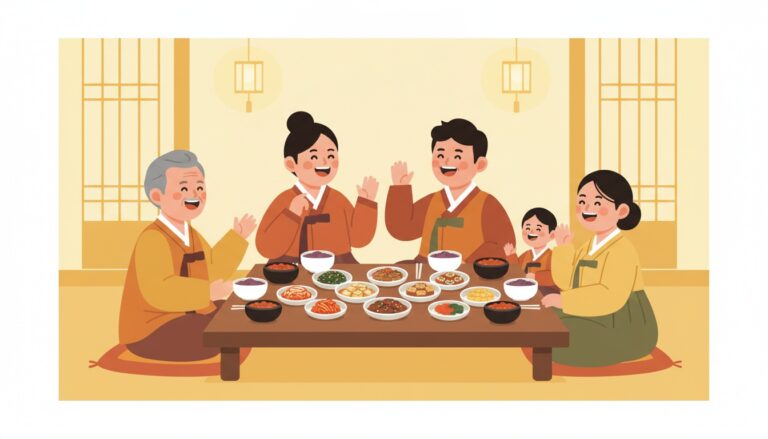
So, you’ve survived a week in Korea, or maybe you’re chatting with your Korean language partner. Suddenly, the topic shifts to the weekend. You want to say, “I had a big family dinner, and it was chaotic but fun,” but all you can manage is “Family… meet… eat.”
Talking about Family Gatherings (가족 모임 – Gajok Moim) is a crucial skill. Why? Because in Korea, family isn’t just a topic; it’s the core of social life. Whether it’s a holiday like Chuseok or just a Sunday dinner, knowing how to describe these moments turns you from a “foreigner” into a “friend who understands our culture.”
Don’t worry. I’ve coached hundreds of students through this. Today, we’re not just learning vocabulary; we’re learning how to convey the warmth (and slight craziness) of a Korean family gathering.
Phase 2: Deep Dive (Core Expressions)
Here are the top 3 expressions you need to sound natural when describing a family get-together.
1. 오랜만이에요 (Orenmanieyo)
- Pronunciation: Oh-ren-man-ee-eh-yo [Sounds like: Oh-ren-man-ee-ay-yo]
- Meaning: It’s been a long time.
- Editor’s Insight: This is the golden phrase. In English, you might say “We haven’t met in ages,” but in Korean, this single phrase covers everything. It implies, “I missed you, and I’m glad we are finally bridging that time gap.”
- Situation Check: ✅ Casual (remove ‘yo’) / ✅ Formal (keep ‘yo’)
2. 다 같이 모였어요 (Da gachi moyeosseoyo)
- Pronunciation: Da ga-chee mo-yeoss-uh-yo
- Tip: Even though it is spelled ‘gat-i’, it is pronounced ga-chee (like ‘cheese’).
- Meaning: We all gathered together.
- Editor’s Insight: ‘모이다’ (moida) means to gather. Adding ‘다 같이’ (all together) emphasizes the completeness of the group. Koreans love the concept of the whole group being present.
- Situation Check: Perfect for explaining your weekend to a coworker or teacher.
3. 정신없었어요 (Jeongsin eopseosseoyo)
- Pronunciation: Jeong-shin op-suss-uh-yo
- Meaning: Literal: “I had no mind/spirit.” / Real Nuance: It was hectic/busy/chaotic.
- Editor’s Insight: Was the family dinner loud? Were kids running around? Was there too much food? This is the perfect honest answer. It’s not negative; it just means it was lively and busy.
- Situation Check: Use this when a friend asks, “How was the party?”
Phase 3: Textbook vs. Real Life
Textbooks teach you to report facts. Real life is about sharing feelings. Let’s upgrade your A2 Korean.
| Textbook Korean (Robotic) 🤖 | Real Korean (Natural) ✨ |
|---|---|
| 가족이 많았어요. (There were many family members.) |
북적북적했어요. (It was bustling/crowded and lively!) |
| 저녁을 먹었어요. (We ate dinner.) |
맛있는 거 많이 먹었어요. (We ate lots of delicious things.) |
| 재미있었어요. (It was fun.) |
시간 가는 줄 몰랐어요. (I didn’t know time was passing / Time flew by.) |
Editor’s Note: “북적북적” (Buk-jeok buk-jeok) is a mimetic word representing the sound and movement of a crowded place. Using this instantly raises your level perception!
Phase 4: Cultural Context (The Art of ‘Bin-son’)
In Western culture, bringing a dish (potluck) is common. In Korea, if you are invited to a family gathering, there is a golden rule:
🚫 Never go with “Bin-son” (Empty hands – 빈손).
Even if they say, “Just come!” (그냥 와!), do not trust it! It’s Korean politeness.
- The Fix: Stop by a store and buy a box of fruit, a roll cake, or a set of healthy drinks. It shows you have Seng-gak (thoughtfulness) and manners.
Phase 5: Real-Life Scenario
Setting: Monday morning at a cafe. Alex (Foreigner) is talking to his Korean friend, Ji-min.
Ji-min: 주말 잘 보냈어? (Did you have a good weekend?)
Alex: 응, 사촌 형 결혼식이라서 다 같이 모였어. (Yeah, it was my cousin’s wedding, so we all gathered together.)
* [Da ga-chee mo-yeoss-uh]
Ji-min: 진짜? 사람 많았겠다. (Really? Must have been a lot of people.)
Alex: 어, 진짜 정신없었어. 그래도 오랜만에 봐서 좋았어. (Yeah, it was really hectic. But it was good to see them after a long time.)
* [Jeong-shin op-suss-uh. Geu-rae-do o-ren-man-eh bwa-seo jo-ah-ssuh]
Ji-min: 맛있는 것도 많이 먹었어? (Did you eat a lot of good food, too?)
Alex: (rubbing stomach) 응, 배 터지는 줄 알았어! (Yeah, I thought my belly would explode!)
Phase 6: 10-Second Shadowing Drill
Read this aloud. Focus on the pause marked by /.
“Everyone gathered after a long time, so the atmosphere was great.”
오랜만에 / 다 같이 모여서 / 분위기가 좋았어요.
[Oh-ren-man-eh / da ga-chee mo-yeo-seo / bun-wi-gi-ga jo-ah-ssuh-yo]
💡 Pro Tip: Raise your pitch slightly on “모여서” (gathered) to show excitement!
Phase 7: FAQ & Troubleshooting
Q: Can I call my friend’s mother “Mom” (Omma) at a gathering?
A: Dangerous! 🛑 Unless you are practically adopted by the family or very close, calling her “Omonim” (Mother-nim) is safer and more respectful. “Omma” is reserved for your mom or when you are extremely close (like a second son/daughter).
Q: Is “정신없다” (Hectic) rude to say about a family gathering?
A: No! It’s actually very relatable. Koreans often say family events are jeongsin-eopda. It implies the event was successful and full of people. Just make sure to smile when you say it!
Phase 8: Wrap-up & Action Mission
Today’s Takeaway: Family gatherings are about “gathering completely” (다 같이 모이다) and navigating the lively chaos (정신없다).
🚀 Your Mission:
Next time you post a group photo on Instagram, caption it with:
“오랜만에 다 같이 모였어요!” (We all gathered after a long time!)
See how many Korean friends comment on it!
Phase 9: Pop Quiz
1. How do you say “We all gathered together”?
A) 다 같이 먹었어요 (Da gachi meogeosseoyo)
B) 다 같이 모였어요 (Da gachi moyeosseoyo)
C) 다 같이 갔어요 (Da gachi gasseoyo)
2. Which word describes a “lively, crowded, chaotic” atmosphere?
A) 조용해요 (Joyong-haeyo)
B) 심심해요 (Simsim-haeyo)
C) 정신없어요 (Jeongsin-eopseoyo)
3. True or False: You should always visit a Korean family gathering with empty hands.
A) True
B) False
(Answers: 1-B, 2-C, 3-B)
Frequently Asked Questions (FAQ)
Q: What does "오랜만이에요 (Orenmanieyo)" mean in Korean and how do you pronounce it?
A: In Korean, "오랜만이에요 (Orenmanieyo)" is pronounced [Oh-ren-man-ee-eh-yo [Sounds like: Oh-ren-man-ee-ay-yo] and means: It's been a long time.
Q: What does "다 같이 모였어요 (Da gachi moyeosseoyo)" mean in Korean and how do you pronounce it?
A: In Korean, "다 같이 모였어요 (Da gachi moyeosseoyo)" is pronounced [Da ga-chee mo-yeoss-uh-yo] and means: a key conversational Korean expression covered in this lesson.
Q: What does "정신없었어요 (Jeongsin eopseosseoyo)" mean in Korean and how do you pronounce it?
A: In Korean, "정신없었어요 (Jeongsin eopseosseoyo)" is pronounced [Jeong-shin op-suss-uh-yo] and means: Literal: "I had no mind/spirit." / Real Nuance: It was hectic/busy/chaotic.