

Phase 1: Introduction
Hello, Daily Hangul family! It’s your Senior Editor here.
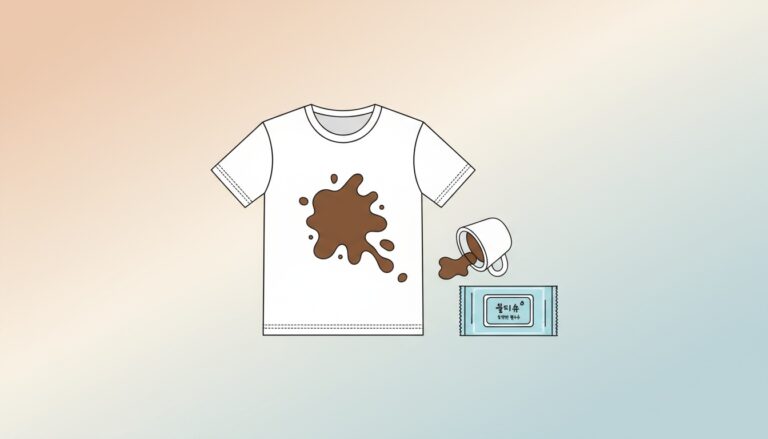
We have all been there. You are wearing your favorite crisp white shirt or a brand-new pastel blouse. You take a sip of your iced Americano, and suddenly—disaster strikes. A brown splash lands right on your chest.
In that split second, panic sets in. But what if you are in Seoul and need to explain this mess to a friend, or worse, ask a dry cleaner if they can save your outfit? If you just point and say “Coffee… problem,” you might not get the help you need.
Knowing how to talk about clothing mishaps isn’t just about vocabulary; it’s about showing you can handle daily life in Korea with grace (even when you are clumsy!). Today’s lesson comes directly from a student named Sarah, who ruined her blouse in Hongdae and didn’t know how to ask for a stain remover pen at the convenience store. Let’s make sure that doesn’t happen to you.
Phase 2: Deep Dive into Key Expressions
Here are the three most natural ways to handle a coffee spill situation.
1. 옷에 커피를 쏟았어요 (I spilled coffee on my clothes)
- Pronunciation: [O-se keo-pi-reul sso-da-sseo-yo]
- Sound-alike tip: “Sso-da” sounds a bit like “Soda”, but imagine you are hissing the first ‘S’ sharply because you are annoyed!
- Meaning:
- Literal: I poured coffee onto clothes.
- Real Nuance: “I spilled coffee.” The verb 쏟다 (ssot-da) implies an accidental spill or pouring out.
- Editor’s Insight: To sound even more like a native B1 speaker, add “-아/어 버렸다” to show regret. “커피를 쏟아 버렸어요” (I ended up spilling coffee… ugh!).
- Situation Check: Safe for Friends (Casual) & Bosses (Polite).
2. 얼룩이 졌어요 (It got stained)
- Pronunciation: [Eol-lu-gi jyeo-sseo-yo]
- Sound-alike tip: “Eol-look” sounds like you are saying “Earl” (as in Earl Grey) + “Look”.
- Meaning:
- Literal: A stain was formed.
- Real Nuance: “It’s stained.” We don’t usually say “I made a stain.” We say the stain “happened” (졌어요).
- Editor’s Insight: 얼룩 (Eolluk) is the magic word for any spot or mark on clothes. If you go to a dry cleaner (세탁소), just point and say “여기 얼룩이요 (Here, stain).”
- Situation Check: Universal.
3. 이거 지워질까요? (Will this come off? / Can this be removed?)
- Pronunciation: [I-geo ji-wo-jil-kka-yo?]
- Sound-alike tip: “Ji-wo” sounds like “Gee, wow” said quickly.
- Meaning:
- Literal: Will this become erased?
- Real Nuance: “Do you think this stain will wash out?” You are asking for an opinion on the possibility of cleaning it.
- Editor’s Insight: This is the perfect phrase to use at the laundry shop (세탁소). It shows you are worried and asking for their expert opinion.
- Situation Check: Polite inquiry.
Phase 3: Textbook vs. Real Life
Textbooks teach you to describe facts. Real life is about emotion and urgency.
| Textbook Korean 📚 | Real Daily Korean 🇰🇷 | Explanation |
|---|---|---|
| 실수를 했어요. (I made a mistake.) |
아, 어떡해! (Ah, what should I do?!) |
When you spill, you don’t announce a mistake; you panic! |
| 얼룩이 생겼습니다. (A stain has appeared.) |
아, 망했다… 흰 옷인데. (Ah, I’m screwed… it’s a white shirt.) |
망했다 (Mang-haet-da) is the ultimate “I messed up” slang. |
| 휴지 있습니까? (Do you have tissue?) |
물티슈 있어요? (Do you have wet wipes?) |
Dry tissue spreads coffee. Koreans always look for mul-ti-shu first. |
- Editor’s Note: “망했다” is very casual. Only use it in front of friends or to yourself!
Phase 4: Cultural Context & Manners
1. The “Ppong-Ppong” Rescue Squad
If you rush to a Korean convenience store with a stain, look for a “sak-seu-tik” (ssak-stick/stain stick). Koreans are obsessed with keeping clothes clean, so you can easily find emergency stain remover pens. Also, in Korean restaurants, if you spill red sauce or coffee, the staff often provides an apron (앞치마) before you eat, but if you spill, asking for “Mul-ti-shu” (wet wipes) is the immediate first step.
2. Don’t Rub It! (비비지 마세요)
If a Korean sees you rubbing a coffee stain, they might stop you saying “비비지 마세요!” (Don’t rub it!). The local wisdom is to dab it gently or wash it immediately in the restroom. Rubbing is seen as making the fabric damage worse.
Phase 5: Roleplay Script
Scenario: You (Alex) spilled an iced latte on your shirt while walking with your Korean friend (Minji).
Alex: (Looking down in shock) 악! 옷에 커피 쏟았어!
(Ack! O-se keo-pi sso-da-sseo!)
(Ack! I spilled coffee on my clothes!)
Minji: (Eyes wide open) 헐, 괜찮아? 흰 셔츠잖아!
(Heol, gwaen-chan-a? Hin syeo-cheu-ja-na!)
(Oh my god, are you okay? That’s a white shirt!)
Alex: 그러게… 이거 얼룩 지워질까?
(Geu-reo-ge… I-geo eol-luk ji-wo-jil-kka?)
(I know… Do you think this stain will come off?)
Minji: 빨리 화장실 가서 씻자. 내가 물티슈 줄게.
(Ppal-li hwa-jang-sil ga-seo ssit-ja. Nae-ga mul-ti-shu jul-ge.)
(Let’s go to the bathroom quickly and wash it. I’ll give you a wet wipe.)
Phase 6: 10-Second Shadowing
Read this aloud to practice your intonation. Pause where the / marks are.
“잠시만요, / 옷에 커피를 쏟아서 / 물티슈 좀 주시겠어요?”
(Excuse me, / I spilled coffee on my clothes, / could you give me some wet wipes?)
Focus: Raise your tone slightly at “쏟아서” (sso-da-seo) to signal a cause/reason.
Phase 7: FAQ & Troubleshooting
- Q: Can I use “흘리다” (heul-li-da) instead of “쏟다” (ssot-da)?
- A: Yes! great question. 쏟다 implies a larger amount (like tipping a cup over). 흘리다 is more like dribbling a few drops while drinking. If you made a huge mess, use 쏟다. If it’s just a drop, 흘리다 is fine.
- Q: Is it rude to ask for wet wipes (물티슈) at a cafe?
- A: Not at all! It is expected. In fact, most cafes have them at the “Service Table” (where the water and napkins are). If not, asking the staff is perfectly polite.
Phase 8: Wrap-up
Today’s Summary:
When disaster strikes, remember: 쏟았어요 (Spilled), 얼룩 (Stain), and 물티슈 (Wet wipe) are your survival kit.
Your Mission:
Next time you are at a convenience store, try to locate where they keep the “물티슈” (Wet wipes) or “얼룩 제거제” (Stain remover). Just knowing where they are makes you feel like a local!
Comments:
Have you ever ruined a favorite outfit in Korea? How did you handle it? Tell me your horror stories below!
Phase 9: Pop Quiz
1. Which verb is best used when you accidentally knock over a whole cup of coffee?
A) 마시다 (Masida)
B) 쏟다 (Ssotda)
C) 사다 (Sada)
2. What is the “magic item” Koreans look for immediately after a spill?
A) Soju
B) Mul-ti-shu (Wet wipes)
C) Kimchi
3. How do you ask “Will this stain come off?”
A) 이거 맛있어요? (Is this delicious?)
B) 이거 얼마예요? (How much is this?)
C) 이거 지워질까요? (Will this be erased?)
(Answers: 1. B, 2. B, 3. C)
Frequently Asked Questions (FAQ)
Q: What does "옷에 커피를 쏟았어요 (I spilled coffee on my clothes)" mean in Korean and how do you pronounce it?
A: In Korean, "옷에 커피를 쏟았어요 (I spilled coffee on my clothes)" is pronounced [O-se keo-pi-reul sso-da-sseo-yo] and means: a key conversational Korean expression covered in this lesson.
Q: What does "얼룩이 졌어요 (It got stained)" mean in Korean and how do you pronounce it?
A: In Korean, "얼룩이 졌어요 (It got stained)" is pronounced [Eol-lu-gi jyeo-sseo-yo] and means: a key conversational Korean expression covered in this lesson.
Q: What does "이거 지워질까요? (Will this come off? / Can this be removed?)" mean in Korean and how do you pronounce it?
A: In Korean, "이거 지워질까요? (Will this come off? / Can this be removed?)" is pronounced [I-geo ji-wo-jil-kka-yo?] and means: a key conversational Korean expression covered in this lesson.







