Phase 1: Introduction
Hello! This is your Head Editor at Daily Hangul. 👋
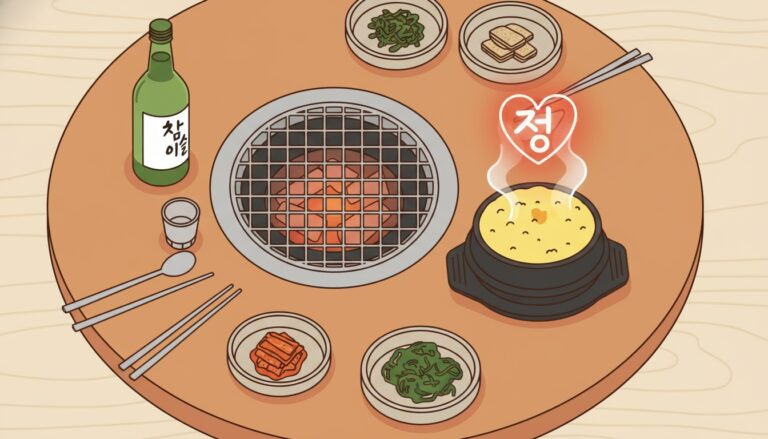
Imagine this: You are at a bustling K-BBQ restaurant in Seoul. You ordered Samgyeopsal (pork belly) and Soju. Suddenly, the friendly Imo-nim (auntie/waitress) places a steaming pot of Gyeran-jjim (steamed egg) on your table. You freeze. You didn’t order this. Is this a mistake? Will they charge you extra? Do you need to check your wallet?
Relax! This is the magic of Jeong (정).
Today, we are diving into a concept that confuses almost every foreigner at the B2 level: the culture of ‘Service’ (서비스) and ‘Deom’ (덤). If you don’t understand this, you might awkwardly refuse free food or, worse, hurt someone’s feelings. But if you master the reaction I’m about to teach you, you’ll be treated not just as a customer, but as a regular (Dangol – 단골).
This guide combines questions from actual students who asked, “Why did she give me a free Coke?” Let’s decode the Korean heart together.
Phase 2: Deep Dive into Core Expressions
Here are the words you need to handle this situation with the grace of a local.
1. 서비스 (Service)
- Pronunciation: [Seobiseu] Sounds like “Seo-bi-sue”
- Meaning:
- Literal: Service (labor/assistance)
- Real Nuance: Freebie / On the house.
- Editor’s Insight: In English, “service” usually means the quality of waiting staff. In Korea, if someone says “This is service,” it means it is free. It is a tangible expression of Jeong. Do not ask, “Is it free?” just smile!
- Situation Check: Casual ✅ / Formal ✅ (Used everywhere from street stalls to restaurants)
2. 덤 (Deom)
- Pronunciation: [Deom] Rhymes with “Thumb”
- Meaning: An extra amount given on top of what was purchased.
- Editor’s Insight: While Service is used in restaurants, Deom is more common in traditional markets (Sijang). If you buy 1kg of apples and the grandma throws in two extra apples, that is Deom. It represents warmth and generosity.
- Situation Check: Casual ✅ / Traditional Markets ✅
3. 정 (Jeong)
- Pronunciation: [Jeong] Sounds like “Jung”
- Meaning: Affection, attachment, deep emotional bond.
- Editor’s Insight: This is the invisible force behind Service and Deom. It’s not just about business; it’s about building a connection. Accepting the free food happily is a way of reciprocating that Jeong.
Phase 3: Textbook vs. Real Life
At the B2 level, you want to sound natural, not like a robot. Here is how to upgrade your reaction.
| Textbook Korean 📘 | Real Korean (Daily Hangul Style) 🚀 |
|---|---|
| 이거 안 시켰는데요. (I didn’t order this.) |
어머, 이거 서비스예요? (Oh my, is this ‘service’?) |
| 감사합니다. (Thank you.) |
와, 이모님(사장님) 최고! 잘 먹겠습니다! (Wow, Auntie (Boss) is the best! I will eat it well!) |
| 얼마예요? (How much is it?) |
이거 진짜 그냥 주시는 거예요? 대박! (Are you really giving this for free? Daebak!) |
💡 Editor’s Note: Using exclamation words like “어머” (Eomeo) or “대박” (Daebak) instantly breaks the ice and makes the staff feel good about giving you the gift.
Phase 4: Cultural Context & Manners
The Art of Receiving (Nunchi Games)
In Western cultures, nothing is truly free, so you might feel suspicious. In Korea, refusing Service can be perceived as rejecting the person’s kindness (Jeong).
- Don’t refuse: Unless you have a severe allergy, accept it with a smile.
- The “Aaah” Reaction: When the plate hits the table, make a sound of pleasant surprise. “Ooh!” or “Waa!”
- Reciprocity: You don’t need to pay money back, but you “pay” with a compliment. “Here is delicious” (Yeogiomsik masisseoyo) is the best currency.
Phase 5: Roleplay Scenario
📍 Location: A crowded Pork Belly (Samgyeopsal) restaurant in Hongdae.
👥 Characters: Alex (B2 Learner) and Imo-nim (Restaurant Staff).
(Imo-nim places a steaming earthen pot of Soybean Paste Stew on the table)
Alex: (Looking confused, checking the receipt in his head)
저기요, 저희 이거 안 시켰는데요…
(Excuse me, we didn’t order this…)
[Jeogiyo, jeohi igeo an sikyeonneundeyo…]
Imo-nim: (Waving hand with a big smile)
아유, 이거 서비스야! 외국인 학생들이 한국말을 너무 잘해서 주는 거야.
(Oh, this is ‘service’! I’m giving it because you foreign students speak Korean so well.)
[Ayu, igeo seobiseu-ya! Oegugin haksaengdeuri hangungmareul neomu jalhaeseo juneun geoya.]
Alex: (Realizing it’s Jeong, smiling broadly)
아, 깜짝 놀랐어요! 사장님 인심 진짜 좋으시네요! 잘 먹겠습니다!
(Ah, I was surprised! Boss, your heart/generosity is really good! I will eat it well!)
[A, kkamjjak nollasseoyo! Sajangnim insim jinjja joseusineyo! Jal meokgetseumnida!]
Imo-nim:
많이 먹고 또 와요~
(Eat a lot and come again~)
[Mani meokgo tto wayo~]
Phase 6: 10-Second Shadowing
Let’s practice the “Social Pro” reaction. Focus on the intonation—raise your pitch at the end to sound grateful and surprised!
“Wow, is this service? Boss, you have the best sense!”
와, 이거 서비스예요? / 사장님 / 센스 짱이세요!
[Wa, igeo seobiseu-yeyo? / Sajangnim / sense jjang-iseyo!]
- Intonation Tip: Stress “Seobiseu” and “Jjang”. Make the pause at the
/marks slightly dramatic.
Phase 7: FAQ & Troubleshooting
Q: Can I ask for service? (e.g., “Give me some service!”)
A: Generally, NO. Asking for freebies (“서비스 좀 주세요”) can be considered rude or “Jin-sang” (a nuisance customer), especially if you are not a regular. Let them offer it first. However, in a playful tone at a market, you might say, “Give me a little more~” (Jom deo juseyo~), but use this carefully!
Q: Do I have to tip for the service?
A: No! Korea is a no-tipping culture. The “Service” food IS the tip from the owner to you. Just enjoy it.
Phase 8: Wrap-up
- Summary: In Korea, “Service” means free food given out of affection (Jeong). Don’t panic, just say thank you enthusiastically.
- Your Mission: Next time you go to a Korean restaurant or cosmetics store and get something extra, look the staff in the eye and say: “Uwa! Kamsahamnida!” with a big smile.
Have you ever received a surprising ‘Service’ in Korea? Tell me in the comments what you got! (I once got a whole plate of Sashimi!) 🐟
Phase 9: Quiz
1. What does it mean when the staff says “Igeo Service-yeyo”?
(A) You need to pay a service charge.
(B) The waiter will serve the food for you.
(C) It is free, on the house.
2. Which word best describes the feeling of affection and connection behind giving freebies?
(A) Han (한)
(B) Jeong (정)
(C) Nunchi (눈치)
3. Which is the most natural reaction when receiving ‘Service’?
(A) Why did you give this?
(B) I don’t have money.
(C) Boss, you are the best! (Sajangnim choego!)
(Scroll down for answers)
⬇️ Click for Answers
1. (C)
2. (B)
3. (C)
Frequently Asked Questions (FAQ)
Q: What does "서비스 (Service)" mean in Korean and how do you pronounce it?
A: In Korean, "서비스 (Service)" is pronounced [Seobiseu] and means: Literal: Service (labor/assistance)
Q: What does "덤 (Deom)" mean in Korean and how do you pronounce it?
A: In Korean, "덤 (Deom)" is pronounced [Deom] and means: An extra amount given on top of what was purchased.
Q: What does "정 (Jeong)" mean in Korean and how do you pronounce it?
A: In Korean, "정 (Jeong)" is pronounced [Jeong] and means: Affection, attachment, deep emotional bond.