

Hello! This is your Editor at Daily Hangul.
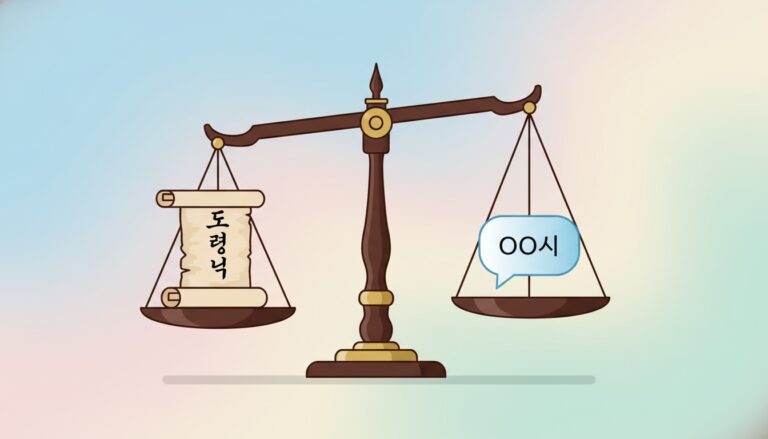
Today, we are diving deep into a topic that even native Koreans find tricky: The Family Title Reform Campaign (가족 호칭 개선 캠페인).
As a C2 learner, you already know the complex family tree. You know that historically, the Korean language has embedded a strict hierarchy, particularly between the husband’s family (Siga) and the wife’s family (Cheoga).
But here is the friction point: Why does a wife have to call her husband’s unmarried younger brother ‘Young Master’ (도련님), while the husband simply calls her younger brother ‘Brother-in-law’ (처남)?
Recently, the Ministry of Gender Equality and Family (여성가족부) and the National Institute of Korean Language have been pushing to modernize these terms to reflect mutual respect rather than feudal hierarchy. If you want to sound like a culturally aware, modern intellectual in Korea, this lesson is your master key.
Phase 2: Deep Dive into the Shift
We are moving away from vertical titles to horizontal names. Here are the core changes you need to know to navigate a modern Korean gathering.
1. 도련님 / 아가씨 → 이름 + 씨/님
(Doryeonnim / Agassi → Name + ssi/nim)
- Pronunciation: [Doryeonnim] sounds a bit like Do-run-neem. [Agassi] is standard. [Ssi] needs a sharp ‘S’, like the sound of escaping steam, not the English ‘She’.
- The Nuance: Doryeonnim (husband’s younger brother) and Agassi (husband’s sister) carry a feudal aristocrat vibe. Using “[Name]-ssi” (e.g., 민수 씨) neutralizes the hierarchy.
- Editor’s Insight: This is the most controversial shift. Traditional in-laws might feel you are being ‘rude’ or ‘distant’ by using a name. However, among the younger generation, this change is seen as a sign of equality.
- Situation Check: Safe with peers/younger in-laws who are progressive. Use with caution around conservative elders.
2. 장인/장모 & 시아버지/시어머니 → 아버님 / 어머님
(Jangin/Jangmo & Si-abeoji/Si-eomeoni → Abeonim / Eomeonim)
- Pronunciation: [Ah-buh-nim] / [Uh-muh-nim]. Soft vowels.
- The Nuance: Traditionally, distinct terms separated the wife’s parents (Jang-) from the husband’s (Si-).
- The Reform: Both spouses call both sets of parents Abeonim and Eomeonim.
- Editor’s Insight: This unifies the family unit. It removes the linguistic barrier that suggests the husband’s parents are ‘closer’ or ‘more important.’
3. 집사람 / 안사람 / 바깥양반 → 배우자 / [Name] 씨
(Jipsaram / Ansaram → Bae-u-ja / Name-ssi)
- Meaning: Jipsaram/Ansaram literally means “person inside the house” (referring to the wife). Bakkat-yangban means “nobleman outside” (referring to the husband).
- Editor’s Insight: These terms enforce gender roles. Modern couples prefer referring to each other as ‘Wife/Husband’ or simply by name when talking to friends, and Bae-u-ja (Spouse) in formal contexts.
Phase 3: Textbook vs. Real Life (The Modern Shift)
At the C2 level, you must distinguish between “Standard Tradition” and “Socially Conscious Modernity.”
| Context | Textbook (Traditional) | Real Life (Reform Style) |
|---|---|---|
| Husband’s Sister | 아가씨 (Agassi) | OO 씨 (Name-ssi) / OO 님 |
| Husband’s Brother | 도련님 (Unmarried) / 서방님 (Married) | OO 씨 (Name-ssi) |
| Introducing Wife | 제 집사람입니다 (My house person) | 제 와이프입니다 / 제 아내입니다 |
| Grandparents | 친할머니 (Paternal) / 외할머니 (Maternal) | 할머니 (Just Grandma for both) |
Note: The distinction between Chin- (Paternal) and Oe- (Maternal) essentially marks the maternal side as “outsiders.” The movement to drop these prefixes is gaining massive traction.
Phase 4: Cultural Context & Manners
The Art of Negotiation (Nunchi Check)
You cannot simply walk into a conservative Korean household during Chuseok and declare, “I will no longer call you Doryeonnim!” That is a declaration of war.
- The Strategy: The change must be mutually agreed upon (합의). usually, the younger generation agrees first: “Hey, let’s just call each other by name, it’s weird being so formal.”
- The Non-Verbal: If you use the new titles, maintain a polite smile and slightly softer tone to compensate for the perceived lack of formality in the title itself. Balance the “casual” title with “honorific” verb endings (Yo/Hapnida).
Phase 5: Roleplay Script
Scenario: A married couple is discussing with the husband’s younger brother (Min-su) about changing titles during a family dinner.
Characters:
* Ji-eun (Wife): Foreigner/Korean, C2 level speaker, progressive.
* Min-su (Husband’s younger brother): Open-minded.
Dialogue:
Ji-eun: (Smiling gently) 민수 씨, 저 질문이 하나 있어요. 사실 ‘도련님’이라는 호칭이 좀 어색해서요. 우리 편하게 이름을 부르는 건 어때요?
(Min-su ssi, I have a question. Honestly, the title ‘Young Master’ feels a bit awkward. How about we comfortably call each other by name?)
Min-su: (Laughs) 아, 사실 저도 형수님한테 꼬박꼬박 존댓말 듣는 거 부담스러웠어요. 네, 좋아요. 민수 씨라고 불러주세요.
(Ah, actually, it was burdensome for me too, hearing you use such formal language constantly. Yes, that sounds good. Please call me Min-su ssi.)
Ji-eun: 고마워요. 그럼 저도 민수 씨라고 부를게요. 훨씬 가깝게 느껴지네요.
(Thank you. Then I will call you Min-su ssi. It feels much closer.)
Acting Tip: Ji-eun frames this as her feeling awkward (using ‘I-message’) rather than accusing the tradition of being bad. This is high-level social skill.
Phase 6: 10-Second Shadowing Drill
Practice this sentence to explain your stance on title reform elegantly.
“호칭이 바뀌면 / 관계도 더 평등해진다고 / 생각해요.”
(I believe that if titles change, / the relationship becomes more equal too.)
- Pronunciation: Ho-ching-i ba-kkwi-myeon / gwan-gye-do deo pyeong-deung-hae-jin-da-go / saeng-gak-hae-yo.
- Focus: Pause after ‘ba-kkwi-myeon’ and ‘pyeong-deung-hae-jin-da-go’ to emphasize the cause and effect.
Phase 7: FAQ & Troubleshooting
- Q: Can I use these new terms with my parents-in-law (Si-eomeoni/Si-abeoji)?
- Answer: NO. Do not call your in-laws by their names (e.g., Chul-soo ssi). That is taboo. The reform is focused on siblings and spouses, not the parents’ generation. Keep calling them Mother/Father (Eomeonim/Abeonim).
- Q: What if they get angry?
- Answer: If the family atmosphere is very traditional (Bo-su-jeok), stick to the traditional terms (Doryeonnim/Agassi). Language is a tool for communication, not conflict. Read the room first.
Phase 8: Wrap-up
- One-Liner: Family titles in Korea are shifting from hierarchy to mutual respect.
- Action Mission: Next time you watch a K-Drama, spot if the characters use ‘Agassi/Doryeonnim’ or names. It tells you everything about their family vibe!
- Your Turn: traditional vs. modern titles—which one do you prefer? Let me know in the comments!
Phase 9: Pop Quiz
- Which term is being replaced by “Name + ssi” in the reform campaign?
a) Aboenim (아버님)
b) Doryeonnim (도련님)
c) Sajangnim (사장님) -
True or False: It is now acceptable to call your mother-in-law by her first name.
a) True
b) False -
What is the modern, gender-neutral way to refer to your spouse officially?
a) Jipsaram (집사람)
b) Bae-u-ja (배우자)
c) Yeobo (여보)
(Answers: 1. b, 2. b, 3. b)






