

Phase 1: Introduction
Greeting: Hello! This is your Senior Editor at Daily Hangul. 👋
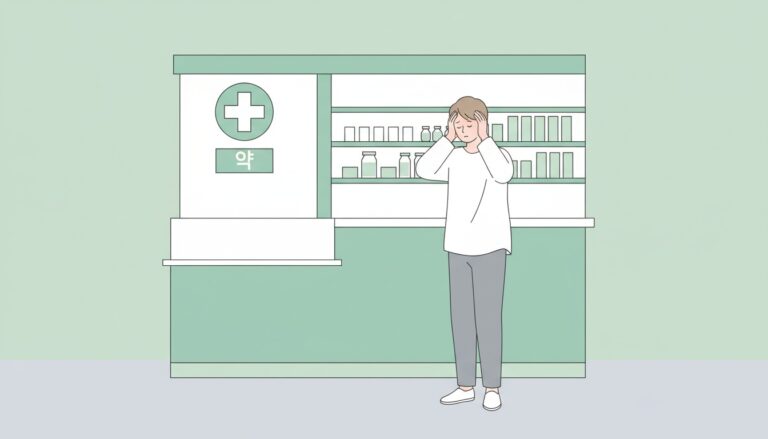
Imagine this: You are in Seoul, enjoying your trip, but suddenly—throb, throb—a massive headache hits you. You walk into a pharmacy (Yakguk), but the pharmacist looks at you expectantly. You point to your head and say “Sick!” The pharmacist looks confused. Do you have a fever? Did you bump your head? Are you dizzy?
The ‘Why’: Being able to specifically say “I have a headache” saves you from playing charades when you are in pain. It ensures you get the right medicine (painkiller vs. cold medicine).
Transparency: This guide answers the most common questions my A2 level students have asked when feeling under the weather in Korea. Let’s get you feeling better, fast.
Phase 2: Deep Dive (Core Expressions)
Here are the three most effective ways to describe your pain.
1. 머리가 아파요 (Meoriga apayo)
- Pronunciation: [Meo-ri-ga A-pa-yo]
- Tip: ‘Meo’ sounds like the ‘mu’ in mud. ‘A-pa’ sounds like Appa (Dad).
- Meaning: My head hurts. (Standard & Polite)
- Editor’s Insight: This is your Swiss Army Knife. It works for a mild stress headache, a migraine, or a cold. It is polite enough for a doctor, a boss, or a teacher.
- Situation Check: ✅ Casual (Drop ‘yo’) / ✅ Formal / ✅ Medical
2. 두통이 있어요 (Dutongi isseoyo)
- Pronunciation: [Du-tong-i Is-seo-yo]
- Meaning: I have a headache. (More formal/medical)
- Editor’s Insight: “Du-tong” (두통) is the Sino-Korean medical term for headache. You will see this written on medicine boxes. Using this makes you sound very educated and precise.
- Situation Check: ❌ Friends (Too stiff) / ✅ Pharmacy / ✅ Hospital
3. 머리가 깨질 것 같아요 (Meoriga kkaejil geot gatayo)
- Pronunciation: [Meo-ri-ga Kkae-jil-geot Ga-ta-yo]
- Meaning: My head feels like it’s going to break/shatter.
- Editor’s Insight: Use this when the pain is extreme (like a 9/10). Koreans love expressive language. If you say this, people will immediately worry and bring you water.
- Situation Check: ✅ Close Friends / ✅ Doctor (To emphasize severity)
Phase 3: Textbook vs. Real Life
Textbooks often teach you to be robotic. Real life is different.
| Textbook (Correct but Stiff) | Real Korean (Natural & Vivid) |
|---|---|
| 머리에 통증이 있습니다. (I have pain in my head.) |
머리가 띵해요. (My head feels foggy/dingy – slightly dizzy.) |
| 약 좀 주세요. (Please give me medicine.) |
두통약 있나요? (Do you have headache medicine?) |
| 많이 아픕니다. (It hurts a lot.) |
머리 아파 죽겠어요. (It hurts so much I could die – Very common exaggeration!) |
Note: As an A2 learner, stick to “머리가 띵해요” if you feel dizzy or lightheaded rather than sharp pain. It’s very natural!
Phase 4: Cultural Context & Manners
The “Hand on Temple” Gesture
In Western cartoons, an ice pack goes on top of the head. In Korea, when saying “I have a headache,” people often rub their temples (the side of the head) with their fingers or palm.
- Acting Tip: If you say “Meoriga apayo” while gently rubbing your temple and closing your eyes for a second, you communicate 100% native nuance.
The Magic of the Pharmacy (Yakguk – 약국)
Korean pharmacists act almost like mini-doctors. You don’t just grab aspirin off a shelf. You must talk to the pharmacist over the counter. Don’t be shy—they expect you to describe your symptom!
Phase 5: Real-Life Roleplay
Setting: Inside a local pharmacy (Look for the ‘약’ sign).
Characters: Alex (Foreigner) vs. Pharmacist (Korean native).
Pharmacist: 어떻게 오셨어요?
(Eotteoke osyeosseoyo?)
(How can I help you? / What brings you here?)
Alex: (Rubbing temples) 안녕하세요. 저 머리가 너무 아파요.
(Annyeonghaseyo. Jeo meoriga neomu apayo.)
(Hello. My head hurts really bad.)
Pharmacist: 감기 기운이 있나요? 열도 나요?
(Gamgi giuni innayo? Yeoldo nayo?)
(Do you have cold symptoms? Do you have a fever too?)
Alex: 아니요, 열은 없어요. 그냥 두통만 있어요.
(Aniyo, yeoreun eopseoyo. Geunyang dutongman isseoyo.)
(No, no fever. I just have a headache.)
Pharmacist: 네, 여기 진통제 드릴게요.
(Ne, yeogi jintongje deurilgeyo.)
(Okay, here is a painkiller.)
Phase 6: 10-Second Shadowing Drill
Read this aloud to practice your rhythm. Pause at the slash / marks.
“어제부터 / 머리가 / 너무 아파요.”
(Eojebuteo / meoriga / neomu apayo.)
Meaning: Since yesterday / my head / hurts so much.
Phase 7: FAQ & Troubleshooting
- Q: Can I use “Apayo” for a heartache (sadness)?
- A: Yes! Koreans often say “마음이 아파요” (Maeumi apayo) which means “My heart hurts” (I’m sad/upset). But if you point to your head, it’s definitely physical pain.
- Q: Should I bow when asking for medicine?
- A: A slight nod or small bow is polite when entering the pharmacy and receiving the medicine with two hands.
Phase 8: Wrap-up
- Summary: Use “머리가 아파요” for general pain, and “두통약” when buying medicine.
- Mission: Next time you walk down a street in Korea, count how many “약” (Medicine) signs you see. They are everywhere!
- Talk to me: Have you ever been sick while traveling? How did you handle it? Tell me in the comments!
Phase 9: Pop Quiz
- Which phrase implies your head feels like it will “break” from pain?
- A) 머리가 아파요
- B) 머리가 깨질 것 같아요
- C) 머리가 띵해요
- What is the specific medical word for “Headache” written on boxes?
- A) 두통 (Dutong)
- B) 치통 (Chitong)
- C) 복통 (Boktong)
- True or False: You should buy painkillers silently without talking to the pharmacist in Korea.
- (True / False)
Click to see answers
1. B
2. A
3. False (You usually explain symptoms to the pharmacist!)
Frequently Asked Questions (FAQ)
Q: What does ""마음이 아파요"" mean in Korean and how do you pronounce it?
A: In Korean, ""마음이 아파요"" is pronounced [Maeumi apayo] and means: which means "My heart hurts" (I'm sad/upset). But if you point to your head, it's definitely physical pain.
Q: What does ""약"" mean in Korean and how do you pronounce it?
A: In Korean, ""약"" is pronounced [Medicine] and means: signs you see. They are everywhere!







