

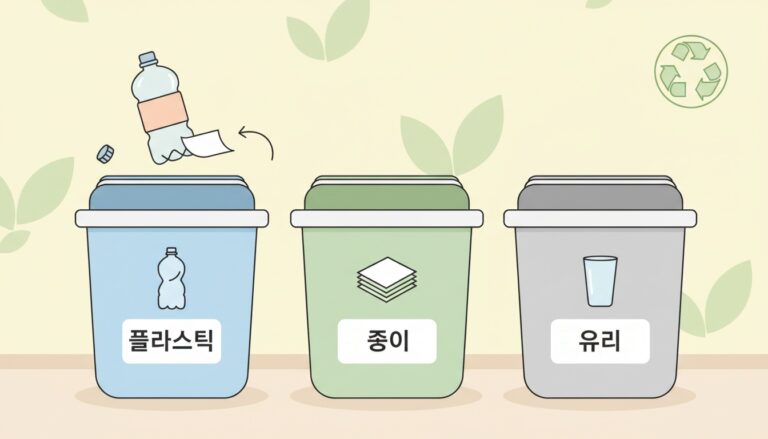
Phase 1: Welcome to the “Recycling Battlefield”
“Ah, excuse me! That’s not where that goes!”
Hello, Daily Hangul readers! This is your editor, Jay.
If you live in Korea, you know that Tuesday (or a specific day of the week) isn’t just a weekday—it’s Recycling Day (분리수거 날). Imagine this: You walk out to the recycling station with your bag of trash. You feel confident. You toss a plastic tteokbokki container into the bin.
Suddenly, the apartment security guard (guard ajeossi) comes running out, waving his hands. 😱 Why? Because that container still had red sauce on it.
Recycling in Korea is serious business. It’s not just about being eco-friendly; it’s a community rule. Today, we will learn how to handle “Plastic” so you can recycle like a local and avoid those awkward scoldings.
(Note: This guide is based on real struggles my B1 students face when moving into Korean apartments!)
Phase 2: Deep Dive into Core Expressions
Here are the three verbs you need to survive recycling day.
1. 헹구다 (To rinse)
- Pronunciation: [heng-gu-da] Sounds like ‘Hang’ + ‘Goo’ + ‘Da’
- Meaning: To rinse off with water (usually without soap).
- Editor’s Insight: This is different from 씻다 (ssit-da), which means to wash thoroughly. When the guard tells you to clean a bottle, he usually means just swish some water in it to remove the dregs.
- Situation Check: Used for cups, bottles, and non-greasy food containers.
2. 라벨을 떼다 (To peel off the label)
- Pronunciation: [la-bel-eul tte-da]
- Meaning: To remove/detach the label.
- Editor’s Insight: Since 2020, Korea requires transparent PET bottles to be label-free. If you don’t do this, the cleaning ladies might sigh loudly behind your back. Use the verb 떼다 (to detach/peel off).
- Situation Check: Essential for clear water bottles (Samdasoo, etc.).
3. 내용물을 비우다 (To empty the contents)
- Pronunciation: [nae-yong-mul-eul bi-u-da]
- Meaning: To empty what is inside.
- Editor’s Insight: You can’t throw away a cup with ice still in it! You must 비우다 first.
- Situation Check: Coffee shops, convenience stores, and recycling stations.
Phase 3: Textbook vs. Real Life
Textbooks are polite, but real life is fast. Here is how people actually talk at the recycling bins.
| Textbook Korean 📚 | Real Life Korean (Spoken) 🗣️ |
|---|---|
| 플라스틱을 씻어서 버리세요. (Please wash the plastic and throw it away.) |
이거 헹궈서 버려야 돼요. (You gotta rinse this before tossing it.) |
| 라벨을 제거해 주세요. (Please remove the label.) |
라벨 떼고 넣으세요. (Peel the label and put it in.) |
| 이것은 재활용이 불가능합니다. (This is not recyclable.) |
이건 일반 쓰레기예요. (This is just general trash.) |
💡 Bottom Note: In B1 level conversation, using -아/어서 (action sequence) is key. Instead of two sentences, say “Wash it and then throw it away” -> 씻어서 버리다.
Phase 4: Cultural Context & Manners
🚮 The “Tteokbokki Container” Dilemma
In Korea, “stained” means “trash.”
If a plastic container has red chili paste marks (like from Tteokbokki or Kimchi) that won’t wash off even after rinsing, you cannot recycle it as plastic. You must throw it in the General Waste (일반 쓰레기 – standard white bag).
👀 Eye Contact & Nunchi
At the recycling station, if an older resident or guard is staring at your trash bag, they aren’t being rude; they are checking your sorting skills!
* Tip: If you are unsure, ask them humbly: “이거 플라스틱 맞나요?” (Is this plastic right?). They will appreciate your effort and help you.
Phase 5: Real Scenario Roleplay
Setting: Apartment recycling station. Tuesday morning.
Characters: Mark (Foreigner) and Guard (Security Ajusshi).
Mark: (Holding a dirty plastic sauce bottle)
여기에 버리면 되나요?
(Can I throw this away here?)
Guard: (Frowning and blocking the bin)
아니요, 그렇게 버리면 안 돼요! 안에 내용물이 남았잖아요.
[A-ni-yo, geu-reo-ke beo-ri-myeon an-dwae-yo! An-e nae-yong-mul-i nam-at-ja-na-yo.]
(No, you can’t throw it like that! There is still content left inside.)
Mark: 아, 죄송합니다. 물로 헹궈서 올게요.
[A, joe-song-ham-ni-da. Mul-lo heng-gwo-seo ol-ge-yo.]
(Ah, I’m sorry. I will rinse it with water and come back.)
Guard: (Softening his expression)
그래요. 그리고 라벨도 꼭 떼세요.
[Geu-rae-yo. Geu-ri-go la-bel-do kkok tte-se-yo.]
(Okay. And make sure to peel off the label, too.)
Phase 6: 10-Second Shadowing Drill
Read this aloud to practice your intonation. The / marks where you should pause slightly.
“페트병은 / 물로 헹구고 / 라벨을 떼서 / 버려 주세요.”
Pronunciation Guide:
Pe-teu-byeong-eun / mul-lo heng-gu-go / la-bel-eul tte-seo / beo-ryeo ju-se-yo.Meaning: Please rinse the PET bottle with water, peel the label, and throw it away.
Phase 7: FAQ & Troubleshooting
Q: Can I crush the bottles?
A: YES! Please do. Compressing them saves space. In Korean, we say “찌그러뜨리다” (to crush/squash). The guard will love you if you do this.
Q: What if the label leaves a sticky residue?
A: It’s usually okay if a little sticky part remains, but try your best. Most Korean bottles now have an “Easy Peel” tab.
Phase 8: Wrap-up
Today’s One-Liner Summary:
Recycling isn’t just throwing things away; it’s Rinsing (헹구다), Peeling (떼다), and Separating (분리하다).
Your Mission:
Go to a convenience store, buy a drink, and when you finish, check for the “절취선” (perforated line) on the label. Practice peeling it off cleanly before throwing it in the bin!
Do you have a recycling horror story in Korea? Tell me in the comments! 👇
Phase 9: Pop Quiz
1. Which verb fits best? “Please _____ the water from the bottle before throwing it away.”
A) 먹다 (eat)
B) 비우다 (empty)
C) 사다 (buy)
2. What should you do with a Tteokbokki container that is stained red?
A) Wash it perfectly white.
B) Recycle it anyway.
C) Throw it in General Waste (일반 쓰레기).
3. What is the Korean word for “to rinse”?
A) 헹구다
B) 춤추다
C) 공부하다
(Answers: 1. B, 2. C, 3. A)
Frequently Asked Questions (FAQ)
Q: What does "헹구다 (To rinse)" mean in Korean and how do you pronounce it?
A: In Korean, "헹구다 (To rinse)" is pronounced [heng-gu-da] and means: To rinse off with water (usually without soap).
Q: What does "라벨을 떼다 (To peel off the label)" mean in Korean and how do you pronounce it?
A: In Korean, "라벨을 떼다 (To peel off the label)" is pronounced [la-bel-eul tte-da] and means: To remove/detach the label.
Q: What does "내용물을 비우다 (To empty the contents)" mean in Korean and how do you pronounce it?
A: In Korean, "내용물을 비우다 (To empty the contents)" is pronounced [nae-yong-mul-eul bi-u-da] and means: To empty what is inside.







