

Introduction: The Longest 10 Seconds of Your Life
Hello! This is your Senior Editor at Daily Hangul.
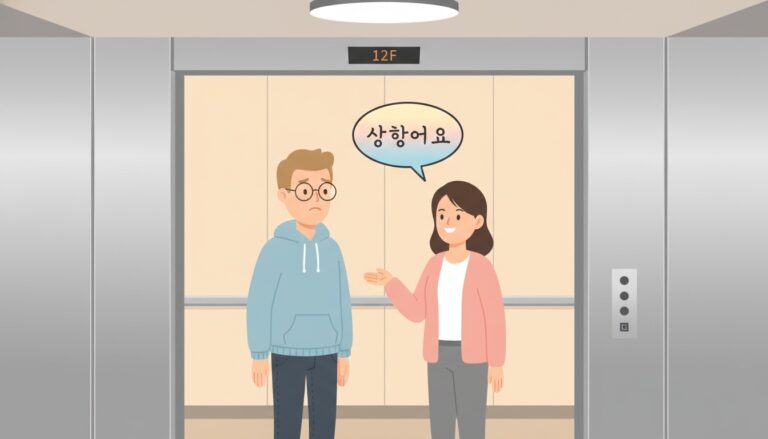
Imagine this: You’ve had a long day. You press the elevator button at your apartment complex. The doors slide open, and you step in—only to realize a neighbor is already there. The doors close. Silence.
Suddenly, the 10th floor feels like it’s miles away. Do you look at your phone? Do you stare at the floor? Or do you say something?
This is the #1 pain point my intermediate (B1) students complain about living in Korea. They tell me, “I want to be polite, but I’m afraid my pronunciation will make it weird, so I just freeze.”
Today, we are going to break that ice. We will learn how to navigate the Korean Apartment Elevator Culture with the natural ease of a local. No more awkward silence!
Deep Dive: Key Expressions for the Elevator
Here are the top phrases to save you from awkwardness.
1. 안녕하세요 (Hello)
- Pronunciation: [An-nyeong-ha-se-yo]
- Tip: It sounds smooth, like a wave. Don’t chop the syllables.
- Meaning: Hello / Good morning / Good evening.
- Editor’s Insight: You know this word. But in an elevator, volume matters. Do not shout it like you are greeting a friend at a party. A soft, calm murmur is best. It’s an acknowledgment of presence, not a conversation starter.
- Situation Check: Universal (Casual neighbors to older residents).
2. 올라가세요? / 내려가세요? (Going up? / Going down?)
- Pronunciation: [Ol-la-ga-se-yo?] / [Nae-ryeo-ga-se-yo?]
- Meaning: Are you going up? / Are you going down?
- Editor’s Insight: This is the perfect “filler” phrase. Use this when you are pressing the buttons for them. It shows you have Sense (wit/situational awareness).
- Situation Check: Polite. Perfect for when someone rushes in at the last second.
3. 먼저 들어가세요 (Please go in first)
- Pronunciation: [Meon-jeo deu-reo-ga-se-yo]
- Tip: ‘Meon-jeo’ sounds a bit like ‘Mon’ in Monday + ‘Juh’.
- Meaning: Literally “Please enter first,” but in this context, it means “After you” or “You go ahead.”
- Editor’s Insight: Use this when the elevator arrives at their floor, or you both get off at the same floor. It is extremely polite and classy.
- Situation Check: Use with neighbors you don’t know well.
Textbook vs. Real Life
How does a textbook teach this versus how real Koreans do it?
| Feature | Textbook Korean 📘 | Real Life Korean (Survival) 🕶️ |
|---|---|---|
| Greeting | 안녕하십니까? (An-nyeong-ha-sim-ni-kka?) | 안녕하세요~ (Softly, trailing off) |
| Body Language | 90-degree bow | Mok-rye (목례): A slight head nod |
| Silence | Always speaking clearly | sometimes just a smile and a nod is enough |
Editor’s Note: “안녕하십니까?” is too military/formal for neighbors. You might scare them! Stick to a soft “안녕하세요.”
Cultural Context: The Art of “Mok-rye” (목례)
In Korean apartment culture, we have a concept called Mok-rye (Eye greeting / Neck bow).
If you see a neighbor you don’t know well, you don’t always have to speak. If you make eye contact, simply nodding your head slightly (a mini-bow) is considered a greeting.
The “Nunchi” (Eye-measure) Rule:
* If they are on the phone: Just do a Mok-rye (nod). Don’t interrupt with a loud “HELLO!”
* If they look tired: A soft “안녕하세요” is enough. Don’t ask “How are you?” (Koreans rarely ask “How are you” to strangers in elevators).
* Eye Contact: Do not stare at them the whole ride. Greet them, then look at the floor indicator or your phone. Giving personal space is a form of politeness.
Real-Life Scenario: The Rush Hour
Setting: 6:00 PM, busy elevator in a Seoul apartment complex.
Characters: Sam (Foreign resident, B1 level), Neighbor (Middle-aged woman holding grocery bags).
(The elevator door opens. Sam steps in. The neighbor is already there.)
Sam: (Slight bow, soft voice) 안녕하세요.
[An-nyeong-ha-se-yo.]
(Hello.)
Neighbor: (Smiles) 네, 안녕하세요.
[Ne, an-nyeong-ha-se-yo.]
(Yes, hello.)
(Sam notices her hands are full. He stands near the buttons.)
Sam: 몇 층 가세요?
[Myeot cheung ga-se-yo?]
(What floor are you going to?)
Neighbor: 12층이요. 고마워요.
[Sibi-cheung-i-yo. Go-ma-wo-yo.]
(12th floor. Thank you.)
(Elevator arrives at 12th floor.)
Sam: (Pressing the open button) 먼저 들어가세요.
[Meon-jeo deu-reo-ga-se-yo.]
(Please go ahead.)
Neighbor: 어머, 센스 있네. 조심히 가요~
[Eo-meo, sense-inne. Jo-sim-hi ga-yo~]
(Oh, you have good manners. Get home safe~)
10-Second Shadowing Drill
Let’s practice the most useful phrase. Read this aloud with the marked rhythm!
“Please go ahead (after you).”
먼저 / 들어가세요.
[Meon-jeo / deu-reo-ga-se-yo]
- Focus: Put a slight stress on Meon-jeo. Say the rest smoothly like water flowing.
FAQ & Troubleshooting
- Q: Can I just stay silent?
- A: If you make eye contact, silence is considered rude or cold. Even a small nod (Mok-rye) transforms you from “that foreigner” to “the nice neighbor.”
- Q: Should I help them hold the door?
- A: YES. In Korea, pressing the ‘Open’ button until the person is fully out is a huge sign of manners. If you do this, they will remember you fondly.
Wrap-up
Today’s Summary: The elevator isn’t a torture chamber. It’s a place for Mok-rye (nod) and soft greetings.
Your Mission: Next time you enter your elevator (or any building elevator), do not look at your phone immediately. Look the person in the eye, give a small nod, and say a soft “안녕하세요.”
Did you try it? Did they smile back? Tell me in the comments! I read every single one.
Quick Quiz
- What is the Korean term for a silent nod/greeting?
- a) Kimchi
- b) Mok-rye
- c) Nunchi
- You are near the buttons and a neighbor walks in with full hands. What do you ask?
- a) 몇 층 가세요? (What floor?)
- b) 이름이 뭐예요? (What is your name?)
- c) 밥 먹었어요? (Did you eat?)
- True or False: You should stare at your neighbor continuously to show respect.
- (True / False)
Click to see answers
1. b) Mok-rye
2. a) 몇 층 가세요?
3. False (Please give them personal space!)
Frequently Asked Questions (FAQ)
Q: What does "안녕하세요 (Hello)" mean in Korean and how do you pronounce it?
A: In Korean, "안녕하세요 (Hello)" is pronounced [An-nyeong-ha-se-yo] and means: a key conversational Korean expression covered in this lesson.
Q: What does "올라가세요? / 내려가세요? (Going up? / Going down?)" mean in Korean and how do you pronounce it?
A: In Korean, "올라가세요? / 내려가세요? (Going up? / Going down?)" is pronounced [Ol-la-ga-se-yo?] and means: Are you going up? / Are you going down?
Q: What does "먼저 들어가세요 (Please go in first)" mean in Korean and how do you pronounce it?
A: In Korean, "먼저 들어가세요 (Please go in first)" is pronounced [Meon-jeo deu-reo-ga-se-yo] and means: a key conversational Korean expression covered in this lesson.







