

Hello! This is your Daily Hangul Head Editor.
Imagine this: You are in a Korean friend’s kitchen, helping them make Ramyeon or Kimchi-jjigae. You want to be helpful, so you pick up a knife and the green onions. Suddenly, your friend shouts, “No! Not like that!”
Panic sets in. Did you break a taboo? No, you just didn’t know the “Korean way” to chop.
In English, we just “cut” things. But in Korean, how you cut changes the verb entirely. If you use the wrong word, it sounds like you are performing surgery on the vegetables! Today, let’s master the art of dealing with 파 (Pa – Green Onion) so you can cook like a local without the tears.
Phase 1: The Core Expressions (Deep Dive)
Here are the top 3 words you need to survive in a Korean kitchen.
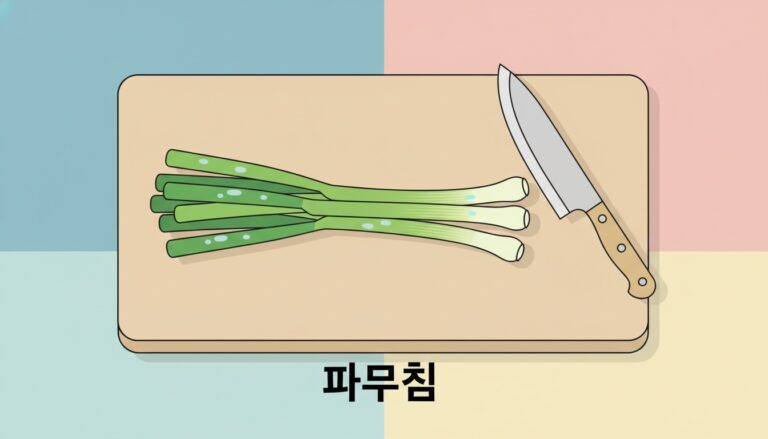
1. 파 (Pa)
- Pronunciation: [Pa]
- Sound Analogy: It sounds exactly like the first part of “Pa-pa”. Short and crisp.
- Meaning: Green onion / Scallion
- Editor’s Insight: This is the soul of Korean cooking. It goes in soup, stew, and side dishes. If you see something green floating in your soup, 99% of the time, it’s 파.
2. 썰다 (Sseol-da)
- Pronunciation: [Sseol-da]
- Sound Analogy: ‘Sseol’ sounds a bit like ‘Sol’ in Solar, but with a strong ‘S’ (tense sound). Imagine a sharp knife sliding through crisp veggies: Ssss-eol.
- Meaning: To chop / To slice (specifically for food)
- Situation Check: Used only for cooking ingredients. Do not use this for cutting paper or hair!
3. 송송 (Song-song)
- Pronunciation: [Song-song]
- Sound Analogy: Like a ‘Song’ you sing, repeated twice.
- Meaning: (Adverb) Finely chopped (usually for round shapes)
- Editor’s Insight: This is a “mimetic word” (sound/shape word). It describes the sound or look of chopping green onions into little circles. It’s a very cute, native way to describe cutting!
Phase 2: Textbook vs. Real Life
Textbooks often teach you generic words. Real Koreans use specific verbs. Let’s upgrade your A2 vocabulary.
| Textbook Korean (Robot Vibe 🤖) | Real Life Korean (Chef Vibe 🧑🍳) |
|---|---|
| 파를 자르세요. (Pa-reul ja-reu-se-yo) | 파 좀 썰어주세요. (Pa jom sseoreo-ju-se-yo) |
| Meaning: Please cut the green onion. | Meaning: Please chop/slice the green onion. |
| 작게 만드세요. (Jak-ge man-deu-se-yo) | 송송 썰어주세요. (Song-song sseoreo-ju-se-yo) |
| Meaning: Please make it small. | Meaning: Please chop it finely (into circles). |
💡 Editor’s Note:
* 자르다 (Ja-reu-da) is for paper, hair, or cutting a connection.
* 썰다 (Sseol-da) is the proper culinary term. Using Ja-reu-da for food isn’t “wrong,” but it lacks the professional kitchen feel!
Phase 3: Cultural Context (Manners & Nunchi)
Cooking in Korea is a communal activity (Zusammen), and Nunchi (reading the room) is key.
- The Scissor Culture:
If you are eating K-BBQ or making Ramyeon, you might see Koreans cutting green onions (and even meat) with kitchen scissors (가위). Don’t be shocked! It’s efficient. If you can’t find a knife, looking for scissors shows you have good “adaptation skills.” -
“Can I help?”:
In Korea, just watching someone cook can be seen as lacking Nunchi. Even if you are a guest, asking “도와드릴까요?” (Dowa-deuril-kkayo? – Shall I help you?) is excellent etiquette.
Phase 4: Real-Life Scenario (Roleplay)
Setting: You are at a pension (vacation house) with a Korean friend, cooking Ramyeon for dinner.
(You pick up the green onions)
- You: 이 파, 어떻게 할까요?
(I pa, eotteoke hal-kkayo?)
[What should I do with this green onion?] -
Friend: 아, 그거 썰어서 넣어줘.
(Ah, geugeo sseoreo-seo neoeo-jwo.)
[Ah, chop that and put it in.] -
You: 어떻게 썰까요? 송송?
(Eotteoke sseol-kkayo? Song-song?)
[How should I chop it? Finely/Circles?] -
Friend: 응, 송송 썰어줘!
(Eung, song-song sseoreo-jwo!)
[Yes, chop it finely!]
Phase 5: 10-Second Shadowing
Practice this sentence to sound natural when asking for instructions. Pay attention to the pause!
“How should I chop the green onions?”
파는 / 어떻게 / 썰까요?
(Pa-neun / eotteoke / sseol-kkayo?)
- Focus Point: Stress the ‘sseol’ sound strongly. Don’t say ‘seol’ (loose), say ‘SSeol’ (tight and sharp)!
Phase 6: FAQ (Troubleshooting)
- Q: Can I use “chop” (다지다 – da-ji-da)?
A: Good question! 다지다 (Da-ji-da) means to “mince” (like garlic). If you say you will da-ji-da the green onions for Ramyeon, you will turn them into a mushy paste. Stick to 썰다 (Sseol-da) unless you are making dumpling filling! -
Q: Is it rude to use scissors instead of a knife?
A: Not at all! In a casual home setting or BBQ restaurant, scissors are the king. It’s actually very “Korean style.”
Phase 7: Wrap-up & Mission
📝 Summary:
* Don’t just “cut” (자르다), you must “slice/chop” (썰다) food.
* 송송 (Song-song) is the cute sound word for chopping green onions into circles.
🚀 Today’s Mission:
Next time you watch a K-Drama or a Korean cooking Youtube video (Mukbang), listen carefully. When they start cutting vegetables, try to hear if they say “자르다” or “썰다”. You will hear “썰다” 90% of the time!
Phase 8: Pop Quiz
1. Which verb is best for cutting vegetables for a meal?
A) 자르다 (Ja-reu-da)
B) 썰다 (Sseol-da)
C) 마시다 (Ma-si-da)
2. What does “Song-song” (송송) describe?
A) The sound of boiling water
B) Finely chopping something into small circles
C) The smell of Kimchi
3. How do you say “Green Onion” in Korean?
A) Ma (마)
B) Pa (파)
C) Ga (가)
(Answers: 1-B, 2-B, 3-B)
Frequently Asked Questions (FAQ)
Q: What does "파 (Pa)" mean in Korean and how do you pronounce it?
A: In Korean, "파 (Pa)" is pronounced [Pa] and means: a key conversational Korean expression covered in this lesson.
Q: What does "썰다 (Sseol-da)" mean in Korean and how do you pronounce it?
A: In Korean, "썰다 (Sseol-da)" is pronounced [Sseol-da] and means: a key conversational Korean expression covered in this lesson.
Q: What does "송송 (Song-song)" mean in Korean and how do you pronounce it?
A: In Korean, "송송 (Song-song)" is pronounced [Song-song] and means: a key conversational Korean expression covered in this lesson.







