

Survived the Treatment? Now Let’s Survive the Bill! 🏥💸
Phase 1: Introduction
안녕하세요! This is your Chief Editor from Daily Hangul.
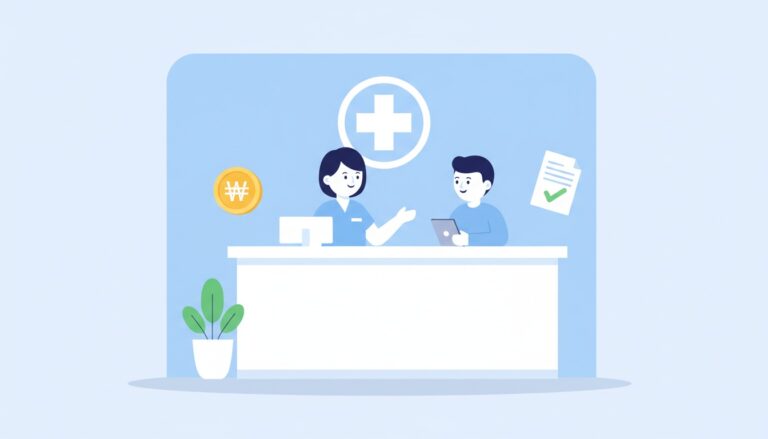
Imagine this: You’ve just finished a doctor’s appointment in Seoul. The doctor was great, the nurses were kind, but now you are standing in front of the reception desk (원무과). The receptionist says something rapidly about “Geupyeo” and “Bigeupyeo,” and shows you a number on the calculator. You just nod and pay… only to realize later you paid for a premium treatment that wasn’t covered by your insurance.
I’ve seen this happen to so many of my intermediate (B2) students. They speak Korean well enough to order food or chat with friends, but they freeze up when medical jargon appears.
Understanding how to ask about National Health Insurance (NHIS) coverage isn’t just about saving money—it’s about knowing your rights as a patient. Today, we are going to learn the exact phrases to ensure you are paying the right amount and getting the documents you need.
Note: This guide is based on real questions from expats living in Korea who hold an ARC (Alien Registration Card) and NHIS.
Phase 2: Deep Dive (Key Expressions)
Here are the three heavy-hitting phrases you need at the billing desk.
1. 이거 건강보험 적용되나요?
(Does health insurance cover this?)
- Pronunciation: I-geo geon-gang-bo-heom jeok-yong-doe-na-yo?
- Tip: ‘Jeok-yong’ (application/coverage) can be tricky. It sounds like jug-yong where ‘jug’ rhymes with ‘mug’.
- Meaning:
- Literal: Is health insurance applied to this?
- Real Nuance: “I need to know if the government pays for a part of this, or if I’m paying 100%.”
- Editor’s Insight: In Korea, treatments are divided into 급여 (Geupyeo – Covered) and 비급여 (Bigeupyeo – Not covered). If a doctor suggests a fancy test or procedure, asking this question is perfectly polite and very smart.
- Situation Check: Formal & Polite. Use this with the doctor before treatment or at the reception desk.
2. 본인 부담금이 얼마예요?
(How much is the out-of-pocket expense?)
- Pronunciation: Bon-in bu-dam-geum-i eol-ma-ye-yo?
- Tip: ‘Bu-dam’ (burden) sounds like saying “Boo!” + “Dam” (like the water barrier).
- Meaning:
- Literal: How much is the self-burden money?
- Real Nuance: “After insurance kicks in, what is the actual final price I have to pay?”
- Editor’s Insight: Just asking “How much is it?” (얼마예요?) is A1 level. At B2 level, specifying 본인 부담금 shows you understand how the Korean medical system works. It signals, “I live here.”
- Situation Check: Very appropriate at the billing counter.
3. 보험 청구하게 서류 좀 떼 주세요.
(Please issue documents so I can claim insurance.)
- Pronunciation: Bo-heom cheong-gu-ha-ge seo-ryu jom tte-ju-se-yo.
- Tip: ‘Tte’ (떼) is a tense sound. Tense up your tongue like you are about to spit out a seed.
- Meaning:
- Literal: Please detach/issue documents so I can claim insurance.
- Real Nuance: “I have private insurance (Shilbi), so give me the receipt and diagnosis details required for reimbursement.”
- Editor’s Insight: The verb 떼다 (tteda) is the most natural verb for “getting an official document issued.” Don’t use ‘주세요’ (give) alone; ‘떼 주세요’ sounds much more native.
- Situation Check: Essential if you have private insurance on top of the national one.
Phase 3: Textbook vs. Real Life
Let’s upgrade your Korean from “Textbook Robot” to “Seoul Resident.”
| Textbook Korean (Formal) | Real Life Korean (Smart & Natural) | Note |
|---|---|---|
| 진료비가 총 얼마입니까? (How much is the total medical fee?) | 오늘 결제할 금액이 얼마예요? (How much is the payment for today?) | ‘결제 (payment)’ is used more often at the counter. |
| 영수증을 주십시오. (Please give me the receipt.) | 진료비 세부 내역서도 같이 주세요. (Please give me the detailed statement too.) | A simple receipt isn’t enough for insurance claims; you need the detailed one. |
| 보험이 됩니까? (Does insurance work?) | 실비 처리 되나요? (Can I process this with private/indemnity insurance?) | ‘Silbi’ (Private Indemnity Insurance) is the magic word for extra coverage. |
Editor’s Note: Using “실비 (Silbi)” instantly categorizes you as a long-term resident. Tourists usually rely on Travel Insurance, but residents have Silbi.
Phase 4: Cultural Context & Manners
1. The “Bigeupyeo” (Non-covered) Shock
Unlike some countries where everything is hidden until the bill arrives, Korean doctors often explain extra costs beforehand. However, for items like MRI, advanced ultrasound, or special injections, the hospital must inform you if it’s 비급여 (Non-insured/Full price). If the price seems shocking, it’s 99% a “Bigeupyeo” item. It is culturally acceptable to ask, “이거 꼭 해야 하나요?” (Do I absolutely need to do this?) if you want to save money.
2. The Speed of “Won-mu-gwa” (Administration Desk)
Korean hospital reception desks are incredibly fast. They expect you to have your card ready. Do not fumble for your wallet when it’s your turn.
* Nunchi Tip: If you need documents (certificates), tell them before you pay. If you ask after payment, they might have to cancel the transaction or make you wait again.
Phase 5: Roleplay Script
Setting: A foreigner (Alex) at the reception desk of an Orthopedic clinic (정형외과) after treatment.
Characters:
* Alex: B2 Level Korean learner.
* Staff: Hospital receptionist (Fast, professional).
Dialogue:
(Alex approaches the counter holding a prescription slip.)
Staff: 알렉스 님, 물리치료 받으셨죠? 처방전 여기 있습니다.
(Alex-nim, you had physical therapy, right? Here is your prescription.)
Alex: 네, 감사합니다. 저, 아까 주사 맞은 거 건강보험 적용된 건가요?
(Yes, thank you. Um, regarding the injection I got earlier, was that covered by health insurance?)
Staff: 아, 그건 비급여 항목이라 본인 부담금이 좀 나와요. 5만 원입니다.
(Ah, that is a non-insured item, so the out-of-pocket cost is a bit high. It’s 50,000 won.)
Alex: 아, 그렇군요. 그럼 실비 보험 청구하게 서류 좀 떼 주시겠어요?
(Ah, I see. Then, could you please issue the documents so I can claim it on my private insurance?)
Staff: 네, 진료비 세부 내역서랑 영수증 챙겨 드릴게요.
(Sure. I will get you the detailed medical statement and the receipt.)
Phase 6: 10-Second Shadowing
Let’s practice the rhythm. In Korean, politeness often comes from a softer ending tone, not a robotic one.
Drill: Asking for documents nicely but clearly.
“실비 보험 청구하게 / 서류 좀 / 떼 주세요.”
(Silbi bo-heom cheong-gu-ha-ge / seo-ryu jom / tte-ju-se-yo.)
- Focus: Pause briefly after ‘cheong-gu-ha-ge’. Stress the ‘Tte’ in ‘tte-ju-se-yo’.
Phase 7: FAQ & Troubleshooting
Q: Can I negotiate the price at a hospital?
A: No. Medical fees in Korea are strictly regulated by the government (for covered items) or set by the hospital (for non-covered items). Trying to haggle like at a market is considered rude. However, you can ask if there is a cheaper alternative (더 저렴한 치료법은 없나요?).
Q: Is it rude to ask for documents (서류) every time?
A: Not at all! It’s your right. In fact, the staff prefers you ask for it on the day of treatment rather than coming back a week later.
Phase 8: Wrap-up & Action Item
- Summary: Don’t just pay blindly! Ask if it’s covered (건강보험 적용), check your co-pay (본인 부담금), and get your papers (서류 떼 주세요).
- Mission: Check your wallet right now. Do you have your ARC (Alien Registration Card)? Next time you go to a pharmacy or clinic, try asking: “영수증 주세요” (Give me the receipt) even if you don’t need it, just to practice the interaction!
- Comment Below: Have you ever been surprised by a hospital bill in Korea? Share your story!
Phase 9: Quiz
1. How do you ask “Is this covered by health insurance?”
a) 이거 비싸요? (Is this expensive?)
b) 이거 건강보험 적용되나요? (Does health insurance cover this?)
c) 의사 선생님 어디 있어요? (Where is the doctor?)
2. Which word means “Non-insured / Not covered”?
a) 급여 (Geupyeo)
b) 월급 (Wolgeup)
c) 비급여 (Bigeupyeo)
3. To ask for official documents, the most natural verb is:
a) 떼다 (Tteda)
b) 사다 (Sada)
c) 먹다 (Meokda)
(Answers: 1-b, 2-c, 3-a)
Frequently Asked Questions (FAQ)
Q: What does "비급여" mean in Korean and how do you pronounce it?
A: In Korean, "비급여" is pronounced [Bigeupyeo - Not covered] and means: . If a doctor suggests a fancy test or procedure, asking this question is perfectly polite and very smart.
Q: What does "떼다" mean in Korean and how do you pronounce it?
A: In Korean, "떼다" is pronounced [tteda] and means: is the most natural verb for "getting an official document issued." Don't use '주세요' (give) alone; '떼 주세요' sounds much more native.
Q: What does "비급여" mean in Korean and how do you pronounce it?
A: In Korean, "비급여" is pronounced [Non-insured/Full price] and means: . If the price seems shocking, it’s 99% a "Bigeupyeo" item. It is culturally acceptable to ask,
Q: What does ""이거 꼭 해야 하나요?"" mean in Korean and how do you pronounce it?
A: In Korean, ""이거 꼭 해야 하나요?"" is pronounced [Do I absolutely need to do this?] and means: if you want to save money.







