

Phase 1: Introduction
Hello, Daily Hangul family! This is your Senior Editor.
Today, we are stepping away from K-Dramas and café orders to talk about something infinitely more important: Saving a life.
Imagine this: You are jogging along the Han River. Suddenly, the person in front of you collapses. You are a C1 learner—you can discuss politics and economics in Korean—but in that split second, do you know the word for “Chest Compressions”? Can you scream “Bring the AED!” without hesitating?
In emergency situations, fluency isn’t about grammar; it’s about speed and precision. Many advanced learners tell me, “I froze because I didn’t want to use the wrong word for medical equipment.”
Don’t worry. By the end of this module, you will be the person who takes charge, not the bystander who watches. Let’s learn the language of survival.
Phase 2: Deep Dive into Critical Expressions
Here are the C1-level technical terms you need to master for CPR scenarios.
1. 흉부 압박 (Chest Compressions)
- Pronunciation:
Hyung-bu Ap-bak[Think of Hyung (older brother) + bu (part) + Ap (up) + bak (pressure)] - Meaning:
- Literal: Chest / Pressure
- Real Nuance: The specific medical act of CPR compressions. Don’t just say “누르세요” (press it); that’s too vague.
- Editor’s Insight: You will hear 119 dispatchers use this term. It sounds professional and urgent. If you say this, people will assume you know first aid.
- Situation Check: 🚑 Emergency Only.
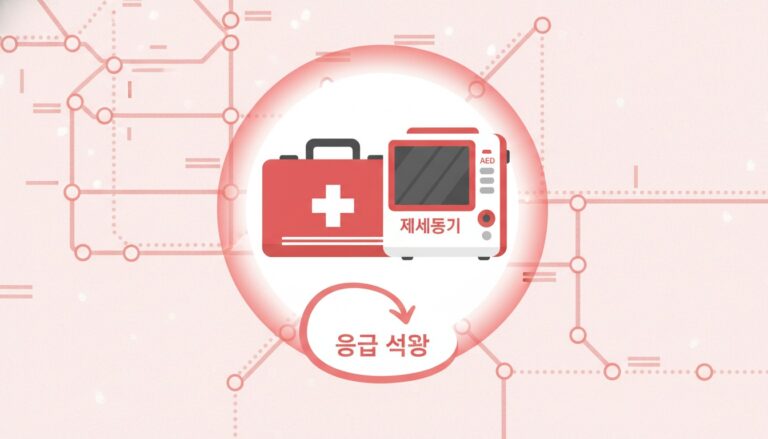
2. 자동 심장 충격기 / 제세동기 (AED / Defibrillator)
- Pronunciation:
Ja-dong Sim-jang Chung-gyeok-giORJe-se-dong-gi - Meaning: Automated External Defibrillator.
- Editor’s Insight: This is the ultimate C1 vocabulary test.
- 자동 심장 충격기 is easier to understand literally (Automatic Heart Shocker).
- 제세동기 is the Sino-Korean medical term. You will see both written on boxes in subway stations. Memorize 제세동기 because it’s faster to shout.
- Situation Check: 🚨 Urgent.
3. 기도 확보 (Securing the Airway)
- Pronunciation:
Gi-do Hak-bo - Meaning: Opening the airway (tilting the head back).
- Editor’s Insight: Gi-do usually means “prayer” in church contexts, but here it means “airway.” Hak-bo means “securing” or “obtaining.” Don’t confuse praying with breathing!
Phase 3: Textbook vs. Real Life (Emergency Edition)
In a C1 level emergency, passivity is your enemy. You must be authoritative.
| Textbook (Polite but Weak) | Real Life (Urgent & Direct) |
|---|---|
| 도와주세요! (Please help me!) | 사람 살려요! 도와주세요! (Save a person! Help!) |
| 119에 전화해 주시겠어요? (Could you please call 119?) | 거기 검은 안경 쓰신 분, 119 신고하세요! (You with the black glasses, report to 119!) |
| 숨을 안 쉬어요. (He is not breathing.) | 심정지 상태입니다! 호흡 없습니다! (Cardiac arrest state! No breathing!) |
Note: The “Real Life” column uses specific pointing (You with the glasses) to break the Bystander Effect. This is standard CPR protocol, but doing it in Korean requires confidence.
Phase 4: Cultural Context & Manners
1. The “Good Samaritan Law” in Korea
Foreigners often ask me, “If I break a rib while doing CPR, can I get sued in Korea?”
Korea has the 응급의료에 관한 법률 (Emergency Medical Service Act), often called the Good Samaritan Law. As long as you act in good faith to save a life, you are protected from liability for injury or property damage. Do not hesitate.
2. Dropping Honorifics (Speech Levels)
While Korea is strict about hierarchy, an emergency overrides etiquette. If you are performing CPR, you become the Commander. You can use short, imperative forms like “비키세요!” (Move back!) or “빨리요!” (Hurry!) to anyone, regardless of age. No one will scold you for being rude when you are saving a life.
Phase 5: Real-Life Scenario (Roleplay)
Setting: A crowded platform at Gangnam Subway Station. A man suddenly falls.
Characters:
* Alex (You): An expat who learned CPR.
* Citizen: A shocked passerby.
(The man collapses. People gasp but do nothing.)
Alex: (Rushing over and tapping the man’s shoulders hard)
여보세요! 괜찮으세요? 제 말 들리세요?
(Hello! Are you okay? Can you hear me?)
Citizen: 어머, 어떡해… 죽은 거 아니야?
(Oh my, what do I do… is he dead?)
Alex: (Pointing directly at the Citizen)
의식이 없습니다! 거기 파란 패딩 입은 분, 지금 바로 119 신고해 주세요!
(No consciousness! You in the blue padding, report to 119 right now!)
Citizen: (Startled) 네, 네! 알겠습니다!
(Yes, yes! I will!)
Alex: 그리고 거기 학생! 역무실 가서 제세동기 좀 가져다주세요!
(And you, student! Go to the station office and get the AED!)
(Alex begins chest compressions)
하나, 둘, 셋, 넷…
(One, two, three, four…)
Phase 6: 10-Second Shadowing Drill
Practice this sentence until you can say it without thinking. Focus on the strong accent on the command.
“환자 의식 없습니다! / 거기 청바지 입은 분, / 119에 신고하고 / 제세동기 가져오세요!”
- Guide: Hwan-ja ui-sik eop-seum-ni-da! / Geo-gi cheong-ba-ji i-beun bun, / il-il-gu-e sin-go-ha-go / je-se-dong-gi ga-jyeo-o-se-yo!
- Meaning: Patient has no consciousness! You in the jeans, report to 119 and bring the AED!
Phase 7: FAQ & Troubleshooting
- Q: Should I call 911 or 119?
- A: In Korea, it is 119 for fire and medical emergencies. (112 is for police). If you dial 911, it might redirect on some roaming phones, but 119 is the native number. Memorize it.
- Q: What if I don’t know the word ‘Defibrillator’ (제세동기)?
- A: Just say AED (Eh-Ee-Dee). Most younger Koreans and station staff will understand the English acronym. Or shout “심장 충격기!” (Heart shocker!).
Phase 8: Wrap-up & Mission
Summary: Emergencies require clarity over politeness. Master the words 흉부 압박 (Chest compressions) and 제세동기 (AED).
🔥 Today’s Mission:
Next time you are in a subway station or your apartment lobby, find the AED box. Read the Korean label. Stand in front of it and whisper, “저게 제세동기야” (That is the defibrillator). Visualizing it now will save you seconds later.
Have you ever faced an emergency in Korea? Tell us in the comments how you handled it! 💬
Phase 9: Pop Quiz
1. What is the most effective way to ask someone to call 119 in a crowd?
A) 누군가 도와주세요… (Someone help…)
B) 119에 전화하면 좋을 것 같아요. (It would be nice to call 119.)
C) 거기 빨간 모자 쓴 분, 119 신고하세요! (You in the red hat, report to 119!)
2. Which word means “Chest Compressions”?
A) 인공 호흡 (Artificial Respiration)
B) 흉부 압박 (Thoracic Pressure/Compressions)
C) 기도 확보 (Securing Airway)
3. True or False: You can be sued for breaking a rib while performing CPR in Korea.
A) True
B) False (Protected by Good Samaritan Law)
(Answers: 1-C, 2-B, 3-B)
Frequently Asked Questions (FAQ)
Q: What does "흉부 압박 (Chest Compressions)" mean in Korean and how do you pronounce it?
A: In Korean, "흉부 압박 (Chest Compressions)" is pronounced [Hyung-bu Ap-bak [Think of Hyung (older brother] and means: Literal: Chest / Pressure
Q: What does "자동 심장 충격기 / 제세동기 (AED / Defibrillator)" mean in Korean and how do you pronounce it?
A: In Korean, "자동 심장 충격기 / 제세동기 (AED / Defibrillator)" is pronounced [Ja-dong Sim-jang Chung-gyeok-gi OR Je-se-dong-gi] and means: Automated External Defibrillator.
Q: What does "기도 확보 (Securing the Airway)" mean in Korean and how do you pronounce it?
A: In Korean, "기도 확보 (Securing the Airway)" is pronounced [Gi-do Hak-bo] and means: Opening the airway (tilting the head back).







