

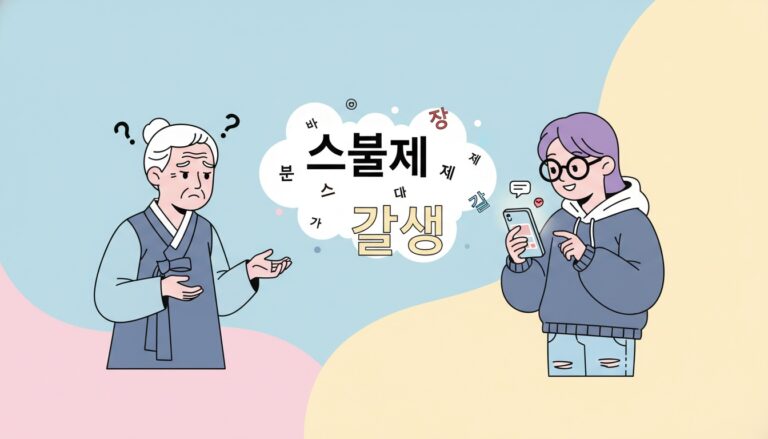
Introduction: Are You Speaking “Book Korean” or “Real Korean”?
Hello, Daily Hangul readers! This is your Senior Editor.
Here is a scenario I often see with my advanced (C1) students: You can read a news article about the economy without a dictionary, and you can discuss Korean history fluently. But then, you go out for drinks with Korean friends in their 20s and 30s, and suddenly… you feel like a beginner again.
Why? Because of “Shinjo-eo” (신조어 – Neologisms) and “Julimmal” (줄임말 – Abbreviations).
In Korea, language evolves at the speed of light—literally. It reflects the “Ppalli-ppalli” (Hurry, hurry) culture. Creating and using these words isn’t just about saving time; it’s a social signal. It says, “I am connected. I know what’s happening right now.”
Today, we aren’t just memorizing slang. We are analyzing the social phenomena behind why Koreans shorten everything, so you can sound like a true insider, not just a foreigner with a textbook.
Phase 2: Deep Dive into Key Expressions
For C1 learners, simply knowing the meaning isn’t enough. You need to understand the sentiment.
1. 별다줄 (Byeol-da-jul)
- Full Phrase: 별걸 다 줄인다 (Byeol-geol da jul-in-da)
- Pronunciation: [Byeol-da-jul] Sounds like: Byul – Da – Jool
- Meaning:
- Literal: You shorten even the weirdest/most trivial things.
- Real Nuance: “Wow, seriously? You’re abbreviating that too?”
- Editor’s Insight: This is a meta-word. It is an abbreviation used to complain about or mock the excessive culture of abbreviation. Ironically, by using this word, you are participating in the very culture you are critiquing. It’s often used with a sigh or a laugh.
- Situation Check: Casual (Friends) ✅ | Formal (Boss) ❌ (Unless your boss is very trendy and joking)
2. 스불재 (Seu-bul-jae)
- Full Phrase: 스스로 불러온 재앙 (Seu-seu-ro bul-leo-on jae-ang)
- Pronunciation: [Seu-bul-jae] Sounds like: Sue – Bull – Jae
- Meaning:
- Literal: A disaster I summoned myself.
- Real Nuance: “Self-inflicted suffering.” or “I dug my own grave.”
- Editor’s Insight: This is perfect for the C1 level. Instead of saying lengthy sentences like “I took on too much work and now I’m tired,” just say “완전 스불재야” (It’s totally a self-inflicted disaster). It captures the Korean sentiment of regretting your ambition but accepting the consequences.
- Situation Check: Casual ✅ | Semi-Formal (Colleagues) 🔺 (Okay if you are close)
3. 중꺽마 (Jung-kkeong-ma)
- Full Phrase: 중요한 건 꺾이지 않는 마음 (Jung-yo-han geon kkeok-i-ji an-neun ma-eum)
- Pronunciation: [Jung-kkeong-ma] Note: The double ‘ㄲ’ creates a sharp, tensed sound.
- Meaning:
- Literal: The important thing is an unbreakable heart/mind.
- Real Nuance: “Resilience is key.” / “Never give up.”
- Editor’s Insight: Originating from an E-sports interview (League of Legends), this phrase exploded socially. It became a slogan for the entire nation during the World Cup and economic hard times. Using this shows you understand the current Korean zeitgeist of enduring hardship.
Phase 3: Textbook vs. Real Life (C1 Edition)
Let’s see how a native speaker transforms a standard sentence into a “trendy” one.
| Textbook Korean (Standard) | Real Life (Trends & Abbreviations) | Nuance Check |
|---|---|---|
| “이 카페는 분위기가 정말 좋네요.” (This cafe has a really good atmosphere.) | “여기 완전 분좋카네.” (This is totally a Bun-jo-ka.) | 분좋카 = 분위기 좋은 카페. Used often on Instagram hashtags. |
| “저는 퇴근 후에 운동하고 공부하면서 열심히 살아요.” (I live diligently by exercising and studying after work.) | “요즘 갓생 살려고 노력 중이야.” (I’m trying to live a God-saeng these days.) | 갓생 (God-saeng) = God + Life. Living a productive, exemplary life. |
| “점심 메뉴는 네가 추천해 주는 걸로 먹을게.” (I will eat whatever lunch menu you recommend.) | “점메추 해줘.” (Please do Jeom-me-chu.) | 점메추 = 점심 메뉴 추천. This represents the fatigue of making choices. |
Editor’s Note: At C1 level, you shouldn’t always use slang. The skill is knowing when to switch codes. Use the left column for your professor; use the right column for your drinking buddies.
Phase 4: Cultural Context – The Sociology of “Shortening”
Why do Koreans shorten everything?
1. Efficiency vs. Intimacy
Yes, it’s about speed (Ppalli-ppalli), but it’s also about belonging. If I say “스불재” and you immediately understand, we share a bond. We are in the same “generation zone.” If you ask “What does that mean?”, the flow breaks, and you become an outsider.
2. The “Nunchi” (눈치) Factor
Using these words requires high Nunchi.
* Do not use these with elders (60s+) unless they use them first. It can seem frivolous.
* Do not overuse them in serious business meetings. It undermines your professionalism.
* Do use them sparingly to break the ice. A foreigner using “스불재” correctly will almost always get a round of applause or laughter for being “sensible” (센스 있다).
Phase 5: Real-Life Scenario (Roleplay)
Setting: Two colleagues (A and B) in their late 20s having coffee during a break.
Characters:
* Min-ji (Korean Native): Looks exhausted.
* Alex (Foreigner, C1 Level): Notices Min-ji’s state.
Dialogue:
Alex: (Looking concerned) 민지 씨, 얼굴이 왜 그래요? 다크서클이 턱까지 내려왔어요.
(Min-ji ssi, why the long face? Your dark circles are down to your chin.)
Min-ji: (Sighing deeply) 하… 이번 주말에 자격증 시험도 보고, 친구 생일 파티도 가야 하고, 월요일 프레젠테이션 준비도 해야 돼. 미치겠어.
(Hah… I have a certification exam this weekend, a friend’s birthday party, and a presentation to prep for Monday. I’m going crazy.)
Alex: (Shaking head with a smirk) 와, 진짜 갓생 사시네요. 근데 그거 완전 스불재 아닌가요?
(Wow, you’re really living the ‘God-saeng’. But isn’t that totally ‘Seubuljae’?)
Min-ji: (Laughs out loud) 인정. 욕심부리다가 망했어. 그래도 어떡해, 중꺽마 정신으로 버텨야지.
(Admitted. I got greedy and now I’m doomed. But what can I do? I have to endure it with the ‘Jungkkeongma’ spirit.)
Alex: 그래요. 커피 마시고 힘냅시다!
(Right. Let’s drink this coffee and cheer up!)
Phase 6: 10-Second Shadowing Drill
Let’s practice the rhythm. Slang is spoken faster and with more “snap” than textbook Korean.
Sentence:
“욕심부리다 / 완전 스불재 됐지만, / 그래도 중꺽마로 / 버텨야지!”
(I got greedy and it became a total self-inflicted disaster, but I must endure with an unbreakable spirit!)
Guide:
* 욕심부리다 (Flow smoothly) -> 완전 스불재 (Emphasize ‘스불재’, pitch goes up slightly) -> 중꺽마로 (Strong accent on ‘중’ and ‘꺽’) -> 버텨야지 (Determination tone).
Phase 7: FAQ & Troubleshooting
Q: Can I make up my own abbreviations?
A: Honestly? No. Unless you are a Korean middle schooler or a celebrity, it will sound very weird. Abbreviations are socially agreed upon. Stick to the ones used by others.
Q: Is it rude to use these words with a stranger?
A: Yes. If you meet someone for the first time, use standard Korean (Left column in Phase 3). Wait until you drop formalities (반말 mode) or become close colleagues before using words like 스불재.
Phase 8: Wrap-up & Mission
Summary:
Korean neologisms are not just vocabulary; they are tools for social bonding and expressing complex modern feelings like “ambitious regret” (스불재) or “resilience” (중꺽마) efficiently.
Your Mission:
Do you have a task this week that you procrastinated on? Or a schedule you overbooked? Go to a Korean friend (or post on your SNS) and say:
* “아, 이번 주 완전 스불재야.” (Ah, this week is a total self-inflicted disaster.)
Watch their reaction. They will likely laugh and say, “Are you Korean?”
Question:
What is your personal “God-saeng” (갓생) routine? Tell us in the comments using Korean!
Phase 9: Pop Quiz
1. Which situation describes “스불재” (Seubuljae) best?
A) Getting hit by a car while walking on the sidewalk.
B) Signing up for a 6 AM gym class and regretting it immediately.
C) Winning the lottery.
2. If your friend complains that everyone shortens words too much, what can you say?
A) 너 진짜 갓생이다 (You are truly God-saeng).
B) 요즘은 별다줄이잖아 (These days, it’s ‘Byeoldajul’, you know).
C) 중꺽마를 기억해 (Remember Jungkkeongma).
3. What does “중꺽마” emphasize?
A) The importance of saving money.
B) The mindset of never giving up.
C) The physical strength of an athlete.
(Answers: 1-B, 2-B, 3-B)
Frequently Asked Questions (FAQ)
Q: What does "별다줄 (Byeol-da-jul)" mean in Korean and how do you pronounce it?
A: In Korean, "별다줄 (Byeol-da-jul)" is pronounced [Byeol-da-jul] and means: Literal: You shorten even the weirdest/most trivial things.
Q: What does "스불재 (Seu-bul-jae)" mean in Korean and how do you pronounce it?
A: In Korean, "스불재 (Seu-bul-jae)" is pronounced [Seu-bul-jae] and means: Literal: A disaster I summoned myself.
Q: What does "중꺽마 (Jung-kkeong-ma)" mean in Korean and how do you pronounce it?
A: In Korean, "중꺽마 (Jung-kkeong-ma)" is pronounced [Jung-kkeong-ma] and means: Literal: The important thing is an unbreakable heart/mind.







