

Phase 1: Introduction
Hello! This is your Senior Editor at Daily Hangul. 👋
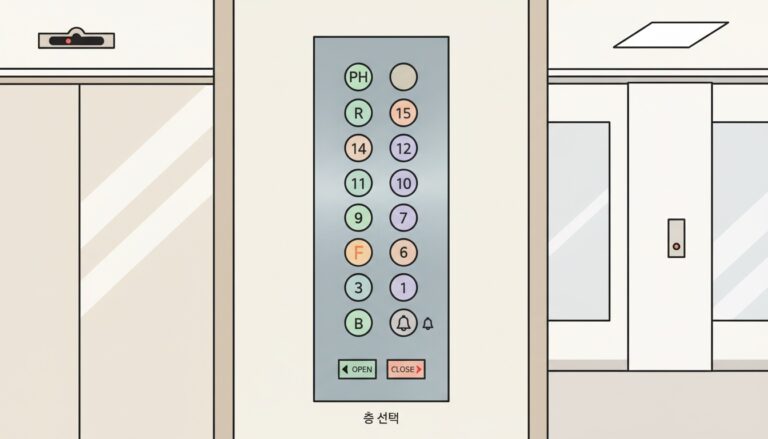
Imagine this: You’ve just arrived in Seoul, checked into a nice hotel, and you step into the elevator to go to your room. You look at the buttons… 1, 2, 3… F… 5? Wait, where did the number 4 go? Did the architect forget how to count?
Don’t worry, you haven’t entered a twilight zone. You’ve just encountered one of Korea’s most persistent superstitions: Tetraphobia (The fear of the number 4).
Today, we are going to dive into why this number is the “Voldemort” of Korean digits (He-Who-Must-Not-Be-Named), and how to talk about these superstitions like a local. This isn’t just about math; it’s about understanding the Korean soul! Let’s get started.
Phase 2: Deep Dive into Core Expressions
Here are the top 3 expressions you need to understand this cultural quirk. Since you are at a B2 level, we will look at the nuance behind the words.
1. 불길하다 (Bulgil-hada)
- Pronunciation: [Bul-gil-ha-da] (Sounds like “Bull-gill-ha-da”)
- Meaning: To be ominous / unlucky / foreboding
- Editor’s Insight: This is a B2/C1 level vocabulary word. While beginners might just say “안 좋아요” (it’s not good), you can use this when something gives you a bad feeling or vibe. It’s slightly formal but very descriptive.
- Situation Check: Used when talking about bad omens, nightmares, or… the number 4.
2. 미신을 믿다 (Misin-eul mit-da)
- Pronunciation: [Mi-sin-eul mit-da]
- Meaning: To believe in superstitions
- Editor’s Insight: ‘미신’ (Misin) is superstition. In Korea, even people who say they don’t believe in superstitions (미신을 안 믿어요) might still avoid writing their name in red ink or sleeping with a fan on. It’s deeply ingrained!
- Situation Check: Casual & Formal.
3. 사 (Sa) = 죽을 사 (Sa)
- Pronunciation: [Sa]
- Meaning: The number 4 / Death (Chinese character)
- Editor’s Insight: This is the root cause. In Korean, the Sino-Korean number for 4 is 사 (sa). Unfortunately, the Hanja (Chinese character) for ‘death’ is also 死 (sa). They are homophones. It’s like if the number “4” in English sounded exactly like the word “Die.”
Phase 3: Textbook vs. Real Life
Textbooks teach you grammar, but they don’t teach you the “vibe.” Let’s compare.
| Textbook Korean (Correct but stiff) | Real Life Korean (Natural & Insider) |
|---|---|
| 이 건물에는 4층이 없습니다. (There is no 4th floor in this building.) |
여기 4층은 그냥 F층이라고 해요. (We just call the 4th floor ‘F’ here.) |
| 한국 사람들은 숫자 4를 싫어합니다. (Koreans dislike the number 4.) |
4자는 좀 찜찜하잖아요. (The number 4 feels a bit uncomfortable/icky, you know?) |
| 그것은 미신입니다. (That is a superstition.) |
에이, 다 옛날 말이죠. (Ay, that’s just old talk.) |
Note: ‘찜찜하다’ (Jjimjjim-hada) is a fantastic word. It means feeling uncomfortable, reluctant, or having a bad aftertaste about a situation. Use this, and Koreans will think you’ve lived here for 10 years!
Phase 4: Cultural Context & Manners
🕵️♀️ The “Nunchi” (Wits) of Numbers
It’s not just about elevators. Understanding the “Death” association saves you from social mistakes.
- Gift Giving: Never give gifts in sets of 4. Three is lucky, five is fine, but four is a big NO. Giving 4 apples to a sick friend? That’s practically sending them a curse!
- Hospitals: You will almost never see a 4th floor in a hospital or a funeral home. It’s usually listed as ‘F’ (Four) or skipped entirely (3rd floor $\to$ 5th floor).
- Room Numbers: In some older buildings, room 404 is skipped. Why? Because 4 (Death) + 0 (Nothing) + 4 (Death) feels doubly bad!
Phase 5: Real-Life Scenario (Roleplay)
Setting: An elevator in a fancy office building in Gangnam.
Characters: Alex (Foreign employee) and Min-ji (Korean colleague).
(Alex stares at the buttons, looking confused.)
Alex: 어? 민지 씨, 여기 버튼이 좀 이상해요. 4층이 없는데요?
(Huh? Min-ji, the buttons here are weird. There is no 4th floor?)
Min-ji: 아, 저기 ‘F’라고 쓰여 있는 거 보이죠? 저게 4층이에요.
(Ah, you see where it says ‘F’ over there? That is the 4th floor.)
Alex: F요? 왜 굳이 F라고 썼어요?
(F? Why did they bother writing F?)
Min-ji: 한국에서는 숫자 4가 ‘죽다’라는 뜻의 한자와 발음이 같아서 불길하다고 생각하거든요.
(In Korea, the number 4 has the same pronunciation as the Hanja for ‘death’, so we consider it ominous.)
Alex: 아, 그렇군요! 그래서 4층 대신 F층이구나. 완전 신기하네요!
(Ah, I see! So it’s the F floor instead of the 4th. That’s totally fascinating!)
Phase 6: 10-Second Shadowing
Let’s practice your flow. Focus on the pause to explain the reason clearly.
Sentence:
“한국 사람들은 / 4자가 ‘죽을 사’ 자랑 발음이 같아서 / 별로 안 좋아해요.”
Pronunciation Guide:
* Han-guk sa-ram-deul-eun / (pause) / sa-ja-ga ‘ju-geul sa’ jja-rang ba-reum-i ga-ta-seo / (pause) / byeol-lo an jo-a-hae-yo.
Key Point: When saying ‘죽을 사’ (Death ‘Sa’), lower your pitch slightly to emphasize the meaning.
Phase 7: FAQ & Troubleshooting
Q: Do young Koreans actually believe this?
A: Honestly? Most young people (MZ generation) don’t care much. However, building owners still use ‘F’ because they want to accommodate older generations and avoid any potential “bad vibes” for their tenants. It’s more about commercial etiquette than actual fear now.
Q: Is it rude to say the number 4?
A: Not at all! You use ‘사’ (sa) or ‘넷’ (net) all the time for counting money, time, etc. Just avoid grouping gifts in fours.
Phase 8: Wrap-up
Summary: Koreans avoid the number 4 in elevators and hospitals because it sounds like the word for “Death” (Sa). Often, ‘F’ is used instead.
Action Mission: Next time you are in a building in Korea (or a Koreatown), check the elevator panel! If you see ‘F’, take a picture and explain it to a friend using the word “불길하다” (ominous).
Tell me in the comments: Does your country have an unlucky number? (Like 13 in the West?) Let me know!
Phase 9: Pop Quiz 📝
- Why is the number 4 considered unlucky in Korea?
A) It looks like a crying face.
B) It sounds like the word for “Death.”
C) It is the number of a bad king. -
What letter is often used to replace ‘4’ in elevators?
A) A
B) F
C) X -
Which word means “ominous” or “unlucky”?
A) 행복하다 (Haengbok-hada)
B) 불길하다 (Bulgil-hada)
C) 시원하다 (Siwon-hada)
(Scroll down for answers)
Click to see answers
1. B, 2. B, 3. B
Frequently Asked Questions (FAQ)
Q: What does "불길하다 (Bulgil-hada)" mean in Korean and how do you pronounce it?
A: In Korean, "불길하다 (Bulgil-hada)" is pronounced [Bul-gil-ha-da] and means: To be ominous / unlucky / foreboding
Q: What does "미신을 믿다 (Misin-eul mit-da)" mean in Korean and how do you pronounce it?
A: In Korean, "미신을 믿다 (Misin-eul mit-da)" is pronounced [Mi-sin-eul mit-da] and means: To believe in superstitions
Q: What does "사 (Sa) = 죽을 사 (Sa)" mean in Korean and how do you pronounce it?
A: In Korean, "사 (Sa) = 죽을 사 (Sa)" is pronounced [Sa] and means: The number 4 / Death (Chinese character)







