

Hello! We are the editors of Daily Hangul.
Have you ever stood in the aisle of Olive Young, staring at fifty different bottles, wondering why some say “Oil,” some say “Balm,” and others say “Foam”? And more importantly, have you ever tried to explain to a Korean friend (or a dermatologist) that your skin feels tight inside but oily outside?
As a C1 (Advanced) learner, simply saying “I wash my face” (세수해요) isn’t enough anymore. To truly understand K-Beauty and achieve that coveted “Glass Skin” (물광 피부), you need to master the art of the “Double Cleanse” (이중 세안) and the specific vocabulary that comes with it.
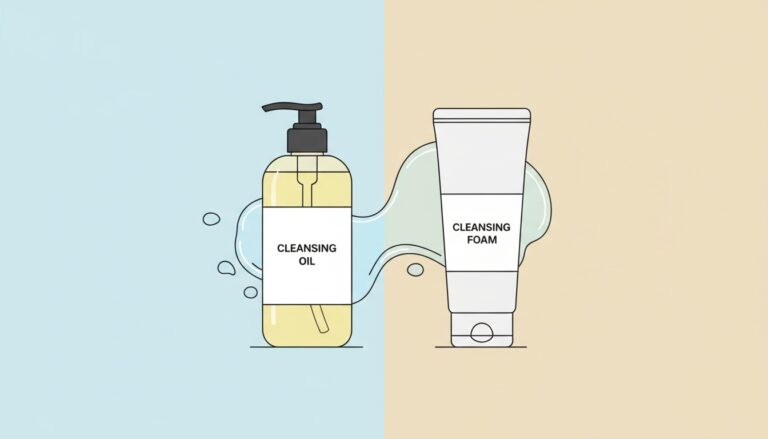
Today, we are diving deep into the technicalities of Cleansing Oil and Foam. These aren’t just words; they are the ritual. Let’s upgrade your Korean from “survival mode” to “beauty guru mode.”
Phase 2: Deep Dive into Core Expressions
Here are the three advanced terms you need to sound like a skincare pro in Seoul.
1. 유화 과정 (Emulsification Process)
- Pronunciation: [Yu-hwa Gwa-jeong] -> Sounds like ‘You-Hwa’ (like Hwa-byung) + ‘Gwa-jung’.
- Meaning: The process where oil turns milky white when mixed with water.
- Editor’s Insight: This is the most critical step in using cleansing oil. If you complain that an oil caused a breakout, a Korean friend will immediately ask, “유화 과정 제대로 했어?” (Did you do the emulsification process properly?). It’s a technical term, but essential for C1 learners.
- Situation Check: Used in beauty consultations, dermatology clinics, or detailed conversations with friends.
2. 속당김 (Inner Tightness)
- Pronunciation: [Sok-dang-gim] -> Think ‘Soak’ (inside) + ‘Dang’ (like dang it!) + ‘Gim’.
- Meaning: When the surface of your skin might look okay (or even oily), but deep inside, it feels dry and tight.
- Editor’s Insight: This is a very specific Korean beauty concept. It’s not just “dry skin” (건성). It describes a sensation. You use this when choosing a cleansing foam to ensure it’s not too harsh.
- Situation Check: Perfect for explaining your skin condition to store staff.
3. 롤링하다 (To Roll / Massage)
- Pronunciation: [Rol-ling-ha-da]
- Meaning: To gently massage the product onto the skin in circular motions.
- Editor’s Insight: While 문지르다 (rub) is the standard verb, in the beauty world, we use the Konglish term 롤링하다. It implies a gentler, more technical technique than just scrubbing your face.
- Situation Check: Commonly used in YouTube tutorials and product instructions.
Phase 3: Textbook vs. Real Life (K-Beauty Edition)
At the C1 level, nuance is everything. Here is how to sound natural when talking about textures and finishes.
| Textbook (Standard) | Real Life (Trendier/More Specific) |
|---|---|
| 화장을 지우다 (To remove makeup) | 메이크업을 녹여내다 (To melt away/dissolve makeup) |
| 거품을 내다 (To make bubbles) | 거품을 쫀쫀하게 만들다 (To make the foam dense/elastic) |
| 깨끗하게 씻기다 (Washed clean) | 잔여감 없이 산뜻하다 (Fresh without any residue feeling) |
| 피부가 건조하다 (Skin is dry) | 수분을 뺏기지 않다 (Doesn’t strip moisture) |
Note: Notice the word 잔여감 (residue feeling). Koreans hate the feeling of oil being left on the face, so emphasizing “no residue” (잔여감 없음) is key.
Phase 4: Cultural Context & Manners
The Myth of “Ppodeuk-Ppodeuk” (뽀득뽀득)
For a long time, Koreans believed that a face wash was only effective if it made a squeaky sound (뽀득뽀득) when you rinsed it. This onomatopoeia represents that “stripped clean” feeling.
However, the trend has shifted completely! Now, everyone is obsessed with 약산성 (Low pH) cleansers that protect the skin barrier (장벽).
- Cultural Tip: If you tell a staff member, “I like the ppodeuk feeling,” they might look concerned and suggest a milder product. To show you are trendy, say: “세정력은 좋은데 마무리가 촉촉한 걸 찾고 있어요.” (I’m looking for something with good cleansing power but a moist finish.)
Phase 5: Roleplay Script
Setting: Inside Olive Young. You are looking for a cleansing oil that clears blackheads but isn’t too heavy.
Characters:
* You: An expat who knows their skincare ingredients.
* Staff: A helpful store employee.
You: (Picking up a yellow bottle) 저기요, 이 오일 유화가 잘 되나요? 블랙헤드 관리 좀 하려고요.
(Excuse me, does this oil emulsify well? I’m trying to manage my blackheads.)
[Jeogiyo, i o-il yu-hwa-ga jal doe-na-yo? Beul-laek-he-deu gwan-li jom ha-ryeo-go-yo]
Staff: 아, 그거 피지 녹이는 데 진짜 좋아요. 근데 좀 묵직한 편이라 지성 피부시면 답답하실 수도 있어요.
(Ah, that one is really good for melting sebum. But it’s on the heavier side, so if you have oily skin, it might feel suffocating/heavy.)
[A, geu-geo pi-ji nog-i-neun de jin-jja jo-a-yo. Geun-de jom muk-jik-han pyeon-i-ra ji-seong pi-bu-si-myeon dap-dap-ha-sil su-do iss-eo-yo]
You: 아, 그래요? 저는 속당김이 심해서… 너무 건조하지 않으면 괜찮아요.
(Oh, really? I have severe inner tightness… as long as it’s not too drying, it’s fine.)
[A, geu-rae-yo? Jeo-neun sok-dang-gim-i sim-hae-seo… neo-mu geon-jo-ha-ji an-eu-myeon gwaen-chan-a-yo]
Staff: 그럼 이거 한번 써보세요. 롤링감도 부드럽고 세안 후에 당김이 거의 없어요.
(Then try this one. The rolling feeling is smooth, and there’s almost no tightness after cleansing.)
[Geu-reom i-geo han-beon sseo-bo-se-yo. Rol-ling-gam-do bu-deu-reop-go se-an hu-e dang-gim-i geo-ui eop-seo-yo]
Phase 6: 10-Second Shadowing
Let’s practice a complex sentence explaining the correct method. Pay attention to the causal flow.
“You have to massage with oil first to melt the sebum, then add a little water to emulsify it.”
오일로 먼저 롤링해서 / 피지를 녹여낸 다음에, / 물을 살짝 묻혀서 / 유화시켜 줘야 해요.
[O-il-lo meon-jeo rol-ling-hae-seo / pi-ji-reul nog-yeo-naen da-eu-me, / mu-reul sal-jjak mu-chyeo-seo / yu-hwa-si-kyeo jwo-ya hae-yo.]
Practice Tips:
* Stress on 녹여낸 (melt away) and 유화 (emulsify).
* Pause briefly at the / marks to catch your breath and organize your thought.
Phase 7: FAQ & Troubleshooting
Q: Can I just use the word “Wash” (씻다) for everything?
A: You can, but it sounds basic. At an advanced level, distinguish between 지우다 (remove/erase makeup) and 세안하다 (cleanse face). Using 세안 implies a routine, whereas 세수 is just splashing water on your face in the morning.
Q: Is it rude to check the ingredients in front of the staff?
A: Not at all! In fact, Koreans are “smart consumers” (스마트 컨슈머). It is very common to check apps like Hwahae (화해) or read the label for 유해 성분 (harmful ingredients) right in the store.
Phase 8: Wrap-up & Action Item
One-Liner Summary:
Don’t just “wash” your face; melt the sebum with oil, emulsify with water, and finish with a foam that doesn’t cause inner tightness.
Your Mission:
Go to your bathroom (or a beauty store) and look at the back of a cleanser bottle. Find the words “미온수” (lukewarm water) or “부드럽게 마사지” (massage gently). If you find the word “유화”, take a picture and share it!
Comment below: Do you prefer a “squeaky clean” (뽀득뽀득) finish or a “moist” (촉촉) finish? Tell us in Korean!
Phase 9: Pop Quiz
1. What is the Korean term for the process where cleansing oil turns white with water?
A) 산화 (Oxidation)
B) 유화 (Emulsification)
C) 소화 (Digestion)
2. How do you describe the feeling where your skin feels dry inside despite being oily outside?
A) 속쓰림 (Heartburn)
B) 속당김 (Inner tightness)
C) 겉돌다 (Hovering on surface)
3. Which verb is most commonly used for “massaging” cleansing oil in K-Beauty contexts?
A) 롤링하다 (To roll)
B) 때리다 (To hit)
C) 긁다 (To scratch)
(Scroll down for answers)
Click to see answers
- B) 유화
- B) 속당김
- A) 롤링하다
Frequently Asked Questions (FAQ)
Q: What does "유화 과정 (Emulsification Process)" mean in Korean and how do you pronounce it?
A: In Korean, "유화 과정 (Emulsification Process)" is pronounced [Yu-hwa Gwa-jeong] and means: The process where oil turns milky white when mixed with water.
Q: What does "속당김 (Inner Tightness)" mean in Korean and how do you pronounce it?
A: In Korean, "속당김 (Inner Tightness)" is pronounced [Sok-dang-gim] and means: When the surface of your skin might look okay (or even oily), but deep inside, it feels dry and tight.
Q: What does "롤링하다 (To Roll / Massage)" mean in Korean and how do you pronounce it?
A: In Korean, "롤링하다 (To Roll / Massage)" is pronounced [Rol-ling-ha-da] and means: To gently massage the product onto the skin in circular motions.







