

Phase 1: Hook & Introduction
Hello! This is your Senior Editor at Daily Hangul.
Imagine this: You finally secured a ticket to see your favorite K-Pop group in Seoul (a miracle in itself!). The lights go down, the intro music starts, and suddenly, thousands of people around you start shouting names and phrases in perfect unison, like a well-trained army.
You? You’re just standing there, waving your lightstick awkwardly, mouthing “Wow…”
Don’t worry! I’ve seen this happen to so many of my students. In the K-Pop world, the concert isn’t just a performance by the artist; it’s a collaboration between the artist and the fans. If you don’t know the rules, you might feel like an outsider. But if you master the “Cheering Guide” (응원법), you transform from a spectator into a true “Seong-deok” (성덕 – successful fan).
Today, I’ll teach you the B2-level vocabulary and cultural nuances you need to survive—and thrive—in a Korean concert hall. These are real expressions used by fans in the standing pit, not the stiff sentences you find in textbooks.
Phase 2: Deep Dive into Core Expressions
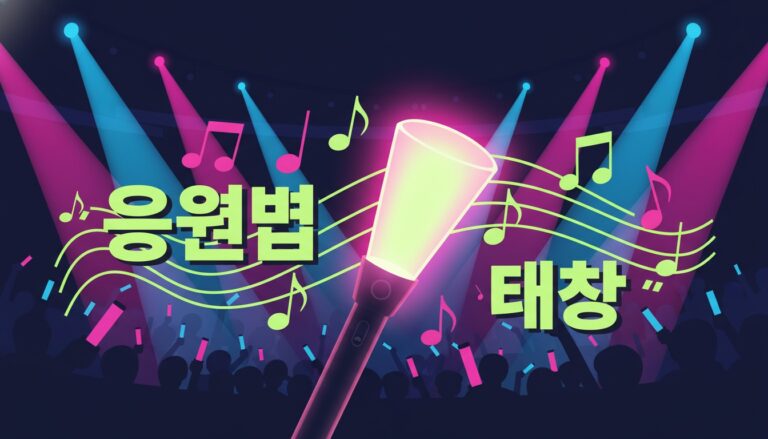
1. 응원법 (Eung-won-beop)
- Pronunciation: [Eung-won-beop] Sounds like ‘Eung’ (the sound you make when agreeing) + ‘won’ (like ‘won’ a game) + ‘bop’ (like a ‘bop’ song).
- Meaning: Fanchant / Cheering Guide (Literal: Cheering Method)
- Editor’s Insight: This is the Holy Grail of concert prep. It’s not just cheering; it’s a specific set of lyrics, names, or chants shouted at precise moments.
- Situation Check: Essential for concerts. If you say “응원법 다 외웠어?” (Did you memorize all the fanchants?) to a Korean fan, they will immediately respect your dedication.
2. 떼창 (Tte-chang)
- Pronunciation: [Tte-chang] ‘Tte’ sounds like ‘De’ in ‘Deck’ but with a stronger, tense T sound. ‘Chang’ sounds like ‘Chang-e’.
- Meaning: Sing-along (Literal: Group singing)
- Editor’s Insight: In Western concerts, you might sing the whole song. In Korea, Tte-chang is powerful but usually reserved for the chorus or specific emotional parts. It’s that goosebump-inducing moment when the artist points the mic to the crowd.
- Situation Check: Casual & Media. You can say, “한국 팬들의 떼창은 정말 감동적이야.” (The sing-along by Korean fans is truly touching.)
3. 막콘 (Mak-con)
- Pronunciation: [Mak-kon]
- Meaning: The Last Concert (Short for 마지막 콘서트 – Majimak Concert)
- Editor’s Insight: K-Pop tours often have multiple days in one city. The “Mak-con” is legendary because artists often cry, give longer speeches, or perform special encores. Conversely, the first concert is “첫콘” (Cheot-con).
- Situation Check: Slang/Casual. Used frequently when buying tickets. “막콘 티켓 구하기가 하늘의 별 따기야.” (Getting tickets for the last concert is like plucking a star from the sky.)
Phase 3: Textbook vs. Real Life
Let’s upgrade your Korean from “Classroom Clean” to “Concert Hall Cool.”
| Textbook / Standard (B1) | Real Korean / Fan Lingo (B2+) | Nuance Difference |
|---|---|---|
| 콘서트 마지막 날이에요. (It is the last day of the concert.) | 오늘 완전 막콘이야! (Today is totally the ‘Mak-con’!) | ‘Mak-con’ implies excitement and exclusivity. |
| 노래를 같이 불러요. (Let’s sing the song together.) | 떼창 가즈아! (Let’s go for a sing-along!) | ‘가즈아’ (Gazua) is a hyped-up way to say “Let’s go!” |
| 응원하는 순서를 연습했어요. (I practiced the cheering order.) | 응원법 숙지 완료. (Fanchant familiarization complete.) | ‘숙지’ (Suk-ji) sounds more professional and serious, like a true fan duty. |
Editor’s Note: At B2 level, using Hanja words like 숙지 (familiarization/mastery) instead of just 연습 (practice) shows you treat fandom seriously!
Phase 4: Cultural Context & Manners
1. The “Nunchi” of Filming
While many fans want to record the moment, Korean concert etiquette (and security) can be strict. If you hold your phone above your head, you are committing “시야 방해” (Si-ya bang-hae – View Obstruction). This is a huge tabo.
* Tip: Keep your phone at chest level. Don’t be the “annoying tall person” (even if you aren’t tall).
2. The Lightstick (응원봉 – Eung-won-bong)
Your lightstick is not just a toy; it’s part of the show. Most are centrally controlled via Bluetooth to change colors with the music.
* Crucial Step: Before the concert, you must perform “페어링” (Pairing) at the booth or via an app. If your lightstick is the only one blinking red during a blue ballad, the embarrassment is real!
Phase 5: Real-Life Roleplay
Setting: Outside the Olympic Gymnastics Arena, waiting for the doors to open.
Characters: Alex (Foreign fan) & Ji-min (Korean friend).
Alex: (Taking a deep breath)
아, 진짜 떨린다. 나 응원법 실수하면 어떡하지?
(Ah, I’m so nervous. What if I mess up the fanchant?)
Ji-min: (Laughing and patting Alex’s shoulder)
괜찮아! 어차피 소리가 커서 아무도 몰라. 그냥 분위기를 즐겨.
(It’s okay! The sound is so loud nobody will know anyway. Just enjoy the vibe.)
Alex: 그래도 오늘 막콘이라서 다들 엄청 열심히 할 텐데…
(Still, it’s the last concert today, so everyone is going to be trying super hard…)
Ji-min: 걱정 마. 너 어제 밤새 유튜브 보면서 숙지했잖아! 우린 떼창만 잘하면 돼.
(Don’t worry. You stayed up all night watching YouTube to master it! We just need to nail the sing-along.)
Phase 6: 10-Second Shadowing
Try reading this sentence naturally to practice your rhythm. Focus on the bold parts for emphasis.
“틀려도 괜찮으니까 / 그냥 이 순간을 / 즐기면 돼요!”
(It’s okay if you make a mistake / just enjoy / this moment!)
- Pronunciation Tip: When saying 틀려도 (Teul-lyeo-do), don’t roll the ‘L’ too much. Keep it crisp.
Phase 7: FAQ & Troubleshooting
Q: Can I sing the whole song loudly?
A: Generally, No. Unlike in the West, Korean fans prioritize hearing the artist’s voice. We only shout during the 응원법 (fanchant) parts and the designated 떼창 (sing-along) sections. If you sing a ballad loudly, you might get side-eyed.
Q: Is it rude to sit down during the concert?
A: If everyone stands up (which usually happens during dance tracks), you should too. But during talking segments (Ment) or ballads, everyone usually sits. Follow the Nunchi (vibe) of the crowd!
Phase 8: Wrap-up
Summary: To be a “Seong-deok,” memorize the 응원법 (Fanchant), prepare for the 떼창 (Sing-along), and respect the 막콘 (Last concert) energy.
Your Mission: Go to YouTube, search for your favorite group’s song + “Cheering Guide,” and try to follow along for just one minute. You’ll realize it’s harder than it looks!
Talk to me: Have you ever been to a K-Pop concert in Korea? What was the most surprising thing? Let me know in the comments!
Phase 9: Pop Quiz
- What is the Korean term for the massive “Sing-along” culture?
- a) Eung-won-bong
- b) Tte-chang
- c) Mak-con
- Why is “Si-ya bang-hae” (View Obstruction) bad?
- a) It drains your battery.
- b) It blocks other fans’ view of the stage.
- c) It makes the artist nervous.
- Which word implies you have “mastered” or “memorized” the fanchants professionally?
- a) 숙지 (Suk-ji)
- b) 구경 (Gu-gyeong)
- c) 놀이 (Nor-i)
(Answers: 1-b, 2-b, 3-a)
Frequently Asked Questions (FAQ)
Q: What does "응원법 (Eung-won-beop)" mean in Korean and how do you pronounce it?
A: In Korean, "응원법 (Eung-won-beop)" is pronounced [Eung-won-beop] and means: Fanchant / Cheering Guide (Literal: Cheering Method)
Q: What does "떼창 (Tte-chang)" mean in Korean and how do you pronounce it?
A: In Korean, "떼창 (Tte-chang)" is pronounced [Tte-chang] and means: Sing-along (Literal: Group singing)
Q: What does "막콘 (Mak-con)" mean in Korean and how do you pronounce it?
A: In Korean, "막콘 (Mak-con)" is pronounced [Mak-kon] and means: The Last Concert (Short for 마지막 콘서트 - Majimak Concert)







