

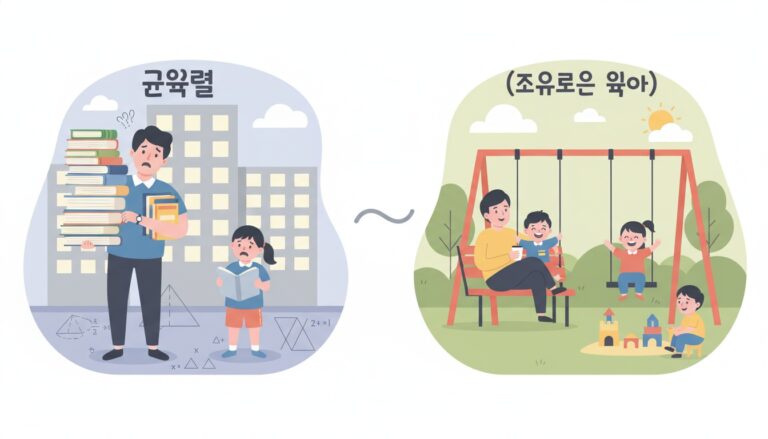
Phase 1: The ‘Hagwon’ Panic – Are You Doing Enough?
Hello! This is your Daily Hangul Editor.
If you are raising a child in Korea, you’ve probably had this moment at a playground or a Kids Cafe. Another parent approaches you and asks, “So, which English kindergarten are you sending Minji to?” or “Have you started math ‘Seonhaeng’ yet?”
Suddenly, you panic. Your kid is only five! 😱
Korean parenting culture, especially regarding education, can feel intense. Today, we are going to look at B2 (Intermediate) level expressions to discuss your educational philosophy (gyoyuk-gwan). These phrases will help you express your worries, understand what other parents are stressing about, and politely defend your own parenting style without sounding rude.
This guide is based on real questions from our expat students who felt overwhelmed by the “Hagwon (academy) culture.”
Phase 2: Core Expressions Deep Dive
Here are the three heavy-hitters you’ll hear constantly in ‘Mom Cafes’ or parent meetings.
1. 선행 학습 (Seonhaeng hakseup)
- Pronunciation: [Seonhaeng hakseup] (Sounds like Sun-hang Hak-sup)
- Meaning: Prerequisite learning / Learning ahead of the curriculum
- Editor’s Insight: This is the #1 keyword in Korean education. It doesn’t just mean ‘studying’; it means studying 6 months to 2 years ahead of the child’s actual grade.
- Situation Check: Used frequently among parents discussing private academies.
- Ex: “요즘은 초등학교 때 수학 선행 학습이 필수래요.” (They say math prior learning is essential in elementary school these days.)
2. 뒤처지다 (Dwicheojida)
- Pronunciation: [Dwicheojida] (Sounds like Dwee-chuh-ji-da)
- Meaning: To fall behind / To lag behind
- Editor’s Insight: This captures the core fear of Korean parents. It’s not just about failing; it’s about being left in the dust while others run ahead.
- Situation Check: Use this to express worry or empathy.
- Ex: “우리 아이만 뒤처질까 봐 걱정이에요.” (I’m worried my child will be the only one falling behind.)
3. 소신 (Sosin)
- Pronunciation: [Sosin] (Sounds like So-shin)
- Meaning: One’s own belief / Conviction / Philosophy
- Editor’s Insight: This is a beautiful B2 word. When everyone tells you to send your kid to 5 academies, you use this word to say, “I have my own way.”
- Situation Check: Perfect for politely shutting down unsolicited advice.
- Ex: “저는 남들 따라가지 않고 제 소신대로 키우고 싶어요.” (I want to raise my child according to my convictions, not follow others.)
Phase 3: Textbook vs. Real Life
How do you say “I want my kid to just play”?
| Textbook Korean (Correct but stiff) | Real Korean (Natural & Relatable) |
|---|---|
| 아이에게 공부를 강요하고 싶지 않아요. (I don’t want to force studying on my child.) |
애 스트레스받을까 봐 그냥 놀게 하려고요. (I’m letting them play because I’m worried they’ll get stressed.) |
| 교육관이 다릅니다. (My educational views are different.) |
저희는 그냥 건강하게만 자랐으면 해요. (We just want him/her to grow up healthy.) |
Note: The “Real Korean” expressions are softer. Instead of directly opposing the other person (“My view is different”), you focus on the child’s well-being (“Stress,” “Health”). This is socially smoother.
Phase 4: Cultural Context & Manners
The Art of “Nunchi” in Parenting Talks
In Korea, asking about a child’s academy (Hagwon) schedule is often a form of ‘small talk,’ not necessarily an interrogation. However, it can feel aggressive.
- Don’t Criticize Directly: Even if you think 5-year-olds shouldn’t study math, don’t say, “That’s crazy/wrong.” Instead, say, “Wow, Korean mothers are really diligent (대단하시네요).” and then pivot to your style.
- The “Humble Brag” Trap: Be careful. If you say, “My kid doesn’t study but gets good grades,” it might spark jealousy. It’s safer to say, “We are just taking it slow (천천히 하려고요).”
Phase 5: Real-Life Scenario (Roleplay)
Setting: Two moms talking at a cafe while waiting for their kids’ art class.
Characters: Sujin (Korean mom), Alex (Foreign parent).
Sujin: 알렉스 씨, 민수는 영어 학원 어디 다녀요? 요즘 선행 학습 안 하면 큰일 난다던데.
(Alex, which English academy does Minsu go to? I heard it’s a big trouble if you don’t do prior learning these days.)
Alex: 아, 저희는 아직 학원 안 보내요. 너무 일찍 시작하면 질릴까 봐요.
(Ah, we don’t send him to an academy yet. I’m worried he might get sick of it if we start too early.)
Sujin: 정말요? 나중에 학교 가서 뒤처지면 어떡해요?
(Really? What if he falls behind later when he goes to school?)
Alex: 걱정은 되지만… 그래도 남들 눈치 안 보고 제 소신대로 하려고 노력 중이에요. (웃음)
(I do worry… but I’m trying to follow my own convictions and not worry about what others think. [Smiles])
Sujin: 와, 알렉스 씨는 정말 뚝심이 있으시네요! 부러워요.
(Wow, you really have backbone/determination! I envy you.)
Phase 6: 10-Second Shadowing
Read this aloud to practice your intonation. Imagine you are politely declining an expensive tutoring offer.
“저는 / 성적보다 / 아이가 행복한 게 / 더 중요하다고 생각해요.”
(I think / more than grades / the child being happy / is more important.)
- Pronunciation: Jeoneun / seong-jeok-boda / a-i-ga haeng-bok-han ge / deo jung-yo-ha-da-go saeng-gak-hae-yo.
- Tip: Pause slightly after “Jeoneun” and “Seong-jeok-boda” to emphasize your opinion.
Phase 7: FAQ & Troubleshooting
Q: Can I use the word ‘소신 (Sosin)’ to an older person or teacher?
A: Yes! deeply recommended. It shows maturity. Saying “I just don’t want to” sounds childish, but saying “I have a Sosin (conviction)” makes you sound like a thoughtful parent. It commands respect.
Q: Is ‘선행 (Seonhaeng)’ only for study?
A: Usually, yes. It’s short for ‘Seonhaeng hakseup’. You wouldn’t use it for sports or music unless it’s strictly about passing a level test ahead of time.
Phase 8: Wrap-up
One-Liner Summary:
Don’t let the pressure of 선행 학습 (prior learning) scare you; express your 소신 (conviction) so you don’t feel like you are 뒤처지는 (falling behind) parents.
Action Mission:
Next time someone asks about your kid’s study schedule, try saying: “아직은 놀게 하고 싶어요” (I want to let them play for now) with a confident smile!
Tell me in the comments:
What is the most shocking thing you’ve heard about Korean education culture? 👇
Phase 9: Pop Quiz
1. Which word means “learning ahead of the curriculum”?
A) 야자 (Yaja)
B) 선행 학습 (Seonhaeng hakseup)
C) 복습 (Bokseup)
2. How do you say “I am worried my child will fall behind”?
A) 아이가 뒤처질까 봐 걱정이에요.
B) 아이가 앞서갈까 봐 걱정이에요.
C) 아이가 소신이 있을까 봐 걱정이에요.
3. Fill in the blank: “I want to raise my child according to my own _____.”
“제 ( )대로 키우고 싶어요.”
A) 눈치 (Nunchi)
B) 학원 (Hagwon)
C) 소신 (Sosin)
(Answers: 1. B, 2. A, 3. C)
Frequently Asked Questions (FAQ)
Q: What does "선행 학습 (Seonhaeng hakseup)" mean in Korean and how do you pronounce it?
A: In Korean, "선행 학습 (Seonhaeng hakseup)" is pronounced [Seonhaeng hakseup] and means: Prerequisite learning / Learning ahead of the curriculum
Q: What does "뒤처지다 (Dwicheojida)" mean in Korean and how do you pronounce it?
A: In Korean, "뒤처지다 (Dwicheojida)" is pronounced [Dwicheojida] and means: To fall behind / To lag behind
Q: What does "소신 (Sosin)" mean in Korean and how do you pronounce it?
A: In Korean, "소신 (Sosin)" is pronounced [Sosin] and means: One’s own belief / Conviction / Philosophy







