

“Am I Just Tired or Is It Burnout?” How to Discuss Mental Exhaustion in Korean Like a Local
Phase 1: The Introduction
Hello, Daily Hangul family! It’s your Senior Editor here.
Congratulations on reaching the C1 level! You can read the news, debate social issues, and maybe even understand Korean rap lyrics. But here’s the irony: the harder you study and work in a Korean environment, the closer you get to “Burnout” (번아웃).
We often say “피곤해요” (I’m tired), but at this level, that word is too simple. It doesn’t capture the feeling of your soul evaporating, does it? Today, we are going to learn how to express deep emotional exhaustion, self-diagnosis, and mental fatigue. These are phrases that will make your Korean friends stop and ask, “Whoa, are you okay? Let’s go get a drink.”
Phase 2: Deep Dive into Key Expressions
Here are the three expressions that separate a beginner from a fluent speaker when talking about mental health.
1. 무기력하다 (Mugiryeok-hada)
- Pronunciation: [Moo-gi-ryeok-ha-da] Think of a cow saying ‘Moo’, ‘Gear’, and then ‘Yuck’.
- Meaning: To be lethargic / To feel listless / To have zero will to do anything.
- Editor’s Insight: This isn’t physical tiredness. This is when you stare at your monitor for 2 hours and haven’t typed a single word. It implies a total lack of energy or motivation.
- Situation Check: Safe for close colleagues, friends, and doctors. Use caution with strict bosses (they might think you are lazy).
2. 자괴감이 들다 (Jagoegam-i deulda)
- Pronunciation: [Ja-gwe-gam-i deul-da]
- Meaning: To feel a sense of shame, self-reproach, or deep regret.
- Editor’s Insight: This is a heavy word. You use this when you work 14 hours a day but feel like you’ve accomplished nothing, leading to questions like “Why am I living like this?” It’s often used in the phrase: “이러려고 내가… 했나 자괴감이 들어.” (I feel a sense of shame wondering if I did [X] just for this result.)
- Situation Check: Deep conversations (Serious mode).
3. 멘탈이 털리다 (Mental-i teollida)
- Pronunciation: [Men-tal-ee tuhl-li-da]
- Meaning: To be mentally drained / To have one’s spirit shaken (Slang/Casual).
- Editor’s Insight: ‘털리다’ literally means ‘to be robbed’ or ‘to be dusted off’. It means your mental state has been robbed by stress. It’s the perfect C1 slang—sophisticated yet colloquial.
- Situation Check: Casual only! Friends or close coworkers.
Phase 3: Textbook vs. Real Life
Let’s upgrade your vocabulary from “Classroom Korean” to “Real World Korean.”
| Textbook Korean (Standard) | Real Korean (Insider / Natural) |
|---|---|
| 요즘 스트레스가 많아서 힘들어요. (I have a lot of stress so it’s hard.) | 요즘 번아웃이 온 것 같아요. (I think burnout has hit me.) |
| 아무것도 하고 싶지 않아요. (I don’t want to do anything.) | 만사가 다 귀찮고 무기력해요. (Everything is a bother and I’m listless.) |
| 정신적으로 너무 지쳤어요. (I am mentally exhausted.) | 완전 방전됐어요. 충전이 필요해요. (I’m completely discharged. I need a recharge.) |
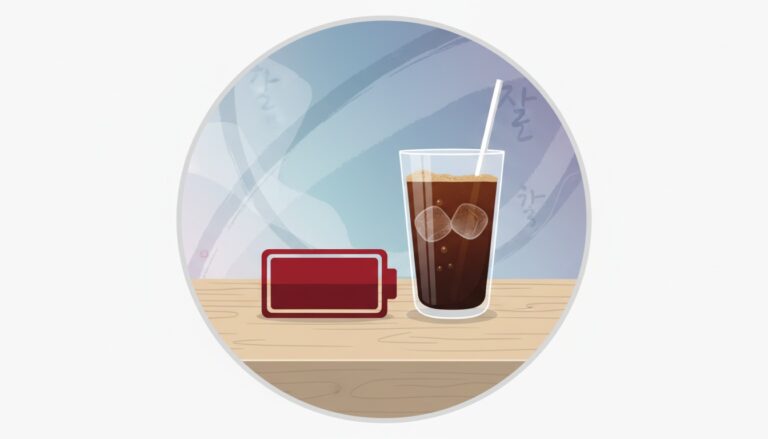
Editor’s Note: Using “방전” (discharged battery) is a very common metaphor in modern Korea!
Phase 4: Cultural Context & Manners
1. The “K-Jikjangin” (Korean Office Worker) Reality
In Korea, admitting you are tired is common, but admitting you are mentally broken requires the right timing (Nunchi). If you say “I have burnout” during a busy project launch, it might burden your team. It is better to discuss this over coffee or dinner after work.
2. “Mung-ttaerigi” (멍때리기 – Spacing Out)
Did you know there are “Spacing Out Competitions” in Seoul? Doing nothing (doing ‘Meong’) is considered a valid form of healing. If you say “저 그냥 멍때리고 싶어요” (I just want to space out), Koreans will immediately sympathize with your need for a brain break.
Phase 5: Roleplay Script
Scenario: Tom is looking exhausted in the break room. His senior colleague, Min-ji, notices.
Min-ji: 톰 씨, 얼굴이 반쪽이네요. 무슨 일 있어요?
(Tom, your face is half its size [You look haggard]. Is something wrong?)
Tom: 솔직히 말하면, 요즘 번아웃이 온 것 같아요. 일은 많은데 성취감이 전혀 안 느껴져요.
(Honestly, I think burnout has hit me. There’s a lot of work, but I don’t feel any sense of accomplishment at all.)
Min-ji: 아… 저런. 무기력증 같은 건가요?
(Ah… oh no. Is it like lethargy?)
Tom: 네, 맞아요. 아침에 눈 뜨는 게 무서울 정도로 자괴감도 들고요.
(Yes, exactly. I even feel a sense of shame/dread to the point where opening my eyes in the morning is scary.)
Min-ji: 오늘 저녁에 삼겹살에 소주 어때요? 멘탈 케어가 좀 필요해 보이는데요.
(How about Pork belly and Soju tonight? Looks like you need some mental care.)
Phase 6: 10-Second Shadowing Drill
Read this aloud to practice your intonation. Pause where the / is marked.
“아무리 쉬어도 / 피곤이 안 풀리고 / 그냥 다 그만두고 싶을 때가 있어요.”
(No matter how much I rest / the fatigue doesn’t go away / and sometimes I just want to quit everything.)
- Intonation Tip: Drop your pitch on ‘안 풀리고’ to emphasize the heaviness. Raise slightly on ‘있어요’ to seek empathy.
Phase 7: FAQ & Troubleshooting
- Q: Can I tell my boss “자괴감이 들어요” (I feel a sense of shame/failure)?
- A: Be careful. If your relationship is formal, they might interpret it as you admitting incompetence. Instead, say “재충전할 시간이 조금 필요한 것 같습니다” (I think I need some time to recharge).
- Q: Is ‘번아웃’ commonly understood?
- A: Yes! It is a loanword fully adopted into Korean. You don’t need to translate it.
Phase 8: Wrap-up & Mission
One-Liner Summary: When physical rest isn’t enough, use words like 무기력하다 (lethargic) and 방전되다 (discharged) to express burnout.
Your Mission: Next time a Korean friend asks “How are you?”, instead of just “Fine”, try saying: “요즘 좀 방전된 것 같아.” (I think I’m a bit discharged/drained lately.) See how they react!
Question for you: What do you do to recharge your mental battery? Tell us in the comments using Korean!
Phase 9: Quiz
1. Which word best describes the feeling of having no will or motivation to do anything?
a) 배고프다 (Hungry)
b) 무기력하다 (Lethargic)
c) 상쾌하다 (Refreshing)
2. How do you say “I feel a sense of shame/self-reproach”?
a) 자신감이 들다
b) 자괴감이 들다
c) 자부심이 들다
3. Which metaphor means “My mental battery is dead”?
a) 방전됐다
b) 감전됐다
c) 충전됐다
(Answers: 1.b, 2.b, 3.a)
Frequently Asked Questions (FAQ)
Q: What does "무기력하다 (Mugiryeok-hada)" mean in Korean and how do you pronounce it?
A: In Korean, "무기력하다 (Mugiryeok-hada)" is pronounced [Moo-gi-ryeok-ha-da] and means: To be lethargic / To feel listless / To have zero will to do anything.
Q: What does "자괴감이 들다 (Jagoegam-i deulda)" mean in Korean and how do you pronounce it?
A: In Korean, "자괴감이 들다 (Jagoegam-i deulda)" is pronounced [Ja-gwe-gam-i deul-da] and means: To feel a sense of shame, self-reproach, or deep regret.
Q: What does "멘탈이 털리다 (Mental-i teollida)" mean in Korean and how do you pronounce it?
A: In Korean, "멘탈이 털리다 (Mental-i teollida)" is pronounced [Men-tal-ee tuhl-li-da] and means: To be mentally drained / To have one's spirit shaken (Slang/Casual).







