

Phase 1: Hook & Empathy
Hello! This is your Senior Editor from Daily Hangul.
So, you survived the Hoesik (company dinner). You shouted “Geonbae!” (Cheers!) one too many times, and mixed Soju with Beer (Somaek). Now, it’s 7:00 AM, your alarm is ringing, and your head feels like a construction site.
Walking into the office looking like a zombie is one thing, but knowing how to communicate your condition and suggest a lunch menu that saves your life? That is a survival skill.
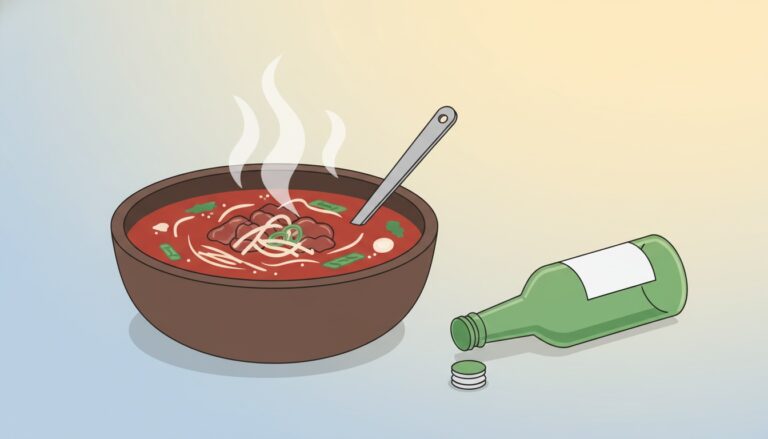
Today, we are not just learning words; we are learning the art of Haejang (해장)—the Korean way to cure a hangover. Using these expressions won’t just fix your stomach; it will make your Korean colleagues nod in deep empathy and say, “Ah, this person really understands Korean corporate life.”
This guide is based on real questions from students who wanted to bond with their coworkers over a steaming bowl of soup the next day.
Phase 2: Deep Dive into Core Expressions
Here are the top 3 expressions you need to survive the morning after. These are B2 (Intermediate) level because they deal with feelings and cultural nuances rather than simple facts.
1. 해장하다 (Haejang-hada)
- Pronunciation: [Hae-jang-ha-da]
- Tip: ‘Hae’ sounds like ‘He’ in ‘Head’, ‘Jang’ sounds like the ‘jang’ in ‘Django’.
- Meaning:
- Literal: To resolve a hangover.
- Real Nuance: It’s not just about taking medicine. It refers to the act of eating (usually soup) or drinking something to settling your upset stomach. It’s almost a ritual.
- Editor’s Insight: You don’t say “I’m eating soup.” You say “I am doing Haejang.” It elevates your lunch to a medical necessity.
- Situation Check: ✅ Casual (Friends) | ✅ Formal (Colleagues/Boss)
2. 속이 풀리다 (Sogi pullida)
- Pronunciation: [So-gi pul-li-da]
- Tip: ‘Sog’ sounds like ‘So’ + a soft ‘g’. ‘Pul-li’ sounds like ‘Pulley’.
- Meaning:
- Literal: The inside is untied/unraveled.
- Real Nuance: Imagine your stomach is a knotted rope because of the alcohol. After eating hot soup, the knot unties. It means “My stomach feels relieved/soothed.”
- Editor’s Insight: Use this after taking the first sip of soup. Make a sound of relief (“Kuhhh~”) for extra points.
- Situation Check: ✅ Casual | ✅ Formal
3. 어제 너무 달렸나 봐요 (Eoje neomu dallyeonna bwayo)
- Pronunciation: [Eo-je neo-mu dal-lyeon-na bwa-yo]
- Tip: ‘Dal’ sounds like the start of ‘Dallas’.
- Meaning:
- Literal: I guess I ran too hard yesterday.
- Real Nuance: “Run” (달리다) is slang for drinking heavily/partying hard. Using the grammar
~나 봐요(I guess/It seems) makes it softer and less direct than saying “I drank too much.”
- Editor’s Insight: This is a humble, slightly humorous way to admit you have a hangover without sounding unprofessional or irresponsible.
- Situation Check: ✅ Casual | ✅ Formal (But use with a polite smile)
Phase 3: Textbook vs. Real Life
Textbooks teach you to be a robot. We teach you to be a local.
| Textbook Korean (Too stiff) | Real Korean (Natural & Insider) |
|---|---|
| 숙취가 심해요. (I have a severe hangover.) | 속이 말이 아니에요. (My stomach is ‘unspeakable’ / a mess.) |
| 술을 깨고 싶어요. (I want to sober up.) | 해장이 시급해요. (Haejang is urgent!) |
| 매운 국물을 먹읍시다. (Let’s eat spicy broth.) | 얼큰한 거 먹으러 갈까요? (Shall we go eat something spicy/refreshing?) |
Note: ‘얼큰하다’ (Eolkeun-hada) is a magic word. It describes soup that is spicy but makes you feel refreshed and cool inside. It’s the ultimate B2 vocabulary for foodies.
Phase 4: Cultural Context & Manners
1. The “Lunchtime Bonding” Rule
In Western culture, if you are hungover, you might want to hide and eat a salad alone. In Korea, the “Haejang lunch” is a team sport. Going to eat Haejang-guk (Hangover soup) together allows you to bond over the shared ‘pain’ of the previous night. If a colleague asks, “Haejang-haru galkkayo?” (Shall we go for Haejang?), say yes!
2. Nunchi (Eye-measure) at Work
Even if you feel terrible, do not lay your head on the desk. Korea values diligence. You can joke about the hangover (“I ran too hard”), but you must show that you are still working hard. The best strategy? Drink an iced Americano (often called ‘Ah-Ah’ for Aiceu Americano) visibly to show you are trying to wake up.
Phase 5: Roleplay Scenario
Setting: Office pantry, 11:30 AM. Discussing lunch menu.
Characters: Alex (Foreigner, B2 level) and Min-su (Korean Co-worker).
Min-su: (Holding his head) 와, 어제 우리 진짜 많이 마셨죠? 머리 안 아파요?
(Wow, we really drank a lot yesterday, right? Doesn’t your head hurt?)
Alex: (Smiling wearily) 어제 너무 달렸나 봐요. 속이 말이 아니에요.
(I guess we ‘ran’ too hard yesterday. My stomach is a mess.)
Min-su: 그쵸? 점심에 뭐 먹을까요? 햄버거?
(Right? What should we eat for lunch? Burgers?)
Alex: 햄버거보다는… 뜨끈한 국물로 해장하고 싶어요. 순대국 어때요?
(Rather than burgers… I want to do ‘Haejang’ with hot soup. How about Sundaeguk?)
Min-su: 오! 알렉스 씨, 진짜 한국 사람이네요. 갑시다! 속 좀 풀어야겠어요.
(Oh! Alex, you really are Korean. Let’s go! I need to untie my stomach.)
Phase 6: 10-Second Shadowing Drill
Read this aloud to practice the rhythm of a suffering but hopeful office worker. Pause at the / marks.
“Yesterday I ran too hard / so today I absolutely need / spicy soup.”
어제 너무 달려서 / 오늘은 무조건 / 얼큰한 국물이 필요해요.
[Eo-je neo-mu dal-lyeo-seo / o-neu-reun mu-jo-kkeon / eol-keun-han gung-mu-ri pi-ryo-hae-yo]
- Intonation Tip: Stress ‘무조건’ (absolutely) to show your desperation for the soup.
Phase 7: FAQ & Troubleshooting
Q: Can I suggest ‘Haejang’ to my boss?
A: YES. In fact, if you see your boss suffering, suggesting, “Manager, shall we go for some refreshing Cod Soup (Daegu-tang) for Haejang?” makes you look very sensible and caring. Just avoid suggesting greasy food unless you know they like it.
Q: Is ‘Haejang’ always spicy soup?
A: Mostly, yes (Ramen, Jjamppong, Haejang-guk). However, younger generations sometimes do “Greasy Haejang” (느끼해장) with burgers or pizza. But in a traditional business setting, stick to the soup!
Phase 8: Wrap-up
One-Liner Summary:
Don’t just say you are sick; say you need Haejang to show you are ready to recover and get back to work!
Your Mission:
Next time you drink with Korean friends, send a text the next morning: “해장은 했어?” (Did you do Haejang?). They will be touched by your care.
Question for you:
What is your country’s version of Haejang? Coffee? Pizza? Tell me in the comments!
Phase 9: Pop Quiz
1. Which expression implies “I drank heavily yesterday” in a casual, idiomatic way?
A) 어제 운동했어요 (I exercised yesterday)
B) 어제 달렸어요 (I ran yesterday)
C) 어제 걸었어요 (I walked yesterday)
2. What does “속이 풀리다” literally mean?
A) My stomach is full.
B) My stomach is empty.
C) My stomach is untied/unraveled.
3. Which adjective describes a soup that is “spicy and refreshing”?
A) 달콤하다 (Sweet)
B) 느끼하다 (Greasy)
C) 얼큰하다 (Spicy/Refreshing)
(Answers: 1.B, 2.C, 3.C)
Frequently Asked Questions (FAQ)
Q: What does "해장하다 (Haejang-hada)" mean in Korean and how do you pronounce it?
A: In Korean, "해장하다 (Haejang-hada)" is pronounced [Hae-jang-ha-da] and means: a key conversational Korean expression covered in this lesson.
Q: What does "속이 풀리다 (Sogi pullida)" mean in Korean and how do you pronounce it?
A: In Korean, "속이 풀리다 (Sogi pullida)" is pronounced [So-gi pul-li-da] and means: a key conversational Korean expression covered in this lesson.
Q: What does "어제 너무 달렸나 봐요 (Eoje neomu dallyeonna bwayo)" mean in Korean and how do you pronounce it?
A: In Korean, "어제 너무 달렸나 봐요 (Eoje neomu dallyeonna bwayo)" is pronounced [Eo-je neo-mu dal-lyeon-na bwa-yo] and means: a key conversational Korean expression covered in this lesson.







