

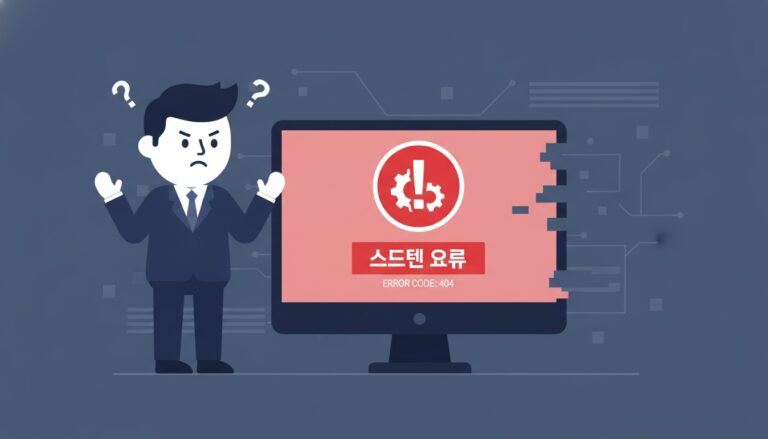
Phase 1: When the Digital World Goes Dark 🔌
Hello! This is your Senior Editor at Daily Hangul.
Imagine this: You are working at a fast-paced Korean company. Suddenly, your monitor freezes, the company messenger goes silent, and your colleagues start murmuring. Is it a power outage? No, it’s the dreaded 전산 마비 (System Paralysis) or perhaps a cyber attack.
Living in Korea—one of the world’s most hyper-connected societies—means that when digital infrastructure fails, everything stops. For a C1 learner like you, simply saying “Computer broken” (컴퓨터 고장 났어요) isn’t enough. You need to explain the scope of the problem, the cause (even if vague), and the recovery status to your boss or clients.
Today, we are moving beyond survival phrases into professional crisis management. I’ve seen advanced students struggle to sound professional during these chaotic moments. Let’s fix that so you can be the calm voice of reason in the office.
Phase 2: Deep Dive into Core Expressions 🧠
Here are the three heavy-hitters you need when the servers go down.
1. 먹통이다 (Meok-tong-i-da)
- Pronunciation: [Meok-tong-i-da] Sounds like ‘Muck’ + ‘Tong’ (as in tongs).
- Meaning: (Lit.) An ink stick holder / (Real) Dead, unresponsive, completely jammed.
- Editor’s Insight: This is the most common word Koreans use when a device or server stops responding completely. While the textbook might say “작동하지 않습니다” (It is not functioning), real Koreans scream, “아, 서버 또 먹통이야!” (Ah, the server is dead again!).
- Situation Check: Used with colleagues (Casual/Polite) or to describe the state of an object. Avoid using it directly to a high-level client in a formal apology.
2. 마비되다 (Ma-bi-doe-da)
- Pronunciation: [Ma-bi-doe-da]
- Meaning: To be paralyzed.
- Editor’s Insight: This is a C1-level verb. We use it for body parts, traffic, and crucially, computer networks (전산망). If a cyber attack happens, the system doesn’t just “break”; it gets “paralyzed.”
- Situation Check: Professional & Formal. Great for reporting to superiors: “전산망이 마비되었습니다.” (The network is paralyzed.)
3. 복구되는 대로 (Bok-gu-doe-neun dae-ro)
- Pronunciation: [Bok-gu-doe-neun dae-ro]
- Meaning: As soon as it is restored/recovered.
- Editor’s Insight: In a crisis, people want to know when it will be fixed. Since you often don’t know the exact time, this is your safety phrase. It implies urgency and promises immediate action once the technical issue is resolved.
- Situation Check: All situations (Business/Daily life).
Phase 3: Textbook vs. Real Life 🇰🇷
Let’s upgrade your vocabulary from “Classroom Student” to “Field Expert.”
| Textbook Korean (Standard) | Real Life Korean (Natural/Field) |
|---|---|
| 시스템에 오류가 발생했습니다. (A system error has occurred.) |
서버가 완전히 뻗어버렸어요. (The server completely stretched out/crashed.) |
| 해킹 때문에 인터넷이 안 됩니다. (Internet doesn’t work due to hacking.) |
디도스 공격으로 접속이 지연되고 있습니다. (Access is delayed due to a DDoS attack.) |
| 언제 고쳐집니까? (When will it be fixed?) |
복구 시점은 언제로 예상되나요? (When is the estimated recovery time?) |
💡 Editor’s Note: Using ‘뻗었다’ (stretched out) for a crashed server is very common in IT circles, but in a formal report, stick to ‘다운됐다’ (down) or ‘마비됐다’ (paralyzed).
Phase 4: Cultural Context – The “Ppalli-ppalli” Panic 💣
In Korea, efficiency isn’t just a goal; it’s a lifestyle. When a ‘전산 장애’ (system failure) occurs, the frustration level spikes much faster than in other cultures.
1. The Hierarchy of Panic:
If you are the person in charge of the system, you must apologize first, explain second. Even if it’s a nationwide cyber attack and not your fault, starting with “시스템 오류로 인해 불편을 드려 죄송합니다” (We apologize for the inconvenience caused by a system error) is mandatory before giving excuses.
2. Nunchi (Eye-measure) Tip:
If the office internet is down, do not just sit back and relax on your phone. This is considered having “no nunchi.” You should visually demonstrate that you are checking cables, calling the IT support team, or trying to find offline work to do. Show that you are bothered by the delay.
Phase 5: Real-World Scenario (Roleplay) 🎬
Setting: A chaotic office morning. The internal network (Intranet) is down.
Characters:
* Min-jun (Manager): Urgently needs a report.
* Alex (You): An advanced foreign employee explaining the situation.
Min-jun: (Frowning while clicking mouse furiously)
알렉스 씨, 지금 결재 시스템 접속 돼요? 급한 건인데…
(Alex, can you access the approval system right now? This is urgent…)
Alex: (Checking monitor with a serious face)
아니요, 부장님. 방금 확인해 봤는데 서버가 완전히 먹통입니다.
(No, Manager. I just checked, and the server is completely dead/unresponsive.)
Min-jun: 아, 진짜… 이거 언제 풀린대요?
(Ah, seriously… When do they say it will be fixed?)
Alex: IT 팀 공지로는 랜섬웨어 공격 의심으로 전산망이 마비되어서, 복구되는 대로 바로 연락 주겠다고 합니다.
(According to the IT team, the network is paralyzed due to a suspected ransomware attack, and they will contact us as soon as it’s restored.)
Min-jun: 하… 알겠습니다. 복구되면 바로 알려줘요.
(Sigh… Okay. Let me know immediately when it’s restored.)
Phase 6: 10-Second Shadowing Drill 🗣️
Let’s practice a sentence you can hear on the news or say in a formal briefing.
“Currently, customer service is suspended because the server is paralyzed due to a cyber attack.”
현재 사이버 테러로 / 서버가 마비되어 / 고객 응대 업무가 / 중단된 상태입니다.
Hyeon-jae sa-i-beo te-reo-ro / seo-beo-ga ma-bi-doe-eo / go-gaek eung-dae eom-mu-ga / jung-dan-doen sang-tae-im-ni-da.
Key Points:
* Pause at the / marks to sound professional.
* Stress ‘마비되어’ (paralyzed) and ‘중단된’ (suspended) to emphasize the severity.
Phase 7: FAQ & Troubleshooting 🧐
Q: Can I use “고장 났다” (Broken) for a website crash?
A: You can, and people will understand, but it sounds a bit childish or physical (like a broken chair). For software, websites, or apps, use 오류가 났다 (An error occurred), 다운됐다 (It went down), or 먹통이다 (It’s unresponsive).
Q: Is “해킹 당했다” (Got hacked) safe to say at work?
A: Be careful. Unless it is officially confirmed by the security team, saying “We got hacked” can cause unnecessary panic. It is safer/more professional to say “보안상의 문제가 발생한 것 같습니다” (It seems a security issue has occurred) until confirmed.
Phase 8: Wrap-up & Mission 📝
Today’s Summary:
When digital disaster strikes, don’t just say “It’s broken.” Use 먹통이다 for the state, 마비되다 for the scope, and promise updates with 복구되는 대로.
Your Mission:
If your Wi-Fi is slow or an app crashes today, try muttering to yourself: “아, 또 먹통이네.” instead of swearing in your native language. Getting angry in Korean is the final step to fluency!
Question for you:
Have you ever experienced a major “System Paralysis” (banking, subway, internet) in Korea? How did people around you react? Tell me in the comments!
Phase 9: Pop Quiz ✍️
1. Which word best fills the blank?
“서버가 갑자기 ______이라서 이메일을 보낼 수가 없어요.”
(The server is suddenly ______, so I can’t send emails.)
A) 피곤함 (tired)
B) 먹통 (dead/unresponsive)
C) 기절 (fainted)
2. How do you say “As soon as it is restored”?
A) 복구되는 대로
B) 복구하기 전에
C) 복구하는 중
3. True or False?
It is considered good manners (Nunchi) to relax and play games on your phone when the office network is paralyzed.
(Scroll down for answers)
Answers: 1. B, 2. A, 3. False (Look busy or find offline work!)
Frequently Asked Questions (FAQ)
Q: What does "먹통이다 (Meok-tong-i-da)" mean in Korean and how do you pronounce it?
A: In Korean, "먹통이다 (Meok-tong-i-da)" is pronounced [Meok-tong-i-da] and means: (Lit.) An ink stick holder / (Real) Dead, unresponsive, completely jammed.
Q: What does "마비되다 (Ma-bi-doe-da)" mean in Korean and how do you pronounce it?
A: In Korean, "마비되다 (Ma-bi-doe-da)" is pronounced [Ma-bi-doe-da] and means: To be paralyzed.
Q: What does "복구되는 대로 (Bok-gu-doe-neun dae-ro)" mean in Korean and how do you pronounce it?
A: In Korean, "복구되는 대로 (Bok-gu-doe-neun dae-ro)" is pronounced [Bok-gu-doe-neun dae-ro] and means: As soon as it is restored/recovered.







